
Bitdefender review
Enterprise-grade GravityZone security for SMBs: ransomware, phishing, and fileless attack protection.
GravityZone gives small businesses genuinely enterprise-grade ransomware and phishing protection with minimal setup, but mobile coverage and full EDR require add-ons or higher tiers.
Pros
- Ransomware mitigation restores encrypted files from tamper-proof backups
- Fileless attack and malicious PowerShell protection enabled by default
- Consistently top-ranked in AV-Comparatives and AV-TEST independent lab tests
- Single cloud console manageable without IT security expertise
- Clear upgrade path to EDR, XDR, and 24x7 MDR on the same platform
Cons
- Mobile device coverage requires a separate add-on
- Full EDR visibility requires upgrading beyond the entry tier
- Console breadth can overwhelm very small teams
- No permanent free plan, trial only
Bitdefender is best known for consumer antivirus, but its business portfolio is where the company does its most serious work. GravityZone, Bitdefender's cloud-managed cybersecurity platform, packages the same multi-layered protection used by large enterprises into tiers a small business can actually run: GravityZone Small Business Security at the entry level, Business Security and Business Security Premium above it, and EDR, XDR, and managed detection and response for teams that want around-the-clock coverage. This review focuses on that B2B lineup, not the consumer products, and on what it offers an SMB without a dedicated security team.
What Bitdefender actually does
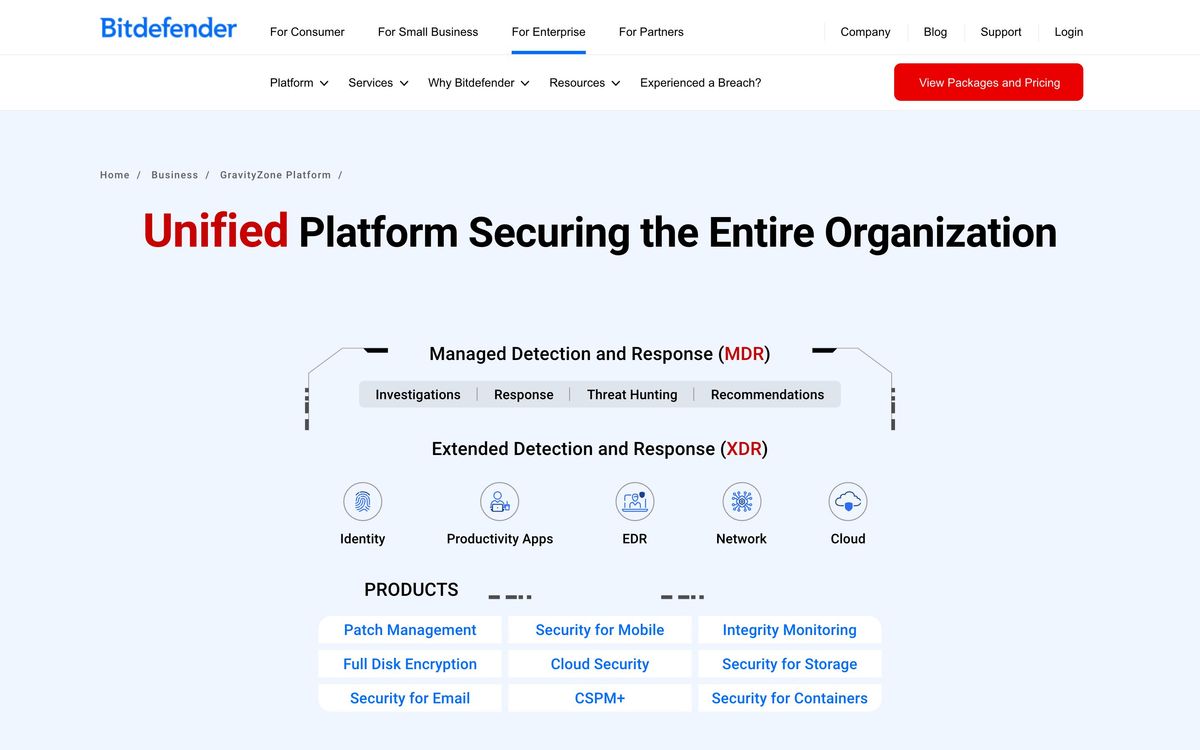
GravityZone is endpoint security managed from a single cloud console. You enroll your laptops, desktops, and file servers, and the platform layers machine learning, behavioral analysis, and continuous monitoring over each device. Three protections matter most for small businesses. Ransomware mitigation detects abnormal encryption attempts (known or brand new) blocks them, and restores affected files from tamper-proof backup copies. Anti-phishing automatically blocks known phishing and fraud pages before an employee can type in credentials. Fileless attack protection, enabled by default, blocks malware at pre-execution and terminates malicious PowerShell commands, the kind of threats that traditional signature-based antivirus misses entirely. Anti-exploit protection adds real-time coverage for browsers, Microsoft Office, and Adobe Reader.
Key features
- Ransomware detection and rollback that restores encrypted files from tamper-proof backups
- Automatic blocking of phishing sites, fake company pages, and online fraud
- Fileless attack protection that terminates malicious PowerShell commands before execution
- One cloud console for policies, alerts, and reporting across all devices
- Coverage for Windows, macOS, and Linux endpoints, with mobile available as an add-on
- Subscriptions for 1 to 100 devices, with up to 30 percent allowed as servers
- Upgrade path to EDR, XDR, and 24x7 managed detection and response without changing platforms
Who it's for
The small business tiers are built for companies with no security analyst on staff. Bitdefender's own positioning is that installation requires no advanced IT security knowledge, and in practice the defaults are sensible enough that a non-specialist can deploy it and leave it alone. It fits SMBs running one to a hundred devices, accounting and professional services firms handling sensitive client files, and growing startups that want serious protection before they can justify a security hire. MSPs get their own multi-tenant licensing tiers, which also means many small businesses will encounter GravityZone through their IT provider.
How it compares
Against Sophos Intercept X, Bitdefender's closest rival for SMB endpoint protection, GravityZone consistently scores at or near the top of independent lab tests from AV-Comparatives and AV-TEST, and its ransomware rollback is a genuine differentiator at the entry tier. Sophos counters with a stronger firewall ecosystem if you buy into its whole stack. ESET PROTECT is lighter on system resources and similarly easy to manage, but its entry tiers lack an equivalent to Bitdefender's tamper-proof backup and restore approach. Where Bitdefender can frustrate is breadth: the GravityZone console exposes a lot of settings, and very small teams may find more knobs than they need.

Verdict
GravityZone Small Business Security is one of the strongest cases of enterprise technology trickling down to small business tiers. The protection stack (ransomware rollback, anti-phishing, fileless attack defense) addresses exactly the three attack types that actually hit SMBs, and the cloud console keeps day-to-day management realistic for a non-expert. The honest caveats: there is no free tier, only a trial; mobile devices need an add-on; and full EDR visibility means stepping up a tier or adding modules. For a small business choosing one security product to run largely unattended, it is hard to argue against.
Ready to try Bitdefender?
More founders tools like Bitdefender
Optery
4.4Finds and removes staff home addresses, phones and emails from people-search sites and data brokers.
Read Optery review →1Password
4.5Team password manager and credential vault that has grown into a wider access platform for small IT teams.
Read 1Password review →Miro
4.5Infinite shared canvas for workshops, diagrams and planning, now wrapped around docs, tables and AI.
Read Miro review →Toggl Track
4.4One-click time tracking with billable rates and profitability reports for teams that bill by the hour.
Read Toggl Track review →Airia
4.3Enterprise platform for building, orchestrating, and governing AI agents and workflows at scale.
Read Airia review →Amplitude
4.3Behavioural product analytics with session replay and experimentation on one event stream.
Read Amplitude review →