
MindStudio review
No-code visual builder for AI agents with 200+ models, 1,000+ integrations, and flexible deployment.
Best-in-class for non-developers who want to ship working AI agents fast, though complex multi-step automations still demand prompt-engineering patience.
Pros
- Visual builder plus the Agent Architect scaffolding tool gets a first agent working in under an hour
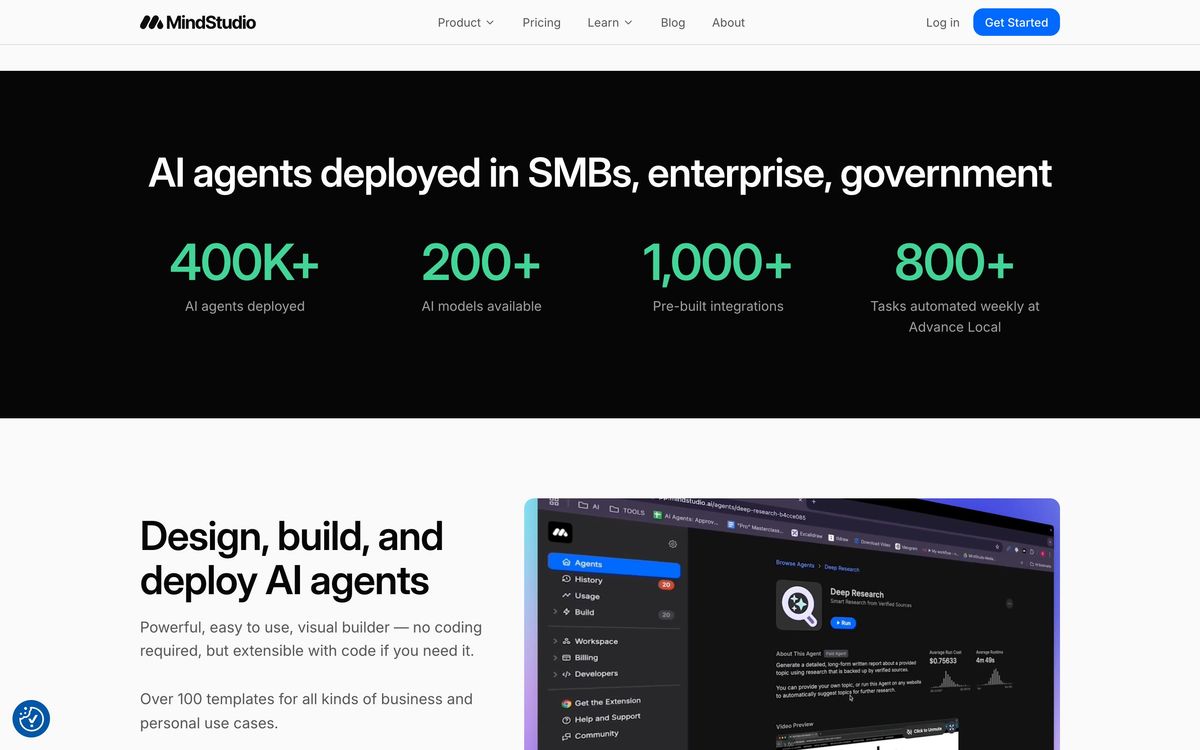
- Access to 200+ AI models from OpenAI, Anthropic, Google, and others without managing your own API keys
- Flexible deployment: web apps, browser extensions, scheduled automations, email triggers, and API endpoints
- Extensible with custom JavaScript and Python functions when no-code blocks hit their limits
- Genuine free tier (one agent, 1,000 runs per month) lets you validate an idea before committing
Cons
- Free plan caps you at a single agent, so testing several use cases in parallel requires upgrading
- Templates only get you so far; reliable production agents still require prompt iteration and testing
- Output quality varies with the model you pick from the catalog, which adds trial and error
- The breadth of features (extensions, multimedia outputs, triggers) creates a learning curve past simple chat agents
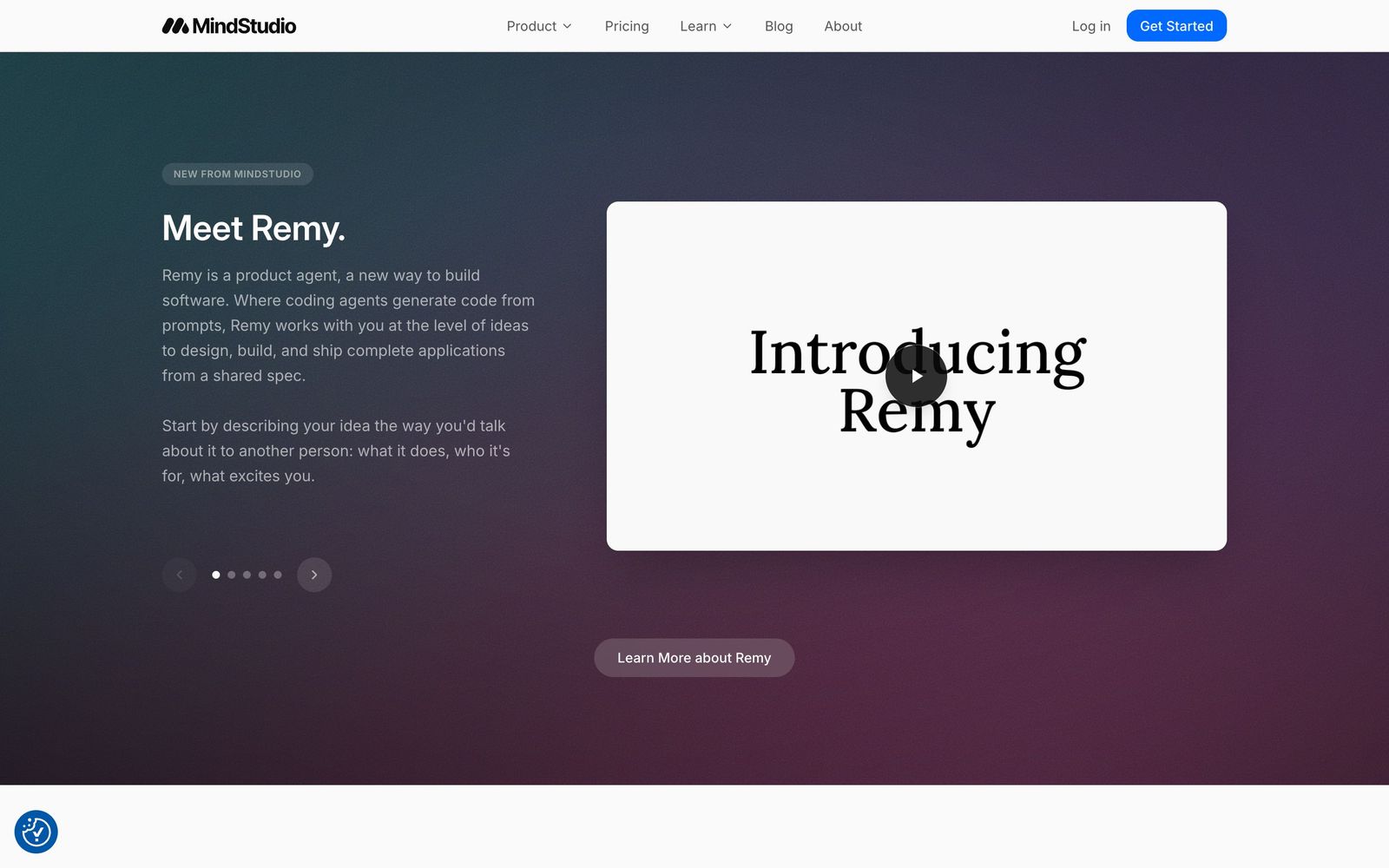
MindStudio is a no-code AI builder for creating and deploying AI agents without writing code. It sits squarely in the no-code AI app building category, pairing a visual workflow editor with access to more than 200 AI models from providers like OpenAI, Anthropic, and Google. The company says teams at Microsoft, Intel, Adobe, and TikTok use the platform, but it is just as clearly aimed at solo founders and operators who want to automate a workflow in an afternoon. This MindStudio review covers what the platform actually does, where it falls short, and how it stacks up against other AI workflow automation tools.
What MindStudio actually does
At its core, MindStudio lets you describe an agent you want, generates a scaffold with its Agent Architect feature, and then hands you a visual editor to refine the logic. Instead of forcing every automation into rigid if-then decision trees, you can define a goal, give the agent access to tools, and let it work out the path. The company claims an average build takes between 15 minutes and an hour, helped along by a library of over 100 templates for business and personal use cases.
Deployment is where MindStudio is more flexible than most no-code AI builders. A finished agent can ship as a user-facing web app, a browser extension, a scheduled background automation, an email-triggered action, or an API endpoint that platforms like Zapier, Make, or n8n can call. The model layer is handled by a built-in router, so you choose from 200+ models without juggling API keys for each provider.

Key features
- Visual agent builder with Agent Architect scaffolding from a plain-language description
- 200+ AI models for text, image, and video generation, including options from OpenAI, Anthropic, Google, Meta, and Stability AI
- 1,000+ pre-built integrations covering tools like HubSpot, Salesforce, Slack, Google Workspace, Zapier, Make, and n8n
- Multiple deployment targets: web apps, browser extensions, scheduled jobs, email triggers, and APIs
- Human-in-the-loop checkpoints so an agent pauses for approval before sensitive steps
- Custom JavaScript and Python functions for logic the no-code blocks cannot express
- Rich outputs beyond text, including PDFs, spreadsheets, HTML, images, audio, and video
- Vision capabilities for image analysis and OCR inside workflows
Who it's for
MindStudio fits operations leads, founders, and marketers who know exactly which repetitive workflow they want to hand to an AI agent but have no developer on call. The free tier, limited to one agent and 1,000 runs per month, is enough to validate a single use case end to end. Agencies and systems integrators are another explicit audience: the platform supports building and managing agents for clients. Developers are not excluded, since custom code functions and API deployment exist, but a team that already lives in code may prefer a framework over a visual builder.
How it compares
Against Zapier, the trade-off is depth versus breadth. Zapier's agent features tap a larger raw app catalog, but MindStudio offers more control over agent design, model selection, and user-facing deployment formats like browser extensions and standalone web apps. Relevance AI is the closer competitor in the AI agent space; it leans harder into multi-agent teams for sales and operations, while MindStudio has a gentler ramp for first-time builders and a wider menu of output types. If your need is a simple trigger-action pipeline, Zapier remains simpler. If you want an agent that feels like a product, MindStudio is the stronger fit.
Verdict
MindStudio earns its place among the top no-code AI builders. The combination of a real free tier, 200+ models behind one router, and unusually flexible deployment makes it a practical first platform for shipping AI agents. The honest caveat: templates and scaffolding get you a demo quickly, but dependable production agents still take iteration, testing, and some prompt-engineering instinct. Start with one well-defined workflow on the free plan and expand only after that agent proves itself.
Ready to try MindStudio?
There's a free tier, so you can test it before committing.
More founders tools like MindStudio
monday.com
4.3Board-based work platform where typed columns drive timelines, dashboards and automated hand-offs.
Read monday.com review →SmartSuite
4.2Structured records, views, dashboards and automations in one platform for teams outgrowing spreadsheets.
Read SmartSuite review →Glide
4.1Turns a spreadsheet or database into a mobile and desktop business app without code, with role-based views per user.
Read Glide review →Softr
4.1No-code builder for client portals and internal tools on top of Airtable, Notion or a SQL database.
Read Softr review →Wrike
4.0Work management with custom workflows, request forms and resource planning for teams running repeatable delivery.
Read Wrike review →Process Street
3.9Checklist-driven workflow platform for recurring processes, approvals and audit-ready completion records.
Read Process Street review →