
Typewise review
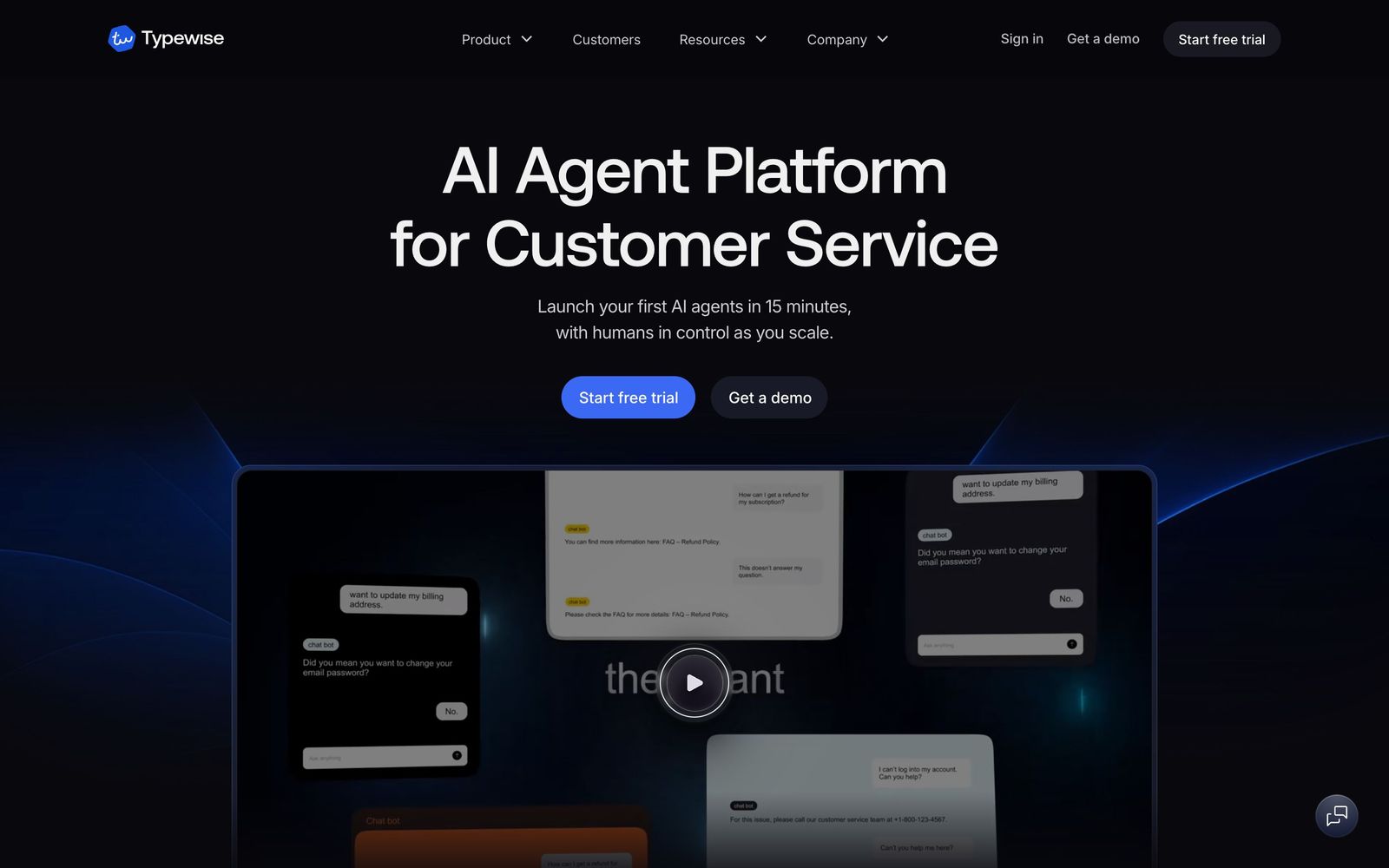
AI agent platform that resolves customer service requests end-to-end across CRM, ERP, and helpdesk systems.
Best at letting enterprise support teams deploy AI agents that actually execute workflows in backend systems, but it is heavier than small teams needing a simple FAQ chatbot require.
Pros
- Multi-agent orchestration: a supervisor agent coordinates specialist, knowledge, and action agents to resolve tickets end-to-end
- Workflows and even integrations are configured in plain language via a no-code, chat-based interface
- 200+ native integrations across CRM, ERP, billing, ITSM, and commerce, plus MCP support for thousands more connectors
- Built-in simulation and automated evaluations let you test agents before they touch real customers
- Human approval gates and defined automation levels keep people in control of complex decisions
Cons
- No free plan: only a trial, so you cannot run it indefinitely at zero cost
- Built for organizations with real backend systems; overkill if you just need a website chatbot
- Success-based pricing makes costs harder to predict than flat per-seat tools
Typewise is an enterprise AI agent platform for customer service and sales teams, and it positions itself a step beyond the usual support chatbot. Instead of answering questions and handing everything else to a human, its orchestrated AI agents resolve requests end-to-end by taking real actions across CRM, ERP, billing, ticketing, and commerce systems. The platform is omni-channel (email, chat, WhatsApp, and social messaging, with voice-ready channels) and the whole thing is configured in natural language through a no-code, chat-based interface. Customers include Galaxus, TUI Cruises, DPD, and IVECO, and the company reports more than 10 million tickets solved on the platform.
What Typewise actually does
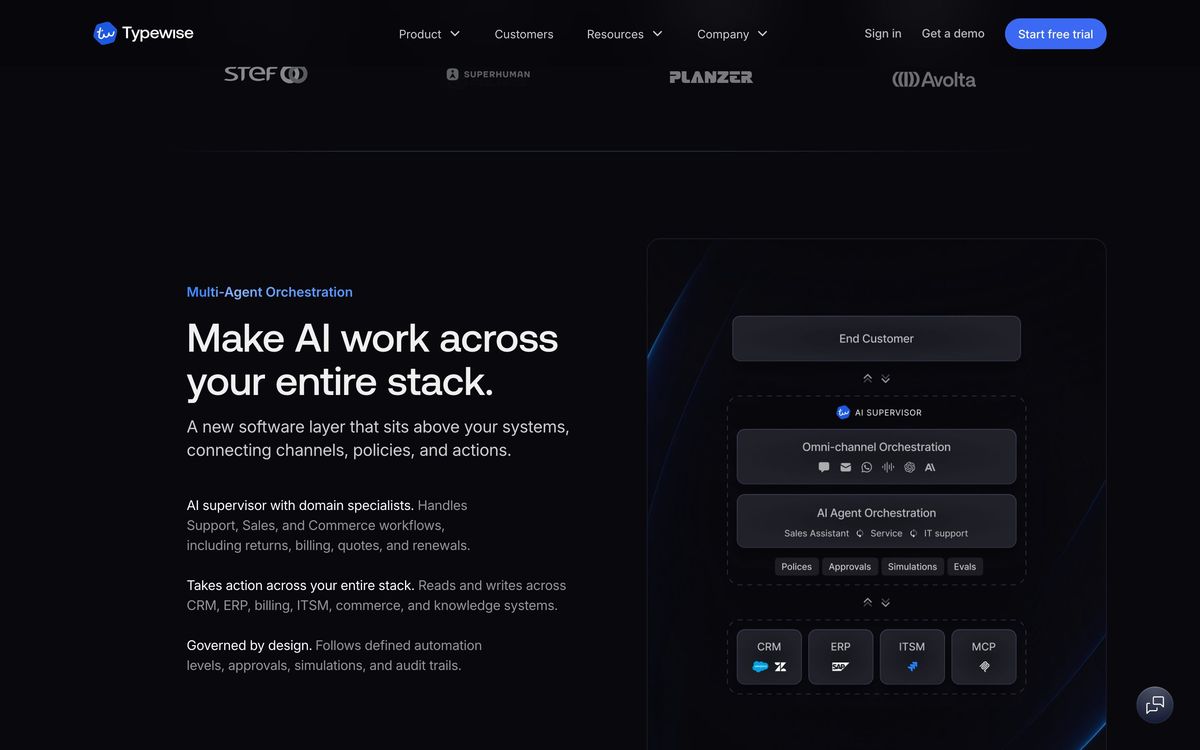
At the core is multi-agent orchestration. An AI supervisor agent coordinates specialist agents, knowledge agents, and action agents; the knowledge side reads from your documentation and connected systems, while action agents write back; creating returns, updating orders, adjusting billing records, or moving tickets through your helpdesk. You describe the outcome you want in plain language, and the platform compiles that into a working automation with defined automation levels, approval steps, and audit trails.
This is the meaningful difference from suggestion-only AI tools: Typewise is built to execute workflows, not just draft replies. It maintains user context and conversational state across channels, so a customer who starts on chat and follows up by email is still one continuous case. It can run on top of Typewise's own ticketing or sit alongside a third-party helpdesk.
Key features
- Multi-agent orchestration with a supervisor coordinating specialist, knowledge, and action agents
- Natural-language workflow building through a no-code, chat-based interface, including integration setup, which usually requires low-code platforms or engineers
- 200+ native integrations spanning CRM, ERP, billing, ITSM, and commerce, including Salesforce, SAP, Microsoft Dynamics 365, Zendesk, and ServiceNow, plus REST and webhooks for everything else
- Model Context Protocol (MCP) support, opening up thousands of additional connectors
- Omni-channel coverage: email, chat, WhatsApp, and social messaging, with voice-ready channels
- Hybrid intelligence: AI handles routine resolutions autonomously while human approval gates complex or risky decisions
- Automated evaluations and simulation so agents are validated before going live
- Works in any language, both reading and responding
Who it's for
Typewise fits enterprise and mid-market support and sales organizations whose tickets require touching backend systems; returns, billing corrections, quotes, renewals, order changes. Reference customers report 17–30% efficiency gains, and the vendor claims a first live agent can be running in about 15 minutes, though realistic enterprise rollouts with approval flows and integrations will take longer. There is no free plan, only a trial, and pricing is success-based rather than per-seat, which rewards high automation rates but makes budgeting less predictable. If your support volume is small or your tickets never leave the inbox, a lighter chatbot will be cheaper and simpler.
How it compares
Against Intercom Fin, the trade-off is depth versus convenience. Fin is excellent at deflecting conversational support inside the Intercom ecosystem and is faster to switch on if you already live there, but it is lighter on executing multi-step workflows inside ERP and CRM systems; exactly where Typewise concentrates. Decagon is the closer rival: both target enterprise customer service with action-taking AI agents. Typewise's distinguishing moves are the chat-based no-code configuration that extends all the way to integration setup, and the breadth of its native plus MCP-based connector catalog.
Verdict
Typewise earns a 4.3. It is one of the more credible AI agent platforms for support because it is judged on resolutions, not deflections, and the governance model (automation levels, approvals, simulations, audit trails) shows it was designed for production use rather than demos. The honest caveats: no free tier, success-based pricing that takes modeling to forecast, and a feature set that assumes you have systems worth integrating. For enterprise customer service and sales teams ready to automate real workflows across CRM and ERP, it belongs on the shortlist. For small teams wanting a quick website bot, it is more platform than you need.
Ready to try Typewise?
More founders tools like Typewise
monday.com
4.3Board-based work platform where typed columns drive timelines, dashboards and automated hand-offs.
Read monday.com review →SmartSuite
4.2Structured records, views, dashboards and automations in one platform for teams outgrowing spreadsheets.
Read SmartSuite review →Glide
4.1Turns a spreadsheet or database into a mobile and desktop business app without code, with role-based views per user.
Read Glide review →Softr
4.1No-code builder for client portals and internal tools on top of Airtable, Notion or a SQL database.
Read Softr review →Wrike
4.0Work management with custom workflows, request forms and resource planning for teams running repeatable delivery.
Read Wrike review →Process Street
3.9Checklist-driven workflow platform for recurring processes, approvals and audit-ready completion records.
Read Process Street review →