
Activepieces review
Open-source, MIT-licensed AI automation platform with a visual builder, AI agents, and 700+ integrations.
The strongest open-source Zapier alternative for teams that want AI agents and self-hosting, though its connector catalog is still smaller than Zapier's.
Pros
- MIT-licensed Community Edition you can self-host with Docker or Helm at no licensing cost
- AI agents are available on every plan, including the free tier
- 747 integrations (pieces) covering mainstream apps plus AI models like OpenAI, Gemini, and Groq
- Free cloud plan with unlimited runs, capped only by active flows
- Large library of MCP servers so AI assistants can use its connectors as tools
Cons
- Connector catalog is still far smaller than Zapier's multi-thousand app directory
- Self-hosting requires real DevOps effort to run and maintain reliably
- Younger ecosystem means fewer tutorials and community recipes than established rivals
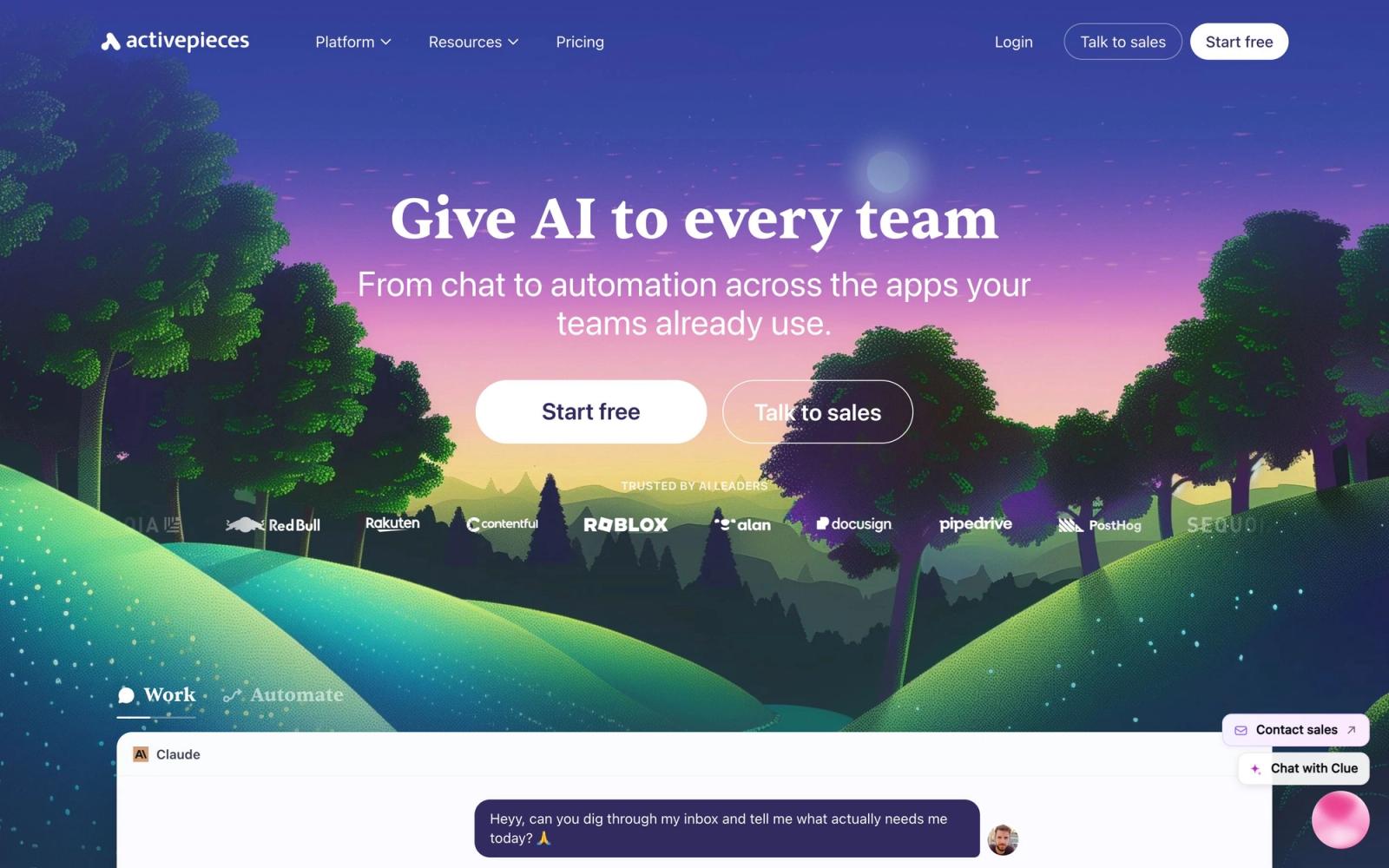
Activepieces is an open-source AI workflow automation platform that lets teams build automations and AI agents through a visual, drag-and-drop builder. The project is MIT-licensed, which means you can run the Community Edition on your own infrastructure with Docker or Helm, or skip the setup and use the hosted cloud version instead. With 747 integrations in its connector catalog and AI agents available on every plan including the free one, it has grown into one of the most credible open-source alternatives in the workflow automation space.
What Activepieces actually does
At its core, Activepieces connects the apps your team already uses and moves data between them automatically. You build flows on a canvas by chaining together pieces, which is what Activepieces calls its connectors. Each piece exposes triggers and actions: a new email in Gmail can start a flow, and downstream steps can update a Notion database, post a message to Slack, add a row to Google Sheets, or create a contact in HubSpot.
The AI layer is where the platform has invested most heavily. You can build AI agents that understand context and make decisions inside a flow, rather than only executing fixed steps. Activepieces also ships a large library of MCP servers, which lets external AI assistants and agents use its connectors as tools. There are dedicated pieces for OpenAI, Google Gemini, Groq, Perplexity AI, and Hugging Face, so you are not locked into a single model vendor.
Key features
- Visual flow builder: drag pieces onto a canvas and wire them together with branching and logic, no code required
- 747 integrations spanning communication, AI, commerce, accounting, and customer support, plus utility pieces for JSON, files, and data mapping
- AI agents on all plans, so you can test agentic automation without upgrading
- MCP server library that exposes connectors as tools for AI agents and assistants
- Open-source Community Edition under the MIT license, deployable via Docker, Helm, or any cloud provider
- Enterprise controls including SSO, SCIM provisioning, role-based access control, and audit logs
Who it's for
Founders and operations leads who want broad team automation without per-task anxiety are the natural audience. The free cloud plan includes unlimited runs with a cap on active flows, which is enough to automate a handful of real processes before paying anything. Activepieces also publishes pre-built automations for sales, support, marketing, finance, HR, IT, and engineering teams, so non-technical staff can start from templates rather than a blank canvas. The second audience is engineering-led companies that want automation infrastructure they fully control: the MIT license and self-hosting path make it one of the few platforms where the core product is genuinely yours to run.
How it compares
Against Zapier, the trade is catalog breadth versus cost model and control. Zapier connects to far more apps, but it bills per task, so high-volume automations get expensive as usage grows. Activepieces prices by active flows with unlimited executions, and reviewers consistently describe it as similarly easy to use while being more flexible. If your must-have app is niche, check the Activepieces pieces catalog first; if it is mainstream, you likely lose little by switching.
Against n8n, the other big open-source automation player, the differences are license and audience. n8n uses a fair-code license with restrictions on commercial redistribution, while Activepieces is plain MIT. n8n leans more developer-centric with heavier use of code nodes and expressions; Activepieces aims its builder at non-developers first, with AI agents and MCP support as the headline features.
Verdict
Activepieces earns its place on an automation shortlist. The free tier is genuinely usable, AI agents are not gated behind upper plans, and the MIT license removes the lock-in worry that hangs over most automation platforms. The honest caveats: the connector catalog trails Zapier's, self-hosting demands maintenance discipline, and the community knowledge base is still maturing. If you want open-source AI workflow automation that ordinary teammates can actually operate, it is one of the best options available in 2026.
Ready to try Activepieces?
There's a free tier, so you can test it before committing.
More founders tools like Activepieces
monday.com
4.3Board-based work platform where typed columns drive timelines, dashboards and automated hand-offs.
Read monday.com review →SmartSuite
4.2Structured records, views, dashboards and automations in one platform for teams outgrowing spreadsheets.
Read SmartSuite review →Glide
4.1Turns a spreadsheet or database into a mobile and desktop business app without code, with role-based views per user.
Read Glide review →Softr
4.1No-code builder for client portals and internal tools on top of Airtable, Notion or a SQL database.
Read Softr review →Wrike
4.0Work management with custom workflows, request forms and resource planning for teams running repeatable delivery.
Read Wrike review →Process Street
3.9Checklist-driven workflow platform for recurring processes, approvals and audit-ready completion records.
Read Process Street review →