
Amplitude review
Behavioural product analytics with session replay and experimentation on one event stream.
The most complete product analytics platform a small team can start on for nothing, though the event-volume pricing and the instrumentation discipline it demands catch people out later.
Pros
- The free tier carries two million events a month with unlimited seats, which is enough to run a real early-stage product
- Funnels, retention curves and behavioural cohorts are built for questions about sequences of actions, not page counts
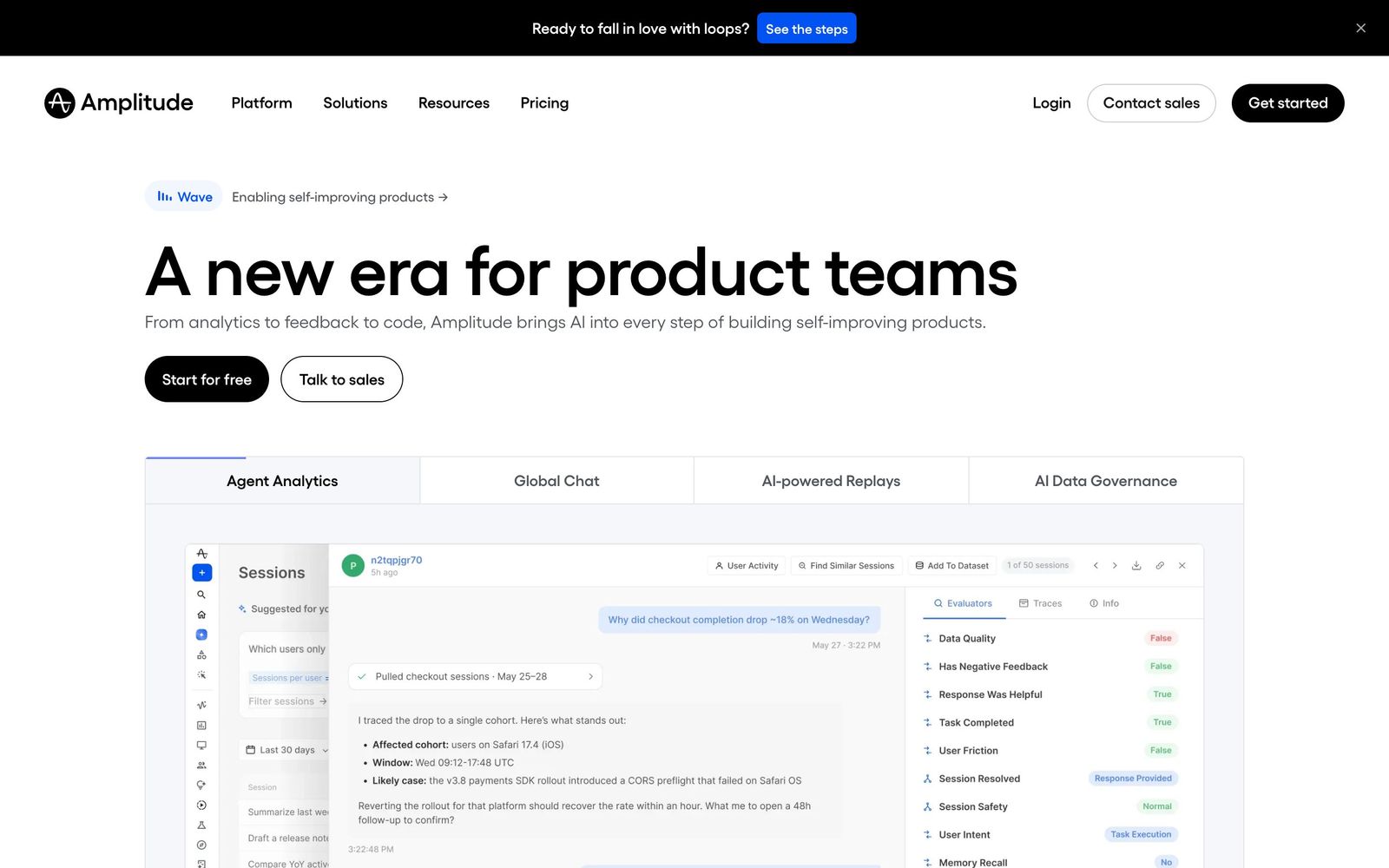
- Session replay is tied to events, so a drop-off in a funnel leads directly to recordings of the sessions that dropped
- Experimentation and feature flags sit on the same event stream, removing the usual reconciliation between test tool and analytics
- Warehouse and CDP connections cover Snowflake, BigQuery, Redshift, Databricks, Segment, mParticle and RudderStack in both directions
Cons
- Pricing scales with event volume, so an over-eager instrumentation pass inflates the bill without adding insight
- SSO and project-level permissions are withheld until the quote-only Growth tier, which is awkward for a security review at a small company
- Session replay is quota-capped on every tier, so a high-traffic product samples rather than records what it wants
Amplitude pricing
List prices in USD per month, taken from the vendor at review time.
| Plan | Per month | What it covers |
|---|---|---|
| Free | Free | 2M events a month, unlimited seats, 10K monthly session replays |
What Amplitude actually does
Amplitude answers questions about behaviour rather than traffic. Instead of counting visits to a page, it records events, actions a person took inside a product, and then lets an analyst ask what happened between them. Which step of onboarding loses the most people. Whether users who create a project in week one are still active in week six. What separates the accounts that convert from the accounts that stall. The unit of analysis is a sequence of actions attached to a user identity, which is why the same data set can produce a funnel, a retention curve and a behavioural cohort without being modelled three times.
Over the past few years the product has widened well past analysis. Session replay records what a user actually saw, and because replays are indexed by event, a drop-off in a funnel leads directly to the sessions where it happened. Feature experimentation and flag management run on the same event stream, so a test result and the product metrics agree by construction rather than by reconciliation. Web analytics covers marketing pages with a single snippet, guides and surveys collect qualitative feedback in-product, and data governance tools police the event taxonomy before it decays. Warehouse and CDP connections run in both directions, into Snowflake, BigQuery, Redshift and Databricks, and through Segment, mParticle, RudderStack and Tealium.
Key features
The platform is broad, but a handful of capabilities carry most of the value.
- Funnels, retention analysis, user paths and custom event formulas over raw behavioural data
- Behavioural cohorts that can be built once and synced to Braze, Klaviyo, HubSpot or advertising platforms
- Session replay indexed against the events in the session
- Experimentation and feature flags sharing the analytics event stream
- Web analytics for marketing pages alongside product events
- Governance tooling for event taxonomy, schemas and warehouse import and export
Who it's for
Amplitude fits a team that ships software and can act on what it learns: a product manager who can reprioritise a roadmap, a growth engineer who can run a test, a founder deciding which half of the product to keep. The free tier is unusually generous, covering two million events a month with unlimited seats, which means a small team can adopt it before there is a budget line for analytics at all.
It is the wrong tool for a content site or a brochure business, where Google Analytics or Plausible answer the actual questions for far less effort. It also punishes teams that do not invest in instrumentation. Amplitude is only as good as the events sent to it, and a taxonomy assembled ad hoc by three engineers over two years produces dashboards nobody trusts. Someone has to own naming, properties and the definition of an active user, or the tool becomes expensive decoration.
How it compares
Mixpanel is the closest competitor and is often quicker to learn, with a cleaner default reporting experience, while Amplitude goes deeper on cohorting, governance and the analysis of long user journeys. PostHog bundles analytics, replay, flags and surveys in one open-source package and appeals to engineering-led teams that want to self-host, though its analysis layer is less refined for non-technical users. Heap's autocapture removes the instrumentation burden that Amplitude imposes, which is genuinely attractive early on, at the cost of a messier data set later. Google Analytics 4 remains free and adequate for acquisition reporting, and unsuited to product questions.
Verdict
Amplitude is the reference product for behavioural analytics, and the combination of analysis, replay and experimentation on a single event stream removes a category of tooling arguments that other stacks never resolve. A serious small team can run on the free tier for a long time. The caveats are the ones that arrive with growth: cost is a function of event volume, so instrumentation choices become budget choices; access controls that a security reviewer will ask about sit behind the quote-only tiers; and session replay is capped rather than unlimited. Adopt it with someone owning the taxonomy, and it repays the discipline.
Ready to try Amplitude?
There's a free tier, so you can test it before committing.
More founders tools like Amplitude
1Password
4.5Team password manager and credential vault that has grown into a wider access platform for small IT teams.
Read 1Password review →ClickUp
4.5All-in-one work platform: tasks, docs, goals, chat, whiteboards, and AI agents in a single workspace.
Read ClickUp review →Fireflies.ai
4.5AI meeting teammate that records, transcribes, and summarizes calls, with action items and searchable notes.
Read Fireflies.ai review →Miro
4.5Infinite shared canvas for workshops, diagrams and planning, now wrapped around docs, tables and AI.
Read Miro review →Reclaim.ai
4.5AI calendar assistant that auto-schedules focus time, tasks, and habits on Google and Outlook calendars.
Read Reclaim.ai review →Activepieces
4.4Open-source, MIT-licensed AI automation platform with a visual builder, AI agents, and 700+ integrations.
Read Activepieces review →