
Snowfire AI review
Decision intelligence platform that fuses internal business data with external signals for executives.
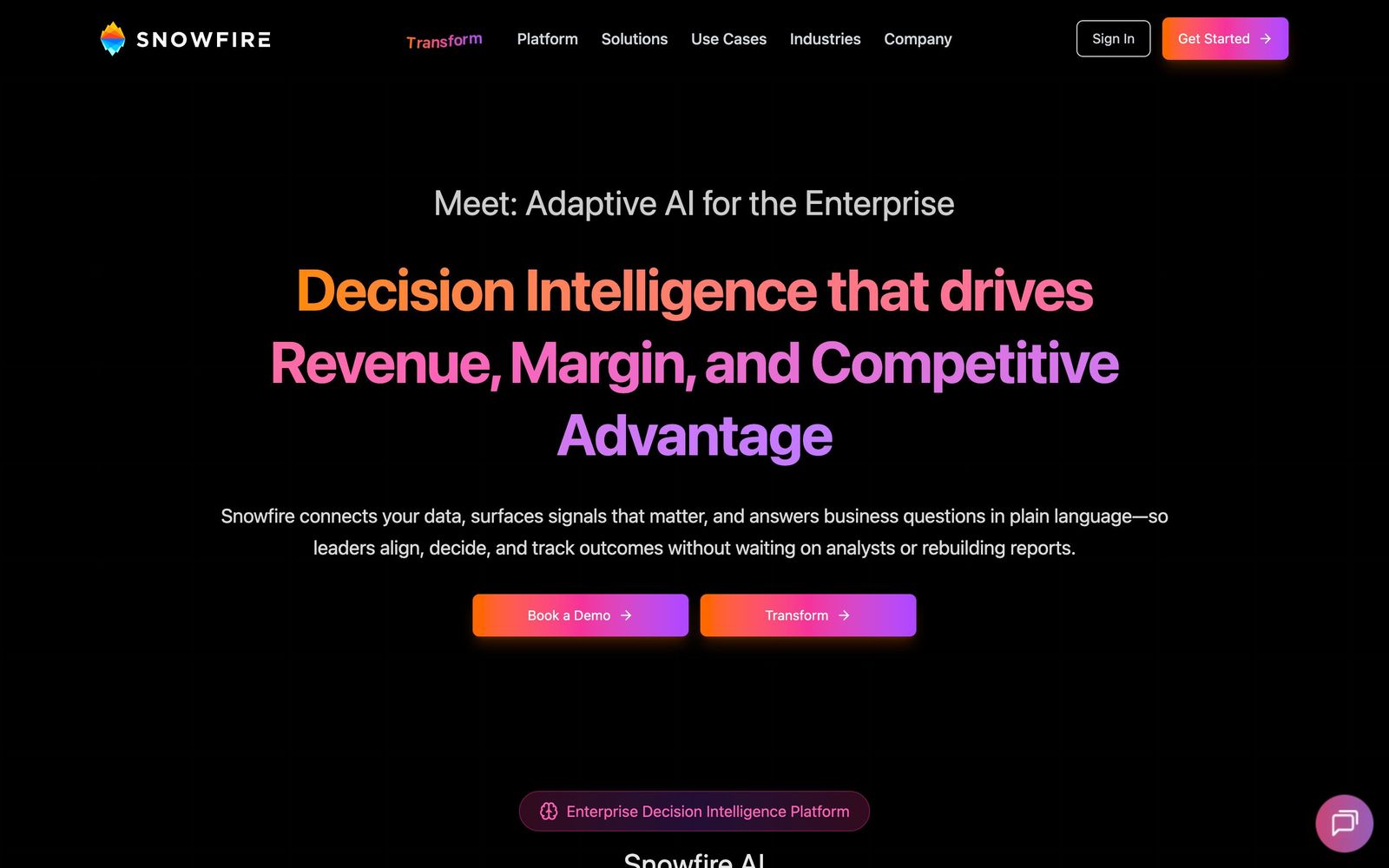
Snowfire AI is strongest at giving non-technical executives real-time, cross-correlated answers from scattered business data, but it is an enterprise product with custom pricing and no self-serve free plan.
Pros
- Connects internal data with external context like news and market signals, not just your own warehouse
- Claims connectors for nearly 1,000 business systems, so most SaaS stacks are covered
- Plain-language questions return synthesized answers instead of raw charts to interpret
- Signals-intelligence style alerting surfaces risks and anomalies proactively, tailored per role
- Fast claimed rollout (production-ready in about 24 hours) with no engineering team required
Cons
- No free plan and custom enterprise pricing, so you cannot trial it self-serve the way you can a BI tool
- Aimed squarely at executives; analysts who want hands-on data modeling will find it limiting
- Young vendor with a thin public track record compared with established BI platforms
- Initial setup and data-source mapping can be involved despite the quick-start claims
Snowfire AI is an adaptive decision intelligence platform built for business executives rather than data teams. Instead of adding another dashboard to the pile, it connects your existing business systems, layers in external signals such as news and market risk, and answers leadership questions in plain language. In a decision intelligence and BI category crowded with chart builders, Snowfire AI positions itself one level up: it wants to tell a CEO, CFO, or CRO what is changing and what to do about it, not hand them a query editor. This review covers what the platform actually does, who it fits, and where it falls short.
What Snowfire AI actually does
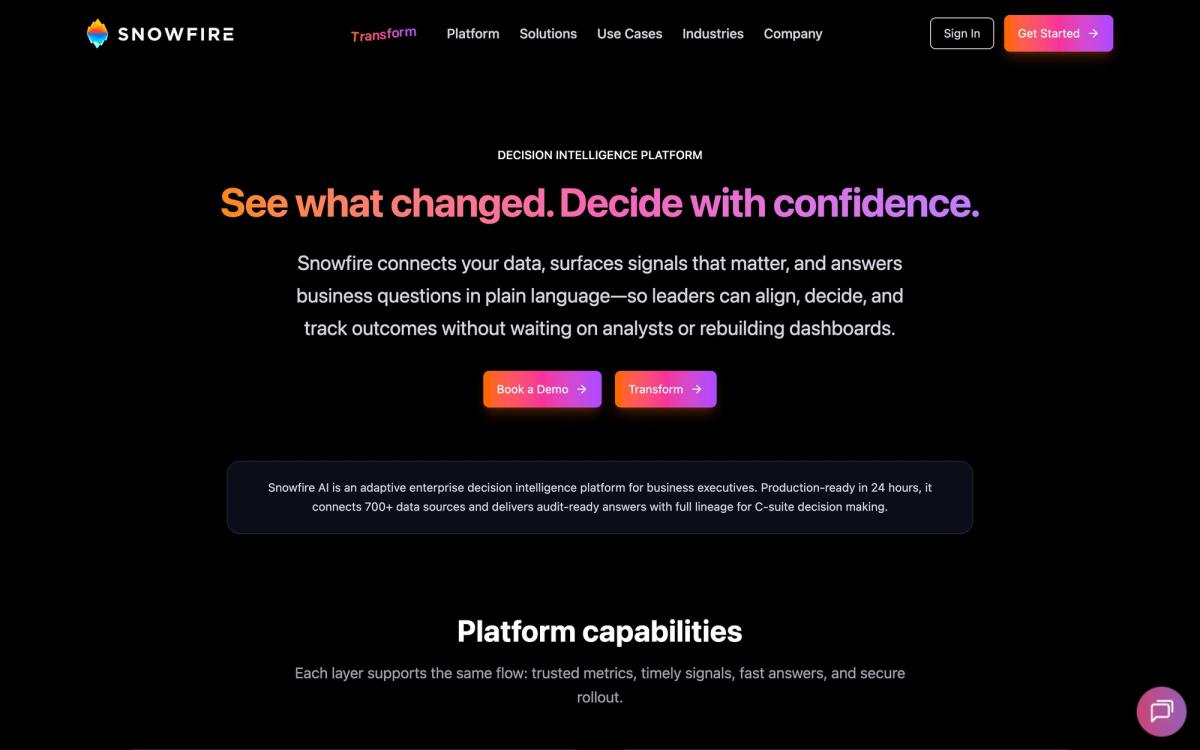
The core idea is fusion. Snowfire AI pulls data from across the company, including finance, sales, operations, and product systems, and cross-correlates it into a synthesized graph rather than isolated reports. The vendor claims connectors for nearly 1,000 business systems, with named integrations including Salesforce, Snowflake, Slack, Gmail, Notion, and Mailchimp. On top of that internal layer it adds external context: news, market movements, and risk indicators relevant to your business.
Executives interact with all of this through natural-language questions and role-personalized views. A CFO and a CRO looking at the same underlying data get different signals, framed around their own metrics. The platform also borrows from military signals intelligence for its alerting: it automates indicators and context so that anomalies, risks, and opportunities surface proactively instead of waiting for someone to notice a number in a report. Snowfire also tracks decisions and outcomes over time, which turns it into a light strategy-execution layer, not just an analytics tool. The company says the platform can be production-ready in about 24 hours and requires no engineering to operate.
Key features
- Cross-correlation of internal business data with external signals such as news and market risk
- Plain-language Q&A that returns synthesized answers and recommendations, not raw charts
- Role-personalized intelligence for CEOs, CFOs, CROs, CTOs, and CPOs
- Signals-intelligence style automated alerts on risks, anomalies, and opportunities
- Decision tracking so leadership teams can follow outcomes after a call is made
- Dedicated solutions for VC and PE due diligence, with portfolio analytics and forecasting
Who it's for
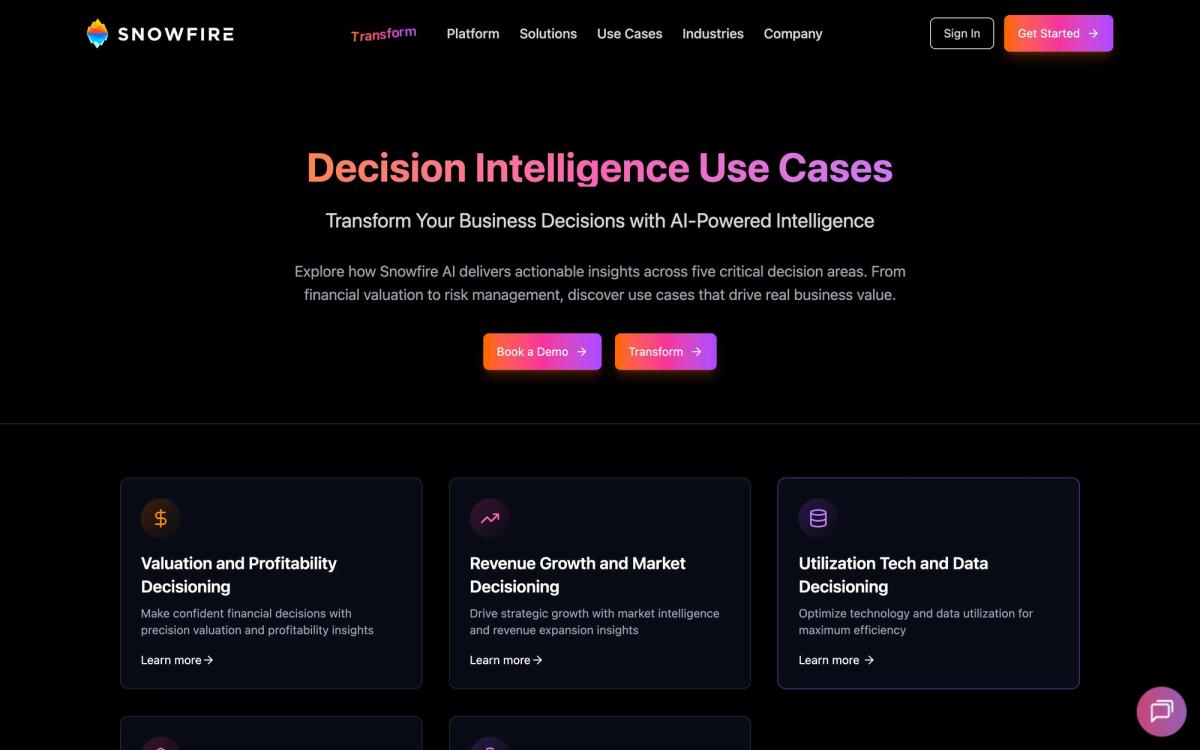
Snowfire AI is for leaders who are tired of waiting on analysts. If your board meetings run on stale slide decks assembled from six tools, this is the problem it targets. The sweet spot is executive teams at companies with a real SaaS stack already in place, plus investors running due diligence who need fast, cross-source answers about a target company. It serves finance, manufacturing, energy, healthcare, tech, and retail use cases. It is not for analysts who want to build their own models, and it is not a fit for early-stage founders who need a cheap self-serve BI tool; pricing is custom and enterprise-oriented, with no free plan.
How it compares
Against ThoughtSpot, the most natural comparison, Snowfire AI is less about search-driven analytics on your warehouse and more about fused, role-specific executive intelligence with external context baked in; ThoughtSpot remains the stronger pick for analyst teams who live in the data. Compared with Microsoft Power BI with Copilot, Power BI wins on ecosystem, maturity, and self-serve accessibility, while Snowfire AI offers a more opinionated, executive-first experience that does not assume anyone on the team builds reports. Snowfire is the younger and less proven vendor in both matchups, which is the honest tradeoff for its sharper focus.
Verdict
Snowfire AI earns a 4.1. The decision intelligence framing is more than marketing: fusing internal metrics with external signals and pushing role-aware alerts is genuinely different from standard BI, and the breadth of integrations makes the promise plausible for real stacks. The tradeoffs are equally clear. There is no free tier, pricing requires a sales conversation, and the company has a short public track record next to the BI incumbents. If you are an executive or investor who wants answers and accountability rather than dashboards, it is worth a demo. If you want hands-on analytics on a budget, look at the established alternatives first.
Ready to try Snowfire AI?
More founders tools like Snowfire AI
Amplitude
4.3Behavioural product analytics with session replay and experimentation on one event stream.
Read Amplitude review →Success.co
4.0Licensed EOS software for quarterly rocks, scorecards, issues and the weekly leadership meeting.
Read Success.co review →P3MO
3.7Portfolio management for PMOs and boards: one view from strategic objectives down to individual projects.
Read P3MO review →PDWare
3.7Resource and portfolio planning that tests whether the people you have can deliver the projects you approved.
Read PDWare review →Cerri
3.6Project and portfolio management with resource capacity, budgets and stage-gate governance, on cloud or on-premise.
Read Cerri review →Plansom
3.5Turns a strategy document into SMART goals, a prioritised task list and a shareable execution plan.
Read Plansom review →