
PDWare review
Resource and portfolio planning that tests whether the people you have can deliver the projects you approved.
A sharp answer to capacity planning for portfolios that outrun their staffing, though quote-only pricing and an unpublished integration list make it hard to evaluate without a sales call.
Pros
- Starts from capacity rather than task lists, so the plan answers whether the work is feasible before it is scheduled
- What-if scenarios let a PMO model delaying, splitting or restaffing a project and see the effect on every other one
- Demand analysis surfaces the specific skills that are oversubscribed rather than a generic utilisation percentage
- Role-based dashboards give finance an FTE and cost view of the same data the resource manager works in
- Implementations are scoped in weeks rather than quarters, and a thin-client on-premise option exists for regulated buyers
Cons
- Pricing is quote-only with a five-user minimum, so budgeting requires a sales conversation before any trial
- The vendor publishes no named integration catalogue; connections to Jira, a PSA or an ERP go through the open API and become an implementation project of their own
- It is a planning layer, not an execution tool, so teams still need a separate system for tasks, boards and time capture
What PDWare actually does
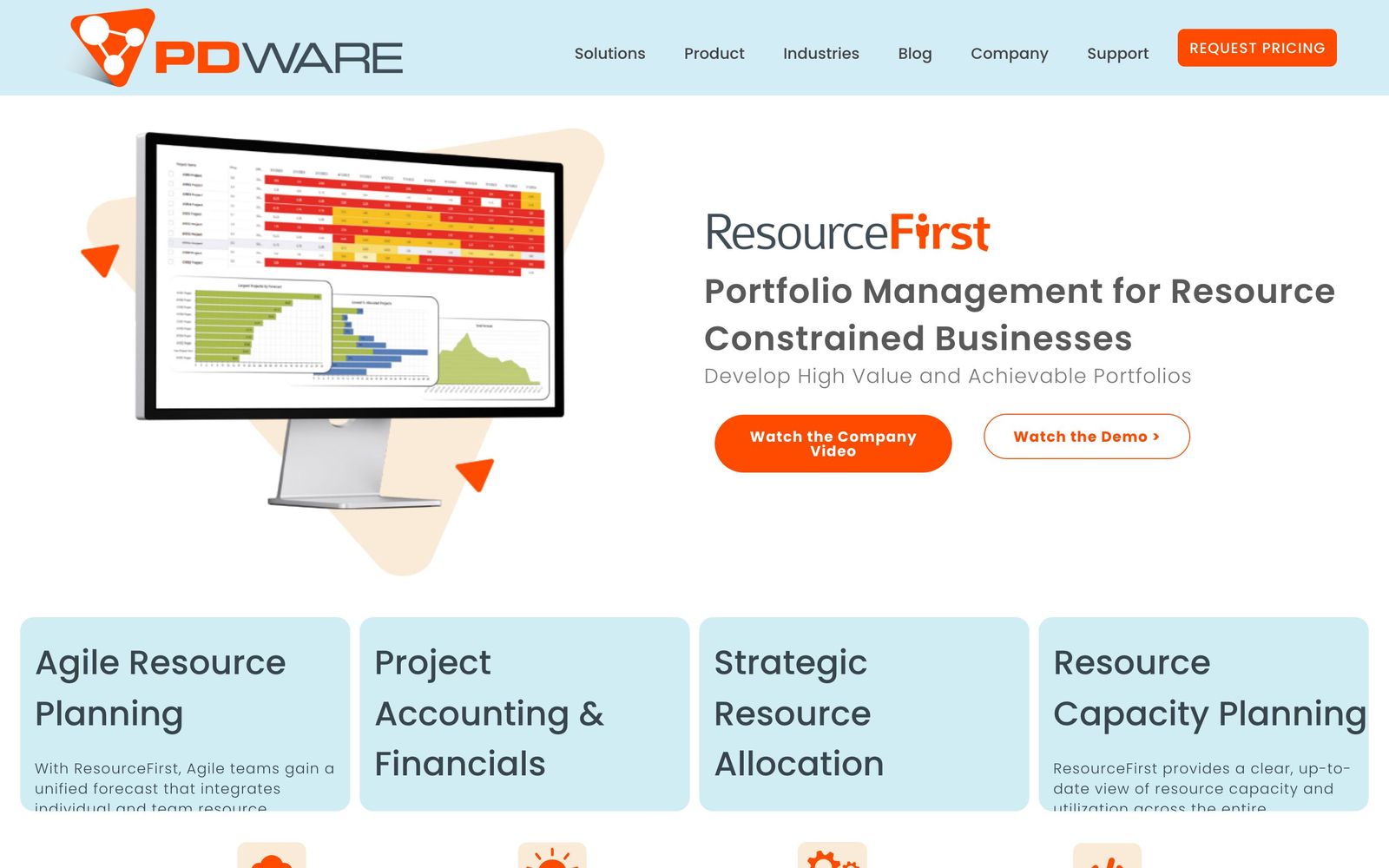
PDWare sells ResourceFirst, a resource and portfolio management application aimed at a narrow, painful question: does the organisation have enough of the right people to deliver the projects it has already approved. Most portfolio tools begin with the project and work down to tasks. ResourceFirst begins with supply, meaning named staff, roles, skills, availability and cost, and compares it against demand from the portfolio. What comes out is a feasibility picture rather than a schedule, showing which projects fall below the resourcing line and which skills are oversubscribed before anyone commits a date.
It is delivered as a cloud application hosted on Microsoft Azure, with a thin-client on-premise option for organisations that cannot put staffing and cost data in a vendor tenant. Dashboards are built on Qlik, so the analytical views are stronger than the average project tool, and the vendor positions the interface as spreadsheet-like on purpose because the people who maintain resource plans are usually the people who currently maintain them in Excel. PDWare states an average of five weeks to production and a minimum of five users.
Key features
The product is organised around planning decisions rather than task execution.
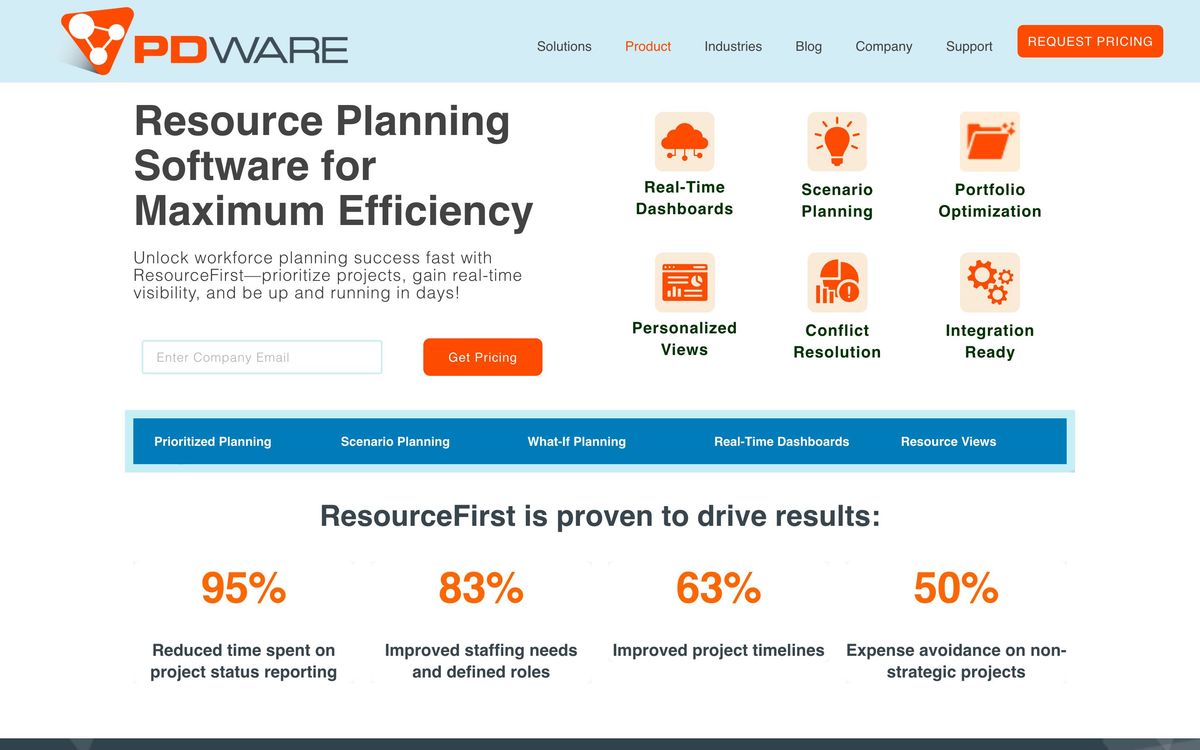
- Capacity and demand modelling across individuals, roles, skills, budgets and time periods
- What-if scenarios that compare delaying, resequencing or restaffing projects and show the knock-on effect on the rest of the portfolio
- Portfolio prioritisation that ranks approved work against available supply and marks what does not fit
- Qlik-powered dashboards with separate role-based views for the PMO, delivery leads and finance
- Reporting against FTE and financial targets, including chargeback allocation and research cost tracking
- Open REST API, plus a choice between Azure-hosted cloud and thin-client on-premise deployment
Who it's for
The buyer is a PMO, a resource manager or a delivery director in an organisation where projects compete for the same scarce specialists: IT and engineering groups, consultancies billing named people, pharmaceutical and medical device programmes, financial services change portfolios. The tell is a quarterly planning cycle currently run in a large shared spreadsheet that nobody trusts by week three.
It is the wrong purchase for a small team that needs a place to run day-to-day work. ResourceFirst does not replace a task board, a sprint tool or a time-tracking system, and buying it to fix a task management problem will disappoint. It is also awkward for organisations that want to evaluate quietly: there is no self-serve trial or published price, so the first step is a demo, and the integration work to feed it live project data has to be scoped rather than switched on.
How it compares
Planview covers the same ground with far more depth across financials, agile delivery and strategic planning, and is the safer choice for a large enterprise portfolio, but it costs considerably more and takes longer to stand up. Smartsheet Resource Management, the former 10,000ft, is easier to adopt and better suited to agencies scheduling billable people, though its scenario modelling is shallower than PDWare's. Runn and Float sit further down again as lightweight forecasting tools that a small services team can run without a PMO, at the cost of portfolio-level prioritisation. PDWare's niche is the middle: serious capacity analytics without an enterprise PPM implementation.

Verdict
ResourceFirst does one difficult thing well, and the waterline view of a portfolio against real staffing is a genuinely useful artefact to put in front of an executive committee that keeps approving work. The analytics are stronger than the interface suggests, and the on-premise option keeps regulated buyers in play. What holds it back is commercial opacity and ecosystem thinness. Nothing about price is published, the five-user floor rules out casual adoption, and the absence of a named integration list means the data that makes the model useful has to be piped in through the API by someone. Worth a demo if capacity is the bottleneck; skip it if the real problem is execution.
Ready to try PDWare?
More founders tools like PDWare
P3MO
3.7Portfolio management for PMOs and boards: one view from strategic objectives down to individual projects.
Read P3MO review →Cerri
3.6Project and portfolio management with resource capacity, budgets and stage-gate governance, on cloud or on-premise.
Read Cerri review →Plansom
3.5Turns a strategy document into SMART goals, a prioritised task list and a shareable execution plan.
Read Plansom review →Todoist
4.3A task manager with natural-language capture and shared projects, built to hold personal and team work in one list.
Read Todoist review →SmartSuite
4.2Structured records, views, dashboards and automations in one platform for teams outgrowing spreadsheets.
Read SmartSuite review →Backlog
4.1Project management and bug tracking with built-in Git/SVN, Gantt charts, and wikis; flat per-space pricing.
Read Backlog review →