
P3MO review
Portfolio management for PMOs and boards: one view from strategic objectives down to individual projects.
A sensible portfolio layer for an organisation already standardised on Microsoft 365, though quote-only pricing and a thin public integration story make it hard to evaluate without a sales call.
Pros
- Built on Microsoft 365 components, so data entered in Planner or Forms does not have to be rekeyed into the portfolio view
- Carries security credentials larger buyers ask for: SOC 2, ISO 27001, Cyber Essentials and GDPR compliance
- Tracks benefits realisation and budget against actuals, not only task status, which is what board reporting actually needs
- Configurable stakeholder views let the same underlying data serve a board pack and a delivery stand-up
- Risk, assumption, issue and dependency records sit in one centralised log with heat-map summaries
Cons
- No published pricing at any tier, so budgeting requires a demo and a quote before the shortlist stage
- The integration story outside the Microsoft stack is undocumented, with no named Jira or Azure DevOps connector on the site
- A small UK vendor with limited independent review coverage, which raises the diligence burden for a regulated buyer
What P3MO actually does
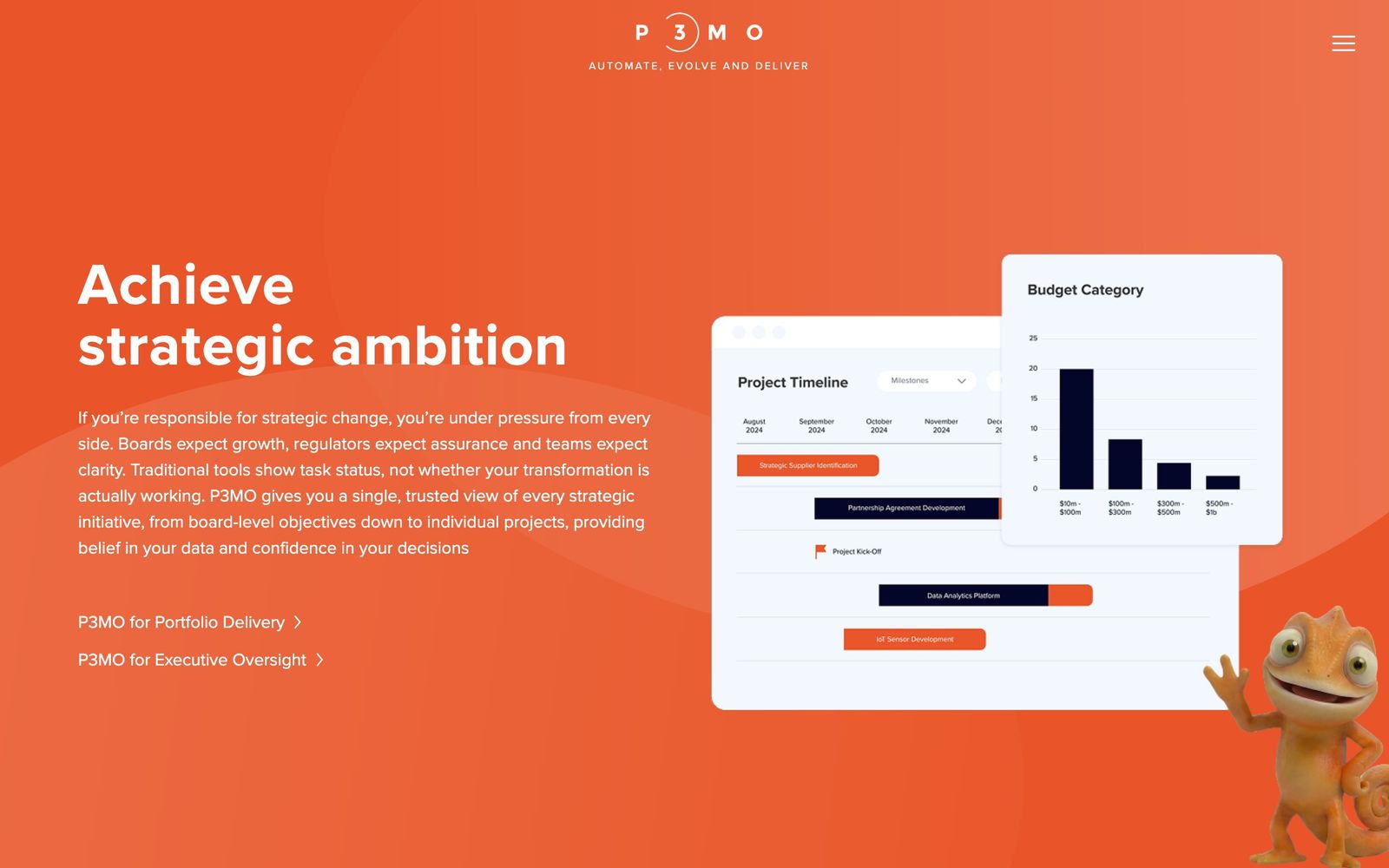
P3MO is portfolio management software for organisations running strategic change, aimed at the gap between a board that has approved a transformation and the projects supposedly delivering it. It holds a single structured plan across portfolios, programmes and projects, tracks money and benefits alongside milestones, and generates the reporting that a steering group consumes. The vendor's framing is that conventional project tools answer whether tasks are done, while a board needs to know whether the transformation is producing the outcome it was funded for.
The platform is built on Microsoft 365 rather than beside it. Planner, Forms, Power Automate and Power BI carry parts of the workflow, which means data captured by a delivery team in tools they already use surfaces in the portfolio view without a second entry. The company is based in Oxford, was founded in 2019, and publishes SOC 2, ISO 27001, Cyber Essentials and GDPR compliance, which is the credential set a public sector or regulated buyer will ask for first.
Key features
The product is organised into a delivery layer for PMOs and an oversight layer for executives.
- One structured plan across portfolios, programmes and projects, with milestone and critical-path dependency tracking
- A centralised register of risks, assumptions, issues and dependencies, summarised as heat-maps
- Resource management showing real-time capacity, skills and competency mapping, and forward demand
- Budget versus actual tracking with forecasts, connected to benefits realisation per initiative
- Automated reporting with configurable views by audience, plus audit trails behind the numbers
- Meeting management with agendas and actions attached to the portfolio records they concern
Who it's for
The fit is a PMO of a few people inside a mid-sized organisation, a council, a health body, a manufacturer, a professional services firm, where several programmes run at once, the board asks quarterly whether any of it is working, and the current answer is assembled by hand in a spreadsheet the week before. The Microsoft 365 foundation makes this materially easier to sell internally at organisations that have already standardised there, since it introduces fewer new tools and no new identity provider.
It is not a tool for a delivery team looking for a better tracker. Engineers will find it heavy and governance-shaped, and a startup with three projects will get nothing from a benefits realisation module. Organisations built on Atlassian or Google Workspace should probe the integration question hard, because the public material names Microsoft components and nothing else, and a portfolio system that cannot read from where work actually happens becomes another manual re-entry job.
How it compares
Planview and Clarity are the enterprise incumbents: far deeper on scenario planning and financial modelling, correspondingly expensive and slow to implement. Monday and Smartsheet are cheaper and quicker to adopt but reach their limits at genuine portfolio governance, with benefits tracking and stage gates left to be improvised in columns. Microsoft's own Project for the web plus Power BI is the closest architectural neighbour and the real competitor for a Microsoft-standardised buyer, and the case for P3MO over it rests on getting the governance model prebuilt rather than assembled by an internal team.
Verdict
P3MO is a credible mid-market portfolio platform that understands its buyer: it reports on benefits and money rather than task completion, it inherits the Microsoft estate instead of competing with it, and it carries the compliance certifications procurement will demand. The caveats are about evaluation rather than capability. Pricing is quote-only at every tier, the integration story beyond Microsoft is undocumented, and independent review coverage of a small UK vendor is thin, so a buyer has to do more of their own diligence than the category usually requires.
Ready to try P3MO?
More founders tools like P3MO
PDWare
3.7Resource and portfolio planning that tests whether the people you have can deliver the projects you approved.
Read PDWare review →Cerri
3.6Project and portfolio management with resource capacity, budgets and stage-gate governance, on cloud or on-premise.
Read Cerri review →Plansom
3.5Turns a strategy document into SMART goals, a prioritised task list and a shareable execution plan.
Read Plansom review →Todoist
4.3A task manager with natural-language capture and shared projects, built to hold personal and team work in one list.
Read Todoist review →SmartSuite
4.2Structured records, views, dashboards and automations in one platform for teams outgrowing spreadsheets.
Read SmartSuite review →Backlog
4.1Project management and bug tracking with built-in Git/SVN, Gantt charts, and wikis; flat per-space pricing.
Read Backlog review →