
Pangram Labs review
Research-backed AI detection with independently verified accuracy, covering 20+ languages and major LLMs.
The most credible AI detector on accuracy evidence, with interpretability that shows which sections look AI-written, though no detector output should ever be treated as standalone proof.
Pros
- Accuracy claims verified by independent researchers at the University of Chicago and University of Maryland
- Detects text from major models including ChatGPT, Gemini, Claude, Grok, and Llama
- Interpretability features highlight which sections appear AI-generated, not just a single score
- AI assistance detection distinguishes fully generated text from AI-edited writing
- Works in 20+ languages, with Canvas, Google Classroom, Chrome, and API integrations
- Real free plan with daily checks, file upload, and OCR
Cons
- False positives are unavoidable in this category, so results need human judgment before any accusation
- API and LMS integrations sit behind paid tiers
- A young company in an adversarial cat-and-mouse field where model updates can shift accuracy
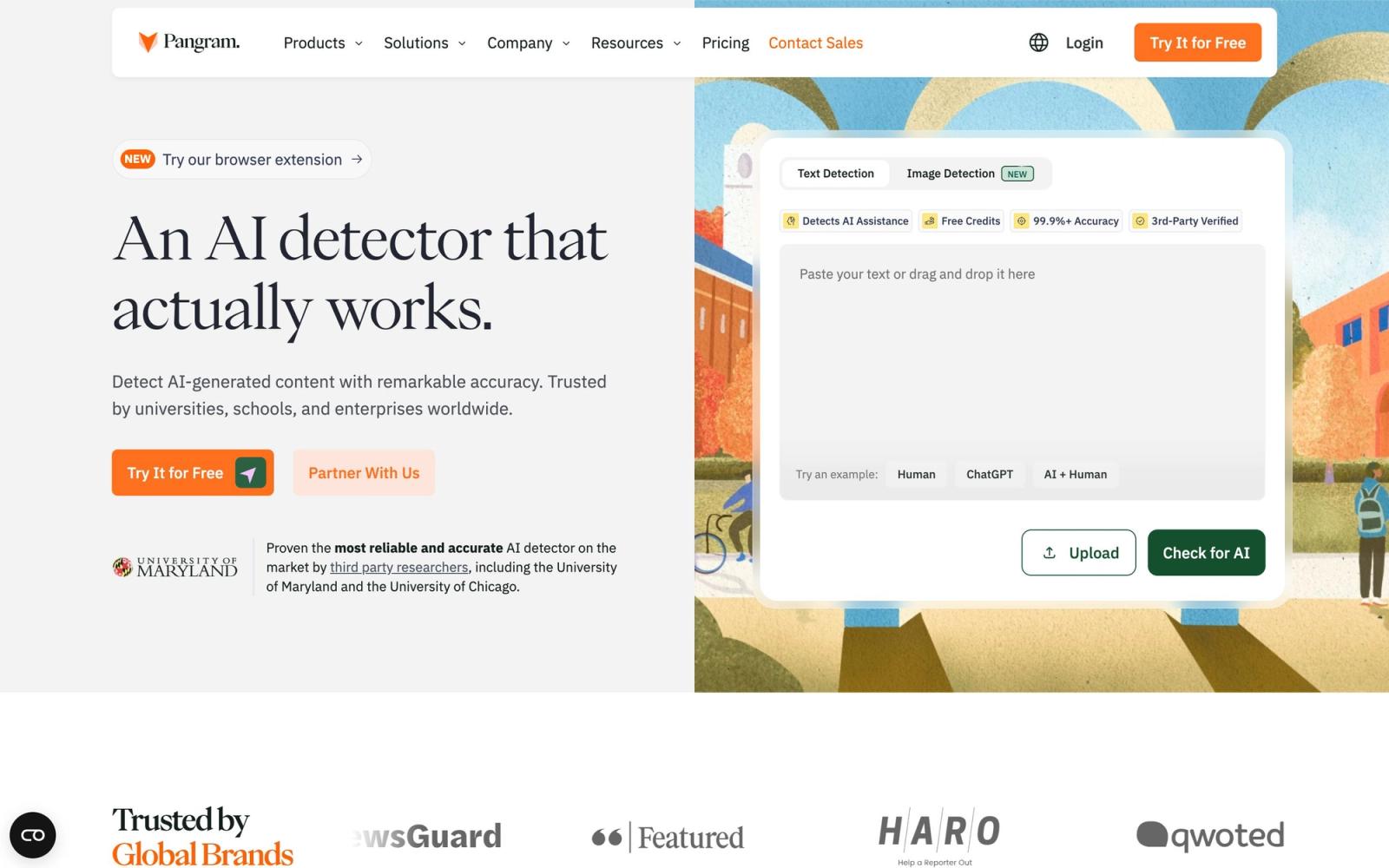
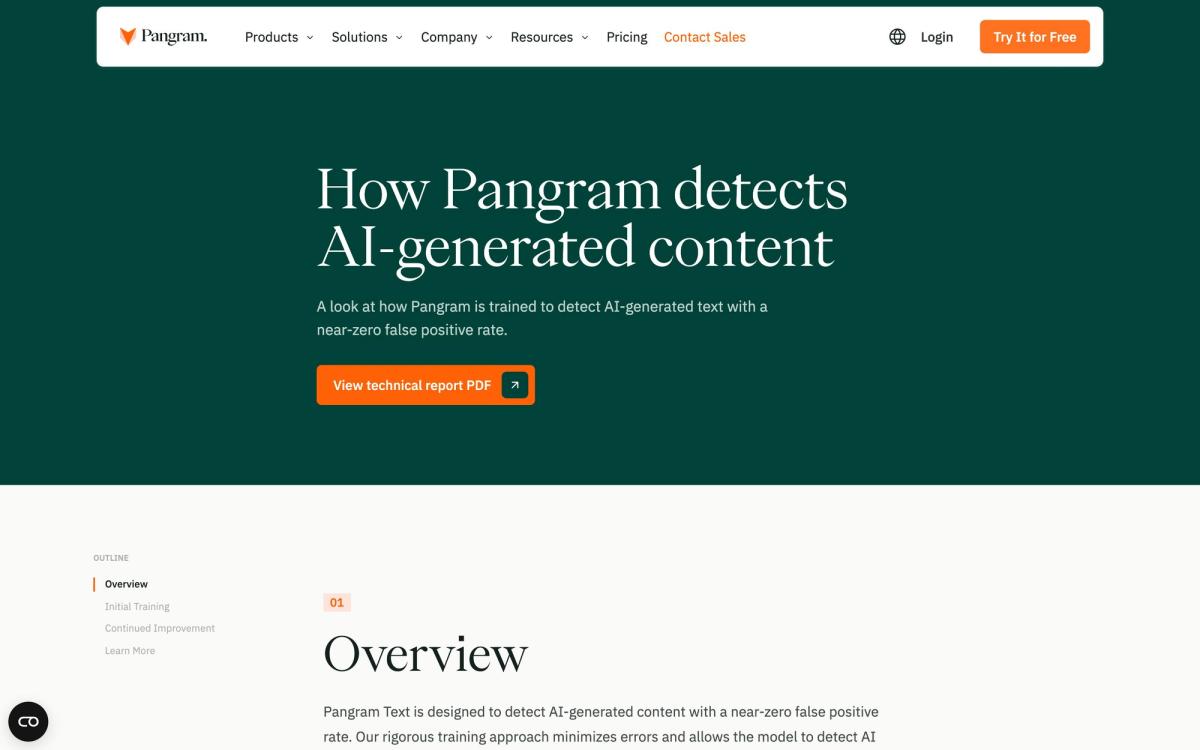
AI detection is a category with a trust problem: most detectors make accuracy claims nobody can check, and false positives have real consequences for students and writers. Pangram Labs is the exception worth knowing about. Founded in Brooklyn in 2024 by AI researchers from Tesla and Google, Pangram publishes its methodology and has had its accuracy verified by independent researchers at the University of Chicago and the University of Maryland, which puts it on firmer ground than nearly every competing AI detector.
What Pangram Labs actually does
Paste text, upload a file, or scan a page with the Chrome extension, and Pangram analyzes the writing against patterns learned from a massive dataset of human and AI text. It detects output from the popular models, including ChatGPT, Gemini, Claude, Grok, and Llama, and works across more than 20 languages, which matters for institutions where English-only detection quietly fails multilingual students.
Two capabilities separate it from score-only detectors. First, interpretability: instead of just a percentage, Pangram highlights which sections of a document look AI-generated and explains its confidence, giving an instructor or editor something concrete to discuss rather than a bare number. Second, AI assistance detection, introduced with Pangram 3.0, attempts to distinguish fully generated text from human writing that was AI-edited, reflecting how people actually use these tools in 2026. A plagiarism check rides alongside the AI analysis, and file upload with OCR handles scanned documents.
Distribution fits its audiences: Canvas and Google Classroom integrations for education, a Google Docs integration and Chrome extension for everyday checking, a feed scanner that flags AI-generated posts on X, LinkedIn, Substack, and Medium, and an API for platforms moderating content at scale.
Key features
- AI detection across major models with independently verified accuracy
- Section-level highlighting and confidence explanation, not just a single score
- AI assistance detection separating generated, edited, and human text
- Multilingual detection across 20+ languages
- Canvas, Google Classroom, Google Docs, and Chrome extension integrations, plus an API
- Free plan with daily checks, file upload, and OCR included
The free plan allows a handful of checks per day with the interpretability features and Chrome extension included, while API access and LMS integrations require paid tiers.
Who it's for
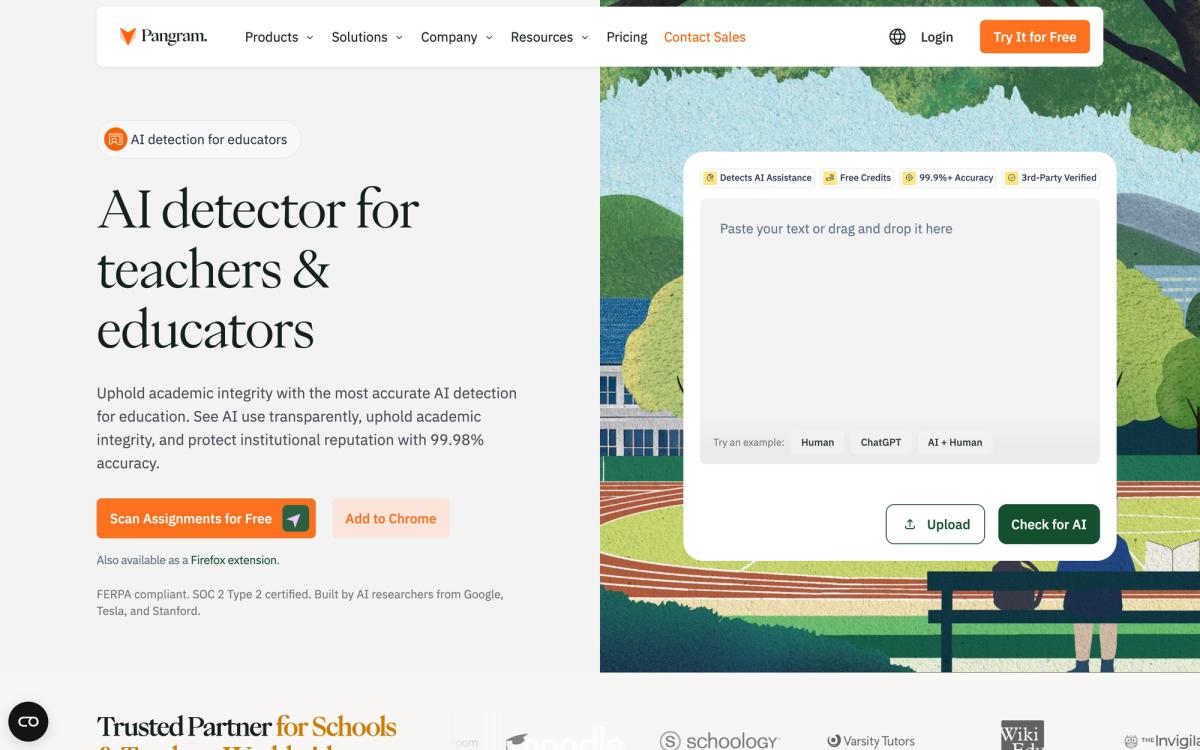
Educators are the clearest fit: the LMS integrations, section-level evidence, and verified accuracy give academic-integrity processes something defensible to work with. Editors, publishers, and content marketplaces screening submissions are the second audience, and the API serves platforms fighting AI spam at scale. Content creators also use detection in reverse, checking that their own writing will not be falsely flagged by clients or platforms. Anyone in these groups should still internalize the category's hard limit: no detector is courtroom proof, and Pangram's own positioning treats results as evidence for human judgment, not a verdict.
How it compares
Against GPTZero, the best-known name in education, Pangram's published research and third-party verification give it a stronger accuracy story, and its section-level interpretability is more actionable than a headline score, while GPTZero counters with brand recognition and a longer institutional track record. Against Turnitin's AI detection, which lives inside an entrenched plagiarism suite, Pangram is the more transparent and more current detector, but Turnitin wins where procurement already standardized on it. Originality.ai competes hardest on the marketer and SEO side, while Pangram's edge remains research credibility and multilingual reach.
Verdict
If you must use an AI detector, use one that shows its work, and Pangram Labs currently makes the strongest case: independently verified accuracy, section-level explanations instead of a naked score, detection that understands AI-assisted writing rather than just AI-generated text, and a real free plan to evaluate it. The honest limits are categorical, since false positives cannot be engineered away and the detection arms race never ends. As one input in a human process, Pangram is the best-in-class choice in AI detection right now.
Ready to try Pangram Labs?
There's a free tier, so you can test it before committing.
More creators tools like Pangram Labs
Riverside
4.5Browser recording studio that captures every remote guest locally in 4K, then edits and publishes the episode.
Read Riverside review →Ticket Tailor
4.3Box office software that charges a flat fee per ticket instead of a percentage of the door.
Read Ticket Tailor review →Beautiful.ai
4.2AI presentation software with smart slides that auto-align layout, spacing, and branding as you type.
Read Beautiful.ai review →Castmagic
4.2Turns audio and video recordings into show notes, posts, articles, and clips-ready copy automatically.
Read Castmagic review →Circle
4.2Community platform with courses, events, paid memberships, email and branded apps on your own domain.
Read Circle review →LearnWorlds
4.2Course platform and LMS for selling training: site builder, interactive video, certificates and checkout.
Read LearnWorlds review →