
Ticket Tailor review
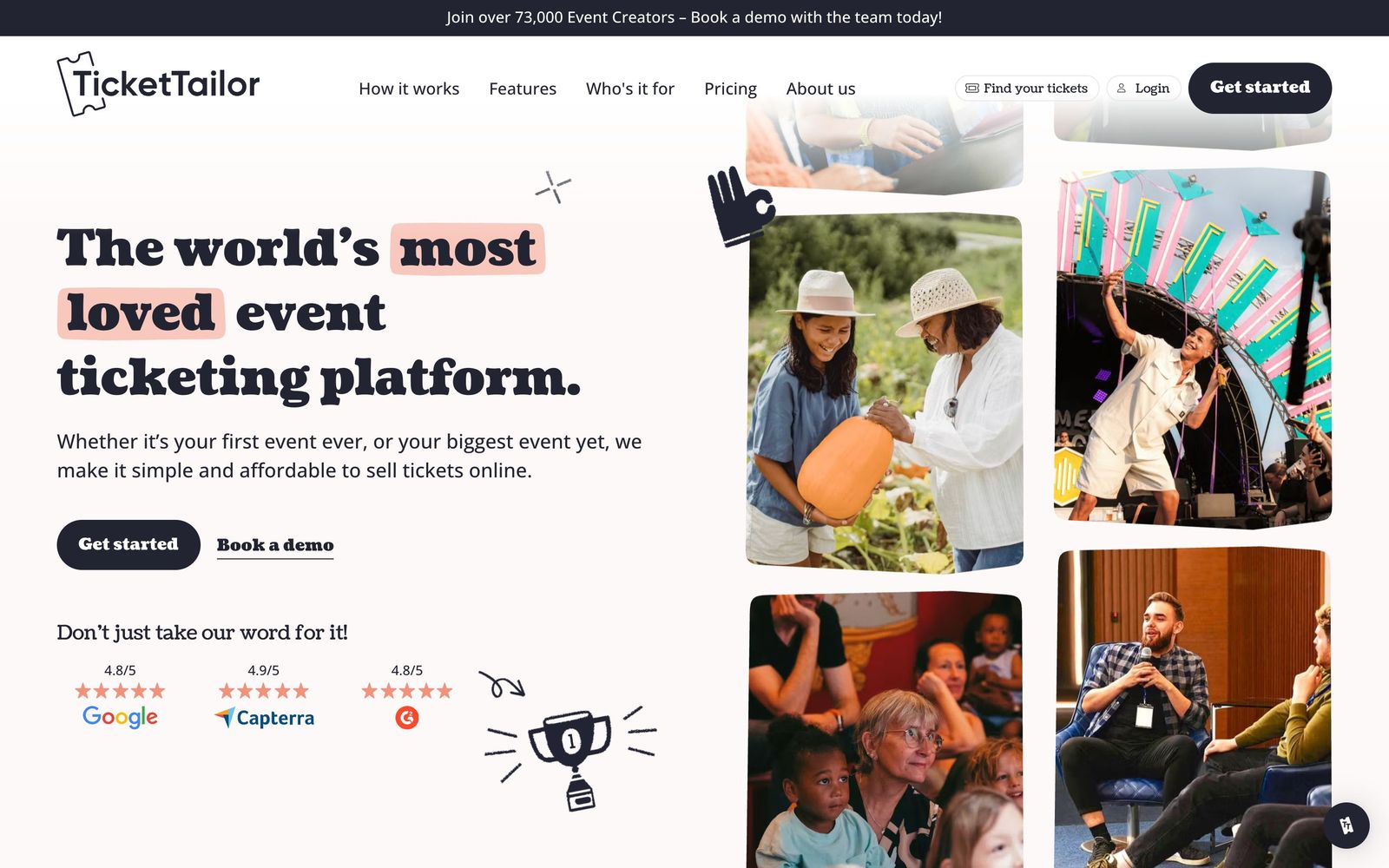
Box office software that charges a flat fee per ticket instead of a percentage of the door.
The cheapest honest way to sell tickets for independent events, though it is a box office and not a marketplace, so it will not find an audience for you.
Pros
- Fees are a flat amount per paid ticket rather than a percentage, so the cost of selling an expensive ticket does not scale with its price
- Money goes straight to your own Stripe, PayPal or Square account, so payouts arrive on the processor's schedule instead of after the event
- Free events cost nothing to run, which makes it viable for community groups and member organisations that never charge
- Every feature is on every account, there is no tier that withholds reserved seating or the check-in app
- The customer list belongs to the organiser and exports cleanly into Mailchimp, HubSpot or ActiveCampaign
Cons
- There is no discovery marketplace, so a new event gets zero audience from the platform itself and all promotion is on you
- Reserved-seating tickets consume twice the credit of a general-admission ticket, which erodes the price advantage for seated venues
- It stops short of conference logistics: no multi-track session management, no badge printing, no exhibitor or sponsor handling
What Ticket Tailor actually does
Ticket Tailor is a box office. You create an event, define ticket types, publish a hosted page or embed the checkout on your own website, and people buy. Payments run through your own Stripe, PayPal or Square account, which means the money lands with you on the processor's normal schedule rather than being held by the ticketing company until after the show. The organiser keeps the buyer list and can push it into an email tool.
The commercial model is the point of the product. Instead of taking a percentage of every sale, Ticket Tailor charges a flat fee per paid ticket, and that fee falls when you buy credits in advance. Free tickets cost nothing, so a community group running open events pays the company nothing at all. Feature access does not vary by plan: reserved seating, the check-in app, discount codes and the API are on every account, and the only variable is how many tickets you sell. For a venue selling higher-priced tickets, the arithmetic against percentage-based platforms is not close.
Key features
The product covers the mechanics of selling and admitting, and deliberately stops there.
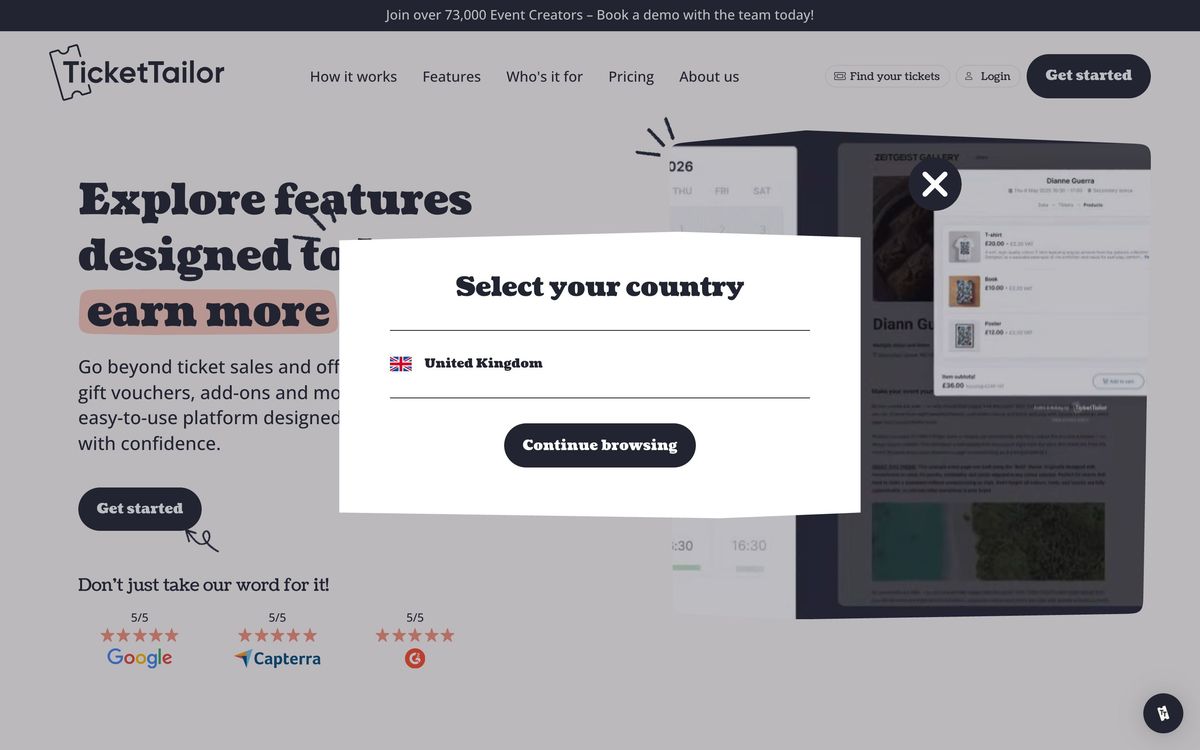
- Hosted event pages plus an embeddable checkout widget for your own site
- Reserved seating charts with per-seat pricing, alongside standard general admission
- Time-slot and recurring scheduling for tours, classes and timed-entry attractions
- A free check-in app that scans tickets at the door and works without a connection
- Discount codes, hidden ticket types, custom order questions and branded ticket designs
- Direct payouts through Stripe, PayPal or Square, with Mailchimp, HubSpot, ActiveCampaign and Zapier connections
Who it's for
This suits organisers who already have an audience: a venue with a mailing list, a festival with a following, a workshop leader whose students come back, a church or club selling to members. The whole value proposition assumes you supply the demand and want the cheapest, least intrusive way to take money for it. It is also a sensible pick for anyone selling internationally, since payouts follow the payment processor rather than a ticketing company's regional rules.
It is the wrong tool for a first-time organiser with no list, because there is no marketplace to be discovered in, a competitor's browse page can genuinely sell tickets, and this has nothing equivalent. It is also too light for a conference with tracks, badges, sponsor booths and attendee networking; those events need dedicated event management software, and stitching the gaps together with a ticketing tool costs more in coordination than the fee difference saves.
How it compares
Eventbrite is the obvious comparison: far more expensive per sale because its fee is a percentage plus a fixed amount, but it brings discovery traffic and a more complete marketing suite. Humanitix charges similar percentage-style fees and donates its profit to charity, which is a different kind of argument for the same money. Eventix and Eventzilla sit closer to Ticket Tailor on the flat-fee model, with Eventzilla stronger on conference features and weaker on interface. For plain self-promoted events, Ticket Tailor is usually the cheapest of the group; for anything that needs an audience found for it, it is the weakest.
Verdict
Ticket Tailor does one job and prices it honestly, which is rarer in ticketing than it should be. Direct payouts, a flat fee that does not punish higher ticket prices, no cost for free events, and every feature on every account together make it the default recommendation for independent organisers who bring their own crowd. The caveat is the one the company is candid about: it sells tickets, it does not sell events. If your problem is filling the room rather than taking the money, a marketplace platform will still earn its higher fee.
Ready to try Ticket Tailor?
There's a free tier, so you can test it before committing.
More creators tools like Ticket Tailor
Sellfy
3.7Storefront for creators selling digital files, subscriptions and print-on-demand merch in one place.
Read Sellfy review →ElevenLabs
4.7AI audio platform with 5,000+ voices in 70+ languages: text-to-speech, voice cloning, dubbing, and agents.
Read ElevenLabs review →Descript
4.5AI audio and video editor where you edit recordings by editing the transcript text.
Read Descript review →Gamma
4.5AI design partner that generates presentations, documents, websites, and social content from a prompt.
Read Gamma review →Riverside
4.5Browser recording studio that captures every remote guest locally in 4K, then edits and publishes the episode.
Read Riverside review →Consensus
4.4AI search engine over 200M+ academic papers, with a Consensus Meter showing where the science agrees.
Read Consensus review →