
Consensus review
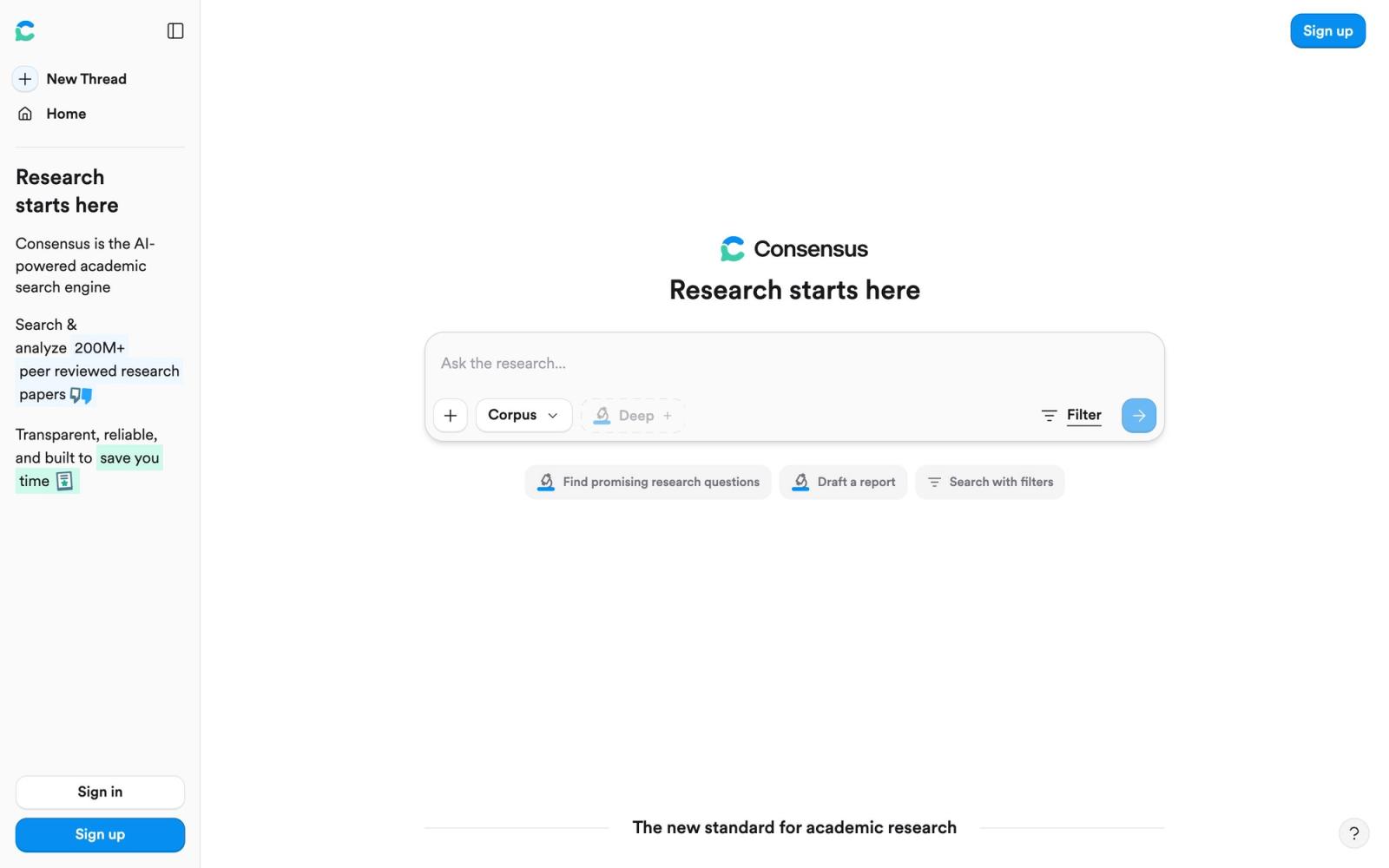
AI search engine over 200M+ academic papers, with a Consensus Meter showing where the science agrees.
The fastest way to find out what peer-reviewed research actually says on a question, as long as you treat its summaries as a starting point rather than a literature review.
Pros
- Searches 200M+ scientific papers and returns answers grounded in actual studies
- Consensus Meter visualizes agreement across studies on yes/no questions
- Study Snapshots surface design, sample size, and population at a glance
- Generous permanent free plan with unlimited searches and Consensus Meter use
- Filters by study design, sample size, and more, applied from natural-language prompts
Cons
- Pro Analysis, Study Snapshots, and Deep Search are capped per month on the free plan
- Summaries can flatten nuance, so important claims still require reading the papers
- Coverage and meter quality vary by field, with thin literatures producing thin answers
Consensus is an AI search engine that answers questions using academic research instead of the open web. Ask whether creatine improves cognition or remote work hurts productivity, and rather than blog posts and opinion pieces, you get findings extracted from peer-reviewed studies, drawn from an index of more than 200 million papers. For content creators who need citations behind their claims, students, educators, clinicians, and anyone tired of laundering Google results, it occupies a genuinely useful niche among research and citation tools.
What Consensus actually does
Type a research question in plain language. Consensus retrieves relevant papers and uses language models to extract each study's key finding, presenting them as a list of evidence rather than a wall of links. For yes/no questions, the signature feature kicks in: the Consensus Meter, which classifies the top relevant studies as yes, no, possibly, or mixed and displays the split. Seeing that the literature runs heavily one direction, or is genuinely divided, in ten seconds is the product's core magic, and it is honest about disagreement in a way single-answer chatbots are not.
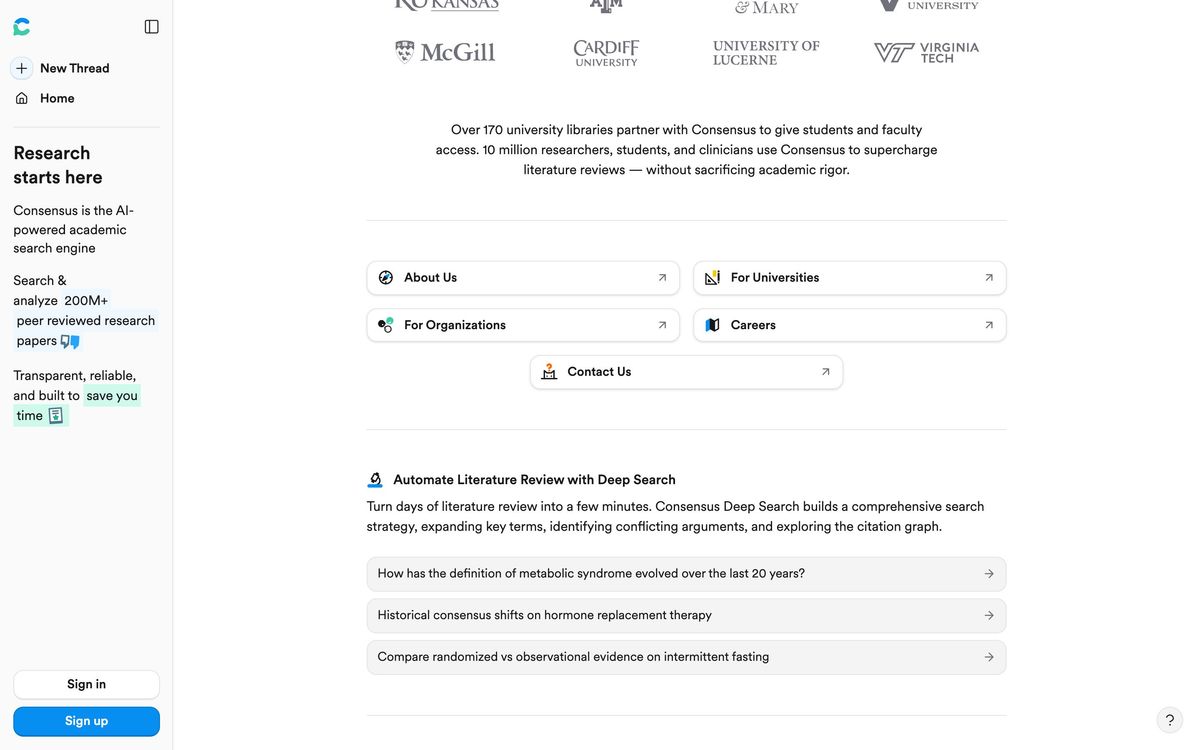
Digging deeper, Study Snapshots summarize a paper's design, sample size, and population without opening the PDF, useful for judging whether a finding comes from a randomized trial on thousands of people or a survey of forty undergraduates. Pro Analysis synthesizes across the top results into a structured summary, and Deep Search runs a more thorough retrieval pass for literature-review-grade questions. Search filters for study design, publication window, and population can be applied directly from the prompt, which keeps the workflow conversational.
Key features
- Natural-language search over 200M+ academic papers
- Consensus Meter showing the yes/no/possibly/mixed split across studies
- Study Snapshots with design, sample size, and population at a glance
- Pro Analysis synthesis and Deep Search for thorough retrieval
- Filters by study design, timeframe, and population, applied from plain-language prompts
- A permanent free plan with unlimited searches and meter use, plus monthly allowances of Pro Analyses, Snapshots, and Deep Searches
Who it's for
Consensus earns its keep for creators and writers who make factual claims in newsletters, videos, and courses and want studies behind them, for students and educators doing source-grounded work, and for health and fitness professionals navigating contested topics. The free plan is unusually generous, with unlimited basic searches and meter use, so casual users may never pay, while researchers leaning on Pro Analysis and Deep Search will hit the monthly caps. It is not a replacement for systematic review work, and anyone making high-stakes decisions should click through to the underlying papers, since extraction occasionally misses context like dosage, population, or effect size.
How it compares
The closest competitor is Elicit, which targets working researchers with extraction tables, screening workflows, and systematic-review tooling, while Consensus optimizes for fast, readable answers and the agreement-at-a-glance meter. Researchers conducting formal reviews lean Elicit; everyone else gets answers faster from Consensus. Against Perplexity, which searches the open web with citations, Consensus trades breadth for rigor, since its index is academic literature only, making it the better tool when the question is what studies show rather than what the internet says. Scite is another adjacent tool, focused on whether later papers support or contrast a given citation.
Verdict
Consensus does one thing better than anything else I have tested: it turns a plain-language question into an honest snapshot of the academic evidence, fast. The Consensus Meter and Study Snapshots make research legible to non-researchers without dumbing it down, and the permanent free tier makes adoption frictionless. Its limits are inherent to the approach, including summaries that compress nuance, field-dependent coverage, and monthly caps on the deeper analysis features. Use it to find and frame the evidence, then read the studies that matter. As a first stop for evidence-backed content, it is an easy recommendation.
Ready to try Consensus?
There's a free tier, so you can test it before committing.
More creators tools like Consensus
Riverside
4.5Browser recording studio that captures every remote guest locally in 4K, then edits and publishes the episode.
Read Riverside review →Ticket Tailor
4.3Box office software that charges a flat fee per ticket instead of a percentage of the door.
Read Ticket Tailor review →Beautiful.ai
4.2AI presentation software with smart slides that auto-align layout, spacing, and branding as you type.
Read Beautiful.ai review →Castmagic
4.2Turns audio and video recordings into show notes, posts, articles, and clips-ready copy automatically.
Read Castmagic review →Circle
4.2Community platform with courses, events, paid memberships, email and branded apps on your own domain.
Read Circle review →LearnWorlds
4.2Course platform and LMS for selling training: site builder, interactive video, certificates and checkout.
Read LearnWorlds review →