
Motion review
Creative analytics for paid social: visual reports and AI tagging that show which ad creatives perform.
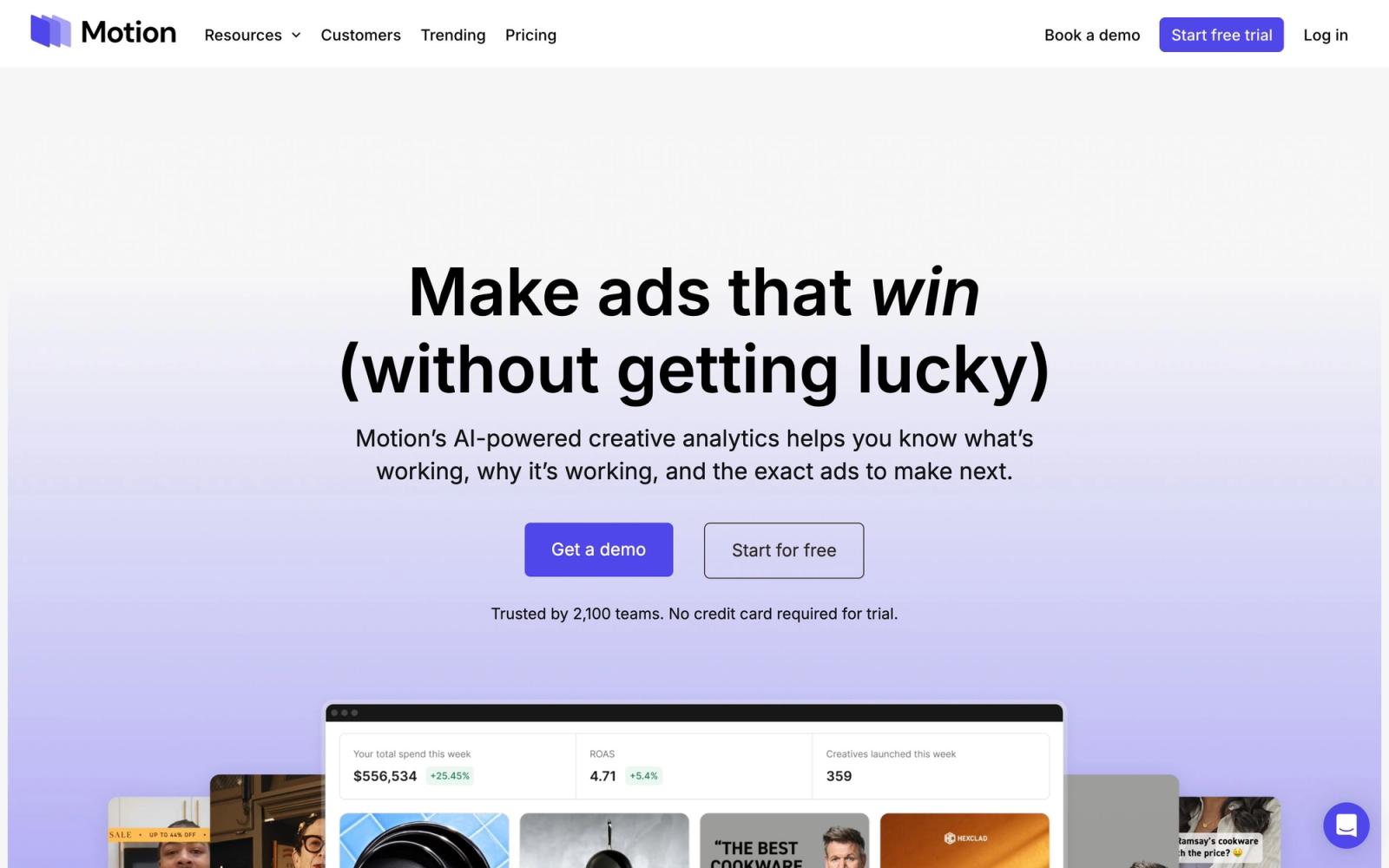
Best-in-class at explaining why ad creatives win on Meta with visual reports and AI tagging; coverage gets progressively thinner on TikTok, YouTube, and LinkedIn.
Pros
- Visual, creative-first reports that creative strategists and leadership can actually read
- AI Tags automatically classify every ad across 8 dimensions (hook style, format, angle, messaging) with no manual labeling
- Hook, watch, click, and conversion ratings pinpoint exactly where a video ad leaks viewers
- Inspo monitors competitor ads and summarizes their testing strategies with AI
- A real free plan lets you connect one ad account and try the analytics before paying
Cons
- Meta gets the deepest integration; TikTok, YouTube, and LinkedIn receive progressively fewer features
- It analyzes creative but barely generates it: you still need production tools
- Paid tiers are priced for teams with substantial monthly ad spend
Motion (motionapp.com: not to be confused with the calendar app of the same name) is the creative analytics platform that performance marketing teams most often name when asked how they know which ads actually work. As of early 2026 the company reports more than 2,100 teams analyzing over 14 billion dollars in annual ad spend through the product. This Motion review covers what the platform measures, how its AI tagging changes creative reporting, and where multi-channel advertisers will hit its limits.
What Motion actually does
Motion connects to your ad accounts (Meta deepest, then TikTok, YouTube, and LinkedIn) and turns raw performance data into creative-first reports. Instead of rows of campaign metrics, you see the actual ads: visual grids of creatives ranked by any KPI you choose, with full previews a click away. That sounds cosmetic until you watch a creative team use it; reports built around thumbnails rather than spreadsheet rows are what finally get strategists, editors, and leadership looking at the same picture.
The analytical core is connecting creative elements to outcomes. Video ads are rated on hook, watch, click, and conversion, so you can see whether an underperformer loses people in the first seconds or at the click. AI Tags automatically classify every creative in your account across eight dimensions (asset type, visual format, hook style, creative angle, messaging, and more) with no manual labeling, and those tags flow into reports and dashboards so you can ask questions like which hook style works for which audience. Inspo, the competitive feature, monitors rival ads through public ad libraries and produces AI summaries of their testing strategies and positioning gaps.
Key features
- Visual, creative-first reporting ranked by any KPI, with shareable custom reports
- AI Tags: automatic classification of every ad across 8 creative dimensions
- Hook, watch, click, and conversion ratings for video ads
- Pattern detection across hooks, formats, creators, and messaging angles
- Inspo competitor monitoring with AI-generated strategy summaries
- Free plan with a single connected ad account
Who it's for
Motion is built for DTC brands, performance agencies, and in-house growth teams that treat creative as the main performance lever and test new ads weekly. The more volume and variety in your account, the more the AI tagging and pattern detection have to work with. Teams running modest spend on a handful of evergreen ads will find it more dashboard than they need, and search-first or display-first advertisers are outside its center of gravity entirely.
How it compares
Atria is the closest rival: it bundles creative analytics with a large ad-inspiration library, AI generation, and asset management, trading some reporting depth for breadth. Motion goes the other way; deeper measurement, lighter creation. Triple Whale is a different comparison: attribution- and store-analytics-first, useful for knowing which channel drove revenue, but not built to explain why one hook outperforms another. Many teams pair Motion with a production or generation tool, since Motion deliberately stops at analysis.
Verdict
Motion is the most polished creative analytics product in the paid social space right now, and the AI tagging layer has turned what used to be a manual labeling chore into something close to automatic. The honest limits: Meta advertisers get the full experience while TikTok, YouTube, and LinkedIn get partial pictures, and the platform will not make a single ad for you. If creative testing on Meta drives your growth, the free plan makes trying it a low-risk decision, and it earns a top spot among ad creative optimization tools for 2026.
Ready to try Motion?
There's a free tier, so you can test it before committing.
More marketers tools like Motion
AgencyAnalytics
4.3Client reporting for marketing agencies: 85+ connectors, white-label dashboards and scheduled reports.
Read AgencyAnalytics review →WhatConverts
4.3Tracks calls, forms, chats and transactions back to the campaign that produced them, in one lead log.
Read WhatConverts review →Survicate
4.1Customer feedback platform for website, in-product, email and link surveys with AI theme analysis.
Read Survicate review →Bïrch
4.0Rule-based automation and bulk campaign management for Meta, Google, TikTok and Snapchat ad accounts.
Read Bïrch review →CallRail
4.0Call, text and form tracking that ties every inbound lead back to the campaign, keyword or page that produced it.
Read CallRail review →Similarweb
4.0Estimated traffic, channel mix and audience data for any website or app, used for competitive and market research.
Read Similarweb review →