
Atria review
AI ad engine for Meta/TikTok teams: 25M+ ad library, performance analysis, generation, and asset management.
Best at combining competitor ad research, creative analytics, and AI generation in one Meta/TikTok workflow; teams advertising mainly on other channels will find it narrow.
Pros
- Ad library of 25M+ saved ads makes competitor research and inspiration genuinely fast
- Radar AI analyzes your connected ad accounts and surfaces which creative elements drive results
- Raya, the AI creative strategist, proactively monitors competitors, tags creatives, and proposes new concepts
- Script and image variation generation keeps research and production in one tool
- Central asset management hub replaces scattered drive folders for creative teams
Cons
- Built around Meta and TikTok; coverage of other ad channels is much thinner
- AI features run on credits, so heavy generation use needs quota management
- Young product: some workflows and reports are still maturing compared to older rivals
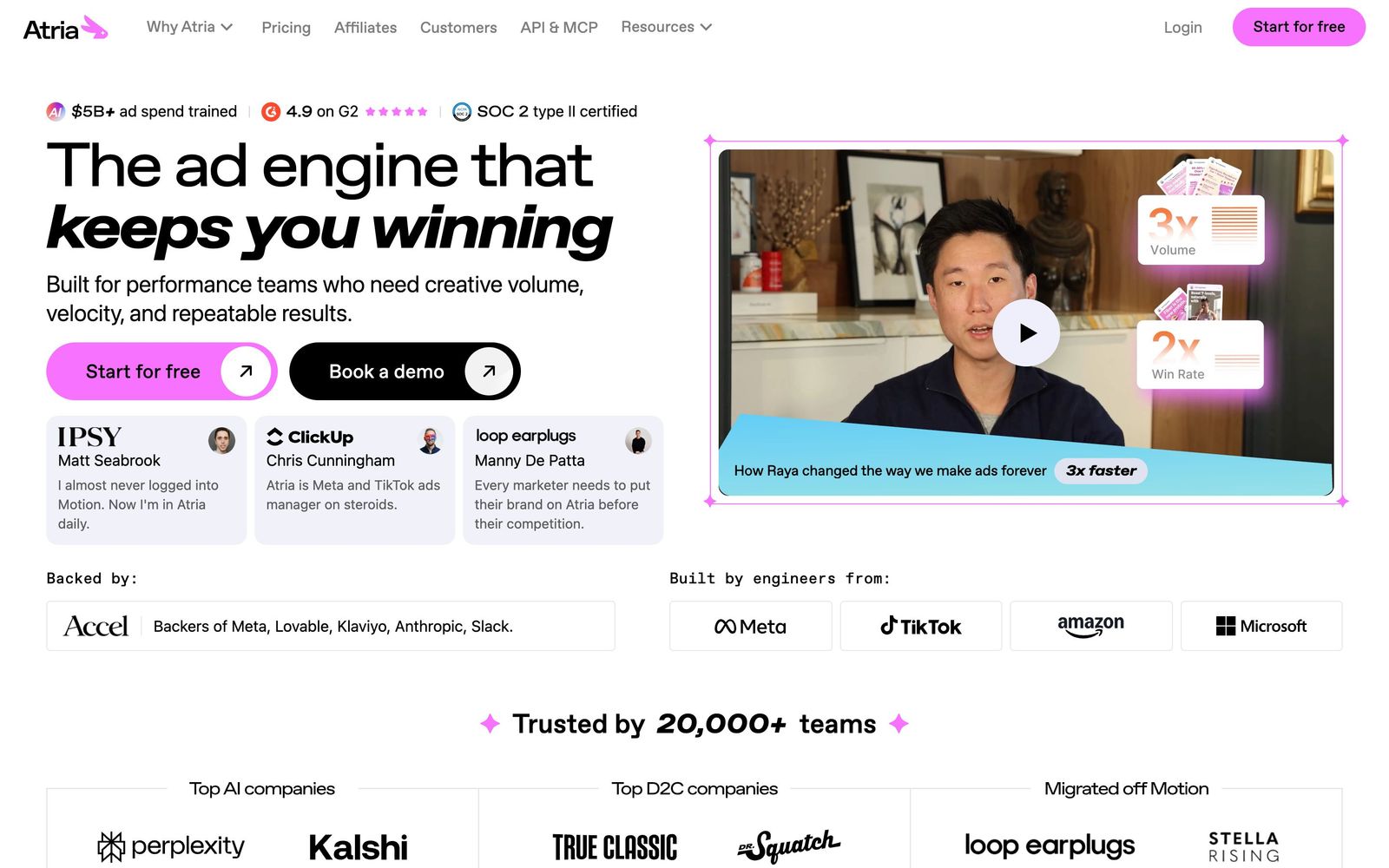
Atria pitches itself as an AI ad engine: one platform where performance marketers research competitor ads, analyze their own creative performance, generate new concepts, and manage assets. That is a crowded promise in 2026, with creative analytics and ad inspiration tools multiplying fast. This Atria review breaks down what the platform actually does for ad creative and optimization work, how its AI strategist differs from chat-style assistants, and which teams should shortlist it.
What Atria actually does
Atria connects directly to your Meta and TikTok ad accounts and organizes its features around four jobs. Research: a library of more than 25 million saved ads lets you search competitor creatives by brand, format, or theme, replacing manual trawling through public ad libraries. Analysis: the Radar AI engine examines your own ad performance and ties results back to creative elements, so you can see which hooks, formats, and angles are carrying your account. Creation: AI generation produces ad scripts and image variations from winning concepts. Management: a central asset hub keeps creatives, tags, and versions in one place instead of scattered cloud folders.
The newest layer is Raya, an AI creative strategist the company says is trained on over five billion dollars of ad spend data. Unlike prompt-driven assistants, Raya works proactively: it monitors competitors, auto-tags your creatives, surfaces insights, and drafts new ad concepts without being asked. How much of that proactivity translates into usable output varies by account, but the direction (an always-on junior strategist rather than a chatbot) is the product's clearest bet.

Key features
- 25M+ searchable ad library for competitor research and inspiration
- Radar AI performance analysis tied to creative elements, not just campaigns
- AI generation of ad scripts and image variations
- Raya: a proactive AI creative strategist that monitors, tags, and proposes concepts
- Central creative asset management with tagging
- Direct Meta and TikTok ad account connections
Who it's for
Atria is built for agencies and in-house performance teams whose main channels are Meta and TikTok and who ship new creatives weekly. The platform assumes meaningful ad spend and a steady testing cadence; that is where the research-analyze-create loop compounds. A small business running a couple of evergreen campaigns, or a team whose budget lives mostly on Google Search or programmatic display, will pay for machinery aimed at someone else's workflow.
How it compares
The most direct comparison is Motion, the creative analytics platform. Motion goes deeper on reporting and creative measurement (visual reports, granular video metrics) but is lighter on generation and structured competitor research. Atria trades some analytical depth for breadth: research, generation, and asset management live alongside analytics. Foreplay is the other frequent alternative; it excels at swipe files, briefs, and creative workflow, but it does not connect to your ad accounts for performance analysis the way Atria does. Teams sometimes pair Foreplay or Motion with other tools; Atria's pitch is that you will not need to.
Verdict
Atria is an ambitious, fast-moving attempt to collapse the performance creative stack into one product, and for Meta/TikTok-first teams the combination of a huge ad library, account-connected analytics, and a proactive AI strategist is genuinely compelling. The honest tradeoffs: it is a young platform still smoothing edges, AI usage is metered by credits, and channel coverage beyond Meta and TikTok is thin. If those two networks are where your budget lives, Atria belongs on your 2026 evaluation list alongside Motion and Foreplay; if they are not, look elsewhere first.
Ready to try Atria?
More marketers tools like Atria
Vibe
3.9Self-serve buying for streaming TV ads, with zip-code targeting and web analytics attribution.
Read Vibe review →ActiveCampaign
4.3Email marketing and automation platform with a built-in CRM, contact scoring, and SMS and WhatsApp sending.
Read ActiveCampaign review →AgencyAnalytics
4.3Client reporting for marketing agencies: 85+ connectors, white-label dashboards and scheduled reports.
Read AgencyAnalytics review →Bouncer
4.3Email verification and deliverability testing that strips invalid addresses before a send hurts your domain.
Read Bouncer review →Customer.io
4.3Behaviour-triggered messaging across email, SMS, push and in-app, built on your own event data.
Read Customer.io review →GetResponse
4.3All-in-one email marketing platform with automation, AI tools, webinars, and creator monetization features.
Read GetResponse review →