
Customer.io review
Behaviour-triggered messaging across email, SMS, push and in-app, built on your own event data.
The most capable lifecycle messaging platform below the enterprise tier and the most honest about its prices, though it assumes someone on the team is comfortable with Liquid and event schemas.
Pros
- Journeys branch on any event or attribute you send, so campaign logic can mirror product behaviour instead of list membership
- Email, SMS, push, in-app and webhooks run from one workflow, which keeps channel fallback logic in a single place
- Liquid templating allows conditional blocks, loops and calculations inside a message, removing the need for many near-duplicate templates
- Pricing is published openly, unusual in a category where competitors quote only through sales
- Data flows both ways through Segment, Snowflake, Amazon S3 and the API, so it fits an existing warehouse rather than replacing it
Cons
- Building even a straightforward welcome sequence takes longer than in list-based tools, because segments must be defined from events before anything sends
- Billing counts every uniquely identified profile, so a large dormant database costs the same as an active one and punishes low-frequency senders
- The entry plan caps profiles at a level most growing consumer apps pass quickly, and there is no free tier to grow into
Customer.io pricing
List prices in USD per month, taken from the vendor at review time.
| Plan | Per month | What it covers |
|---|---|---|
| Essentials | $100 | starting price; 5,000 profiles and 1 million emails a month, scaling with profile count |
What Customer.io actually does
Customer.io is a customer engagement platform that treats messaging as a consequence of behaviour rather than a scheduled send. Events and attributes arrive from a product, a warehouse or a customer data platform, and campaigns are built as journeys that watch for those signals: a trial started but no project created, a subscription about to lapse, a cart abandoned an hour ago. The journey then decides what to send, over which channel, and when to stop. Email, SMS, push notifications, in-app messages and outbound webhooks all run from inside that same workflow, so a fallback from push to email is a branch rather than a second campaign in a second tool.
Delivery is cloud-hosted and priced by the number of uniquely identified profiles in the account rather than by seats. Data movement is deliberately two-way. Segment, Salesforce, HubSpot, Amplitude, Mixpanel, Snowflake and Amazon S3 all connect natively, and the API and webhooks cover the rest, so the platform sits alongside an existing analytics stack instead of demanding to be the source of truth. Personalisation is written in Liquid, which allows conditional blocks, loops and arithmetic inside a single template, the reason one message here often replaces five variants elsewhere.
Key features
The product is a workflow engine with messaging attached, and its features follow from that shape.
- Visual journey builder with event triggers, delays, branching conditions and exit rules
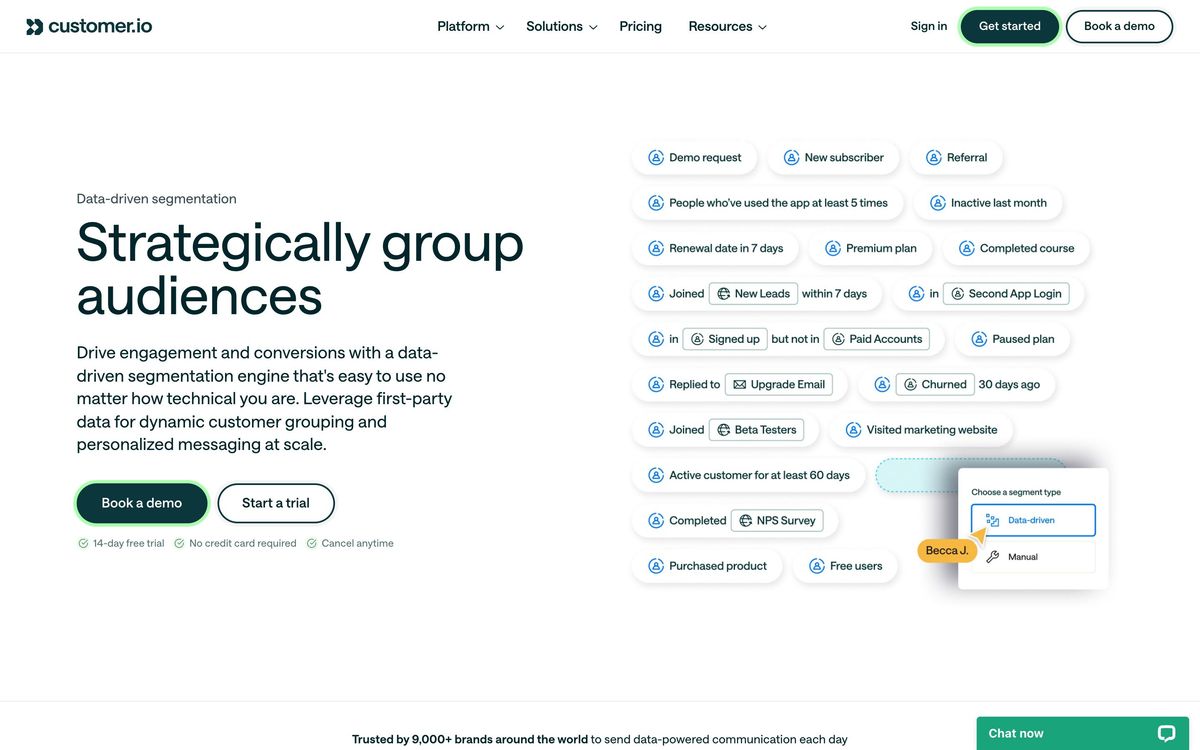
- Live segments computed from behavioural events, profile attributes and relational objects
- Email, SMS, push, in-app messages and webhooks orchestrated from one campaign
- Liquid templating for per-recipient conditional content and calculated values
- Data Pipelines for streaming events between the platform, warehouses and analytics tools
- Conversion goals, A/B testing and per-branch reporting inside campaign analytics
Who it's for
This suits product-led software companies, marketplaces and subscription apps where the interesting moments happen inside the product and someone technical can be pulled in to model them. The team shape that works best is a lifecycle marketer paired with an engineer or analyst who owns the event schema; that pairing gets more out of it than either would alone. Companies already running Segment or a warehouse are halfway set up on day one.
It is a poor fit for a small business that wants to write a newsletter and press send, or for an ecommerce team whose entire logic is store-based. The learning curve is not a matter of interface polish, it is that nothing sends until the data model is right, and teams without event tracking will spend their first month on instrumentation rather than campaigns. Profile-based billing also makes it an expensive home for a large, mostly inactive contact list.
How it compares
Braze is the enterprise version of the same idea, with deeper mobile tooling and a sales-led process that suits large consumer apps but prices out most mid-market teams. Iterable sits in similar territory with a friendlier campaign interface and less flexible data modelling. Klaviyo wins outright for pure ecommerce, where its native store data and revenue attribution do work Customer.io would need custom events to replicate. Against all three, Customer.io's argument is accessibility: comparable journey logic, published pricing, and no procurement cycle before the first campaign ships.
Verdict
Customer.io has earned its position as the default choice for teams that outgrew list-based email tools but do not want an enterprise contract. The journey builder handles genuinely complicated logic without falling apart, the multi-channel orchestration is real rather than bolted on, and publishing prices in a category built on opaque quotes counts for something. The caveat is the one every honest review reaches: this is a technical product wearing a marketing product's clothes. Teams without clean event data or someone who can write Liquid will find the first weeks slow, and organisations with very large, lightly engaged databases should model the profile-based cost carefully before committing.
Ready to try Customer.io?
More marketers tools like Customer.io
Sender
4.1Email and SMS marketing for small stores and newsletters, with automation included on the free plan.
Read Sender review →Campaigner
3.7Long-running email and SMS platform with multivariate testing and workflow automation for mid-sized senders.
Read Campaigner review →CleverTap
4.2Behavioural analytics and cross-channel campaigns for teams whose customers live inside a mobile app.
Read CleverTap review →SimpleTexting
4.2SMS campaigns and a two-way texting inbox for teams that want mass sends and real replies in one place.
Read SimpleTexting review →RGE Studio
4.1Drag-and-drop email and landing page builder that exports into whichever platform you already send from.
Read RGE Studio review →Brevo
4.0Email, SMS, WhatsApp and a light CRM on one bill, priced by messages sent rather than contacts stored.
Read Brevo review →