
Brevo review
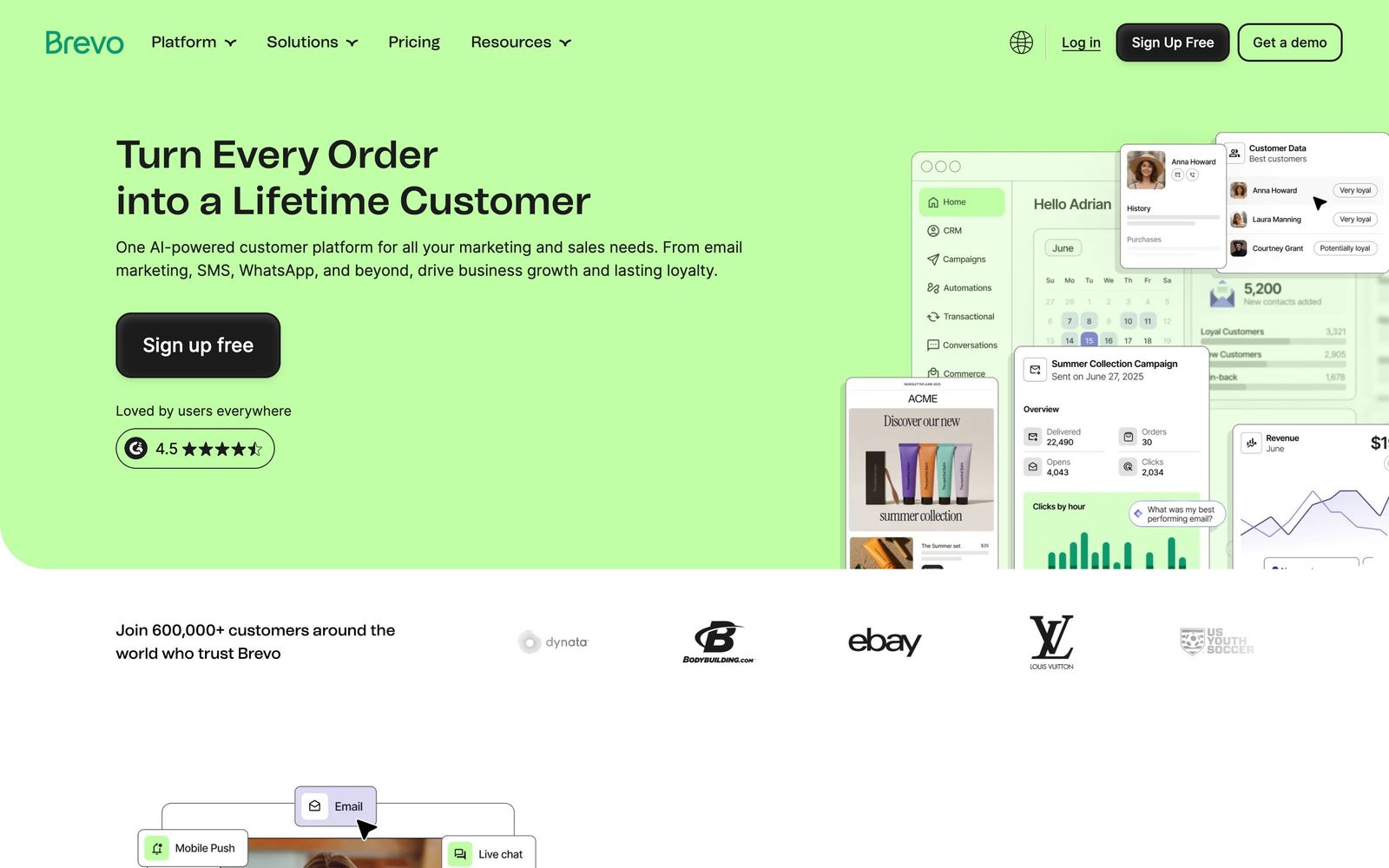
Email, SMS, WhatsApp and a light CRM on one bill, priced by messages sent rather than contacts stored.
The cheapest sensible home for a large list that is emailed infrequently, though the editor, templates and automation depth trail Klaviyo and ActiveCampaign.
Pros
- Billing counts emails sent rather than contacts stored, so a large dormant list costs nothing to keep.
- The free plan has a daily send allowance and no meaningful contact ceiling, which almost no rival matches.
- Email, SMS, WhatsApp, on-site chat and a CRM sit behind one login and one invoice.
- Transactional sending over SMTP and API is part of the same account instead of a separate product.
- The company is French and EU-based, which simplifies the processor question for teams under GDPR scrutiny.
Cons
- Removing Brevo branding from email footers is a paid extra on the entry tier rather than included.
- Daily sending caps on the lower plans force a single large campaign to be split across several days.
- Automation branching, reporting and the template library are visibly thinner than ActiveCampaign's or Klaviyo's.
Brevo pricing
List prices in USD per month, taken from the vendor at review time.
| Plan | Per month | What it covers |
|---|---|---|
| Free | Free | 300 emails a day, Brevo branding on messages |
| Starter | $9 | from, for 5,000 emails a month; logo removal is a paid add-on |
| Standard | $18 | from; adds A/B testing, landing pages and advanced reporting |
What Brevo actually does
Brevo, previously called Sendinblue, is a marketing and communication platform built around one pricing decision: it charges for messages sent, not for contacts stored. Almost every competitor bills on list size, which punishes a business holding a decade of accumulated addresses it emails four times a year. Brevo inverts that, and the free plan carries a daily send allowance with no serious contact ceiling. The company reports use by around 600,000 businesses.
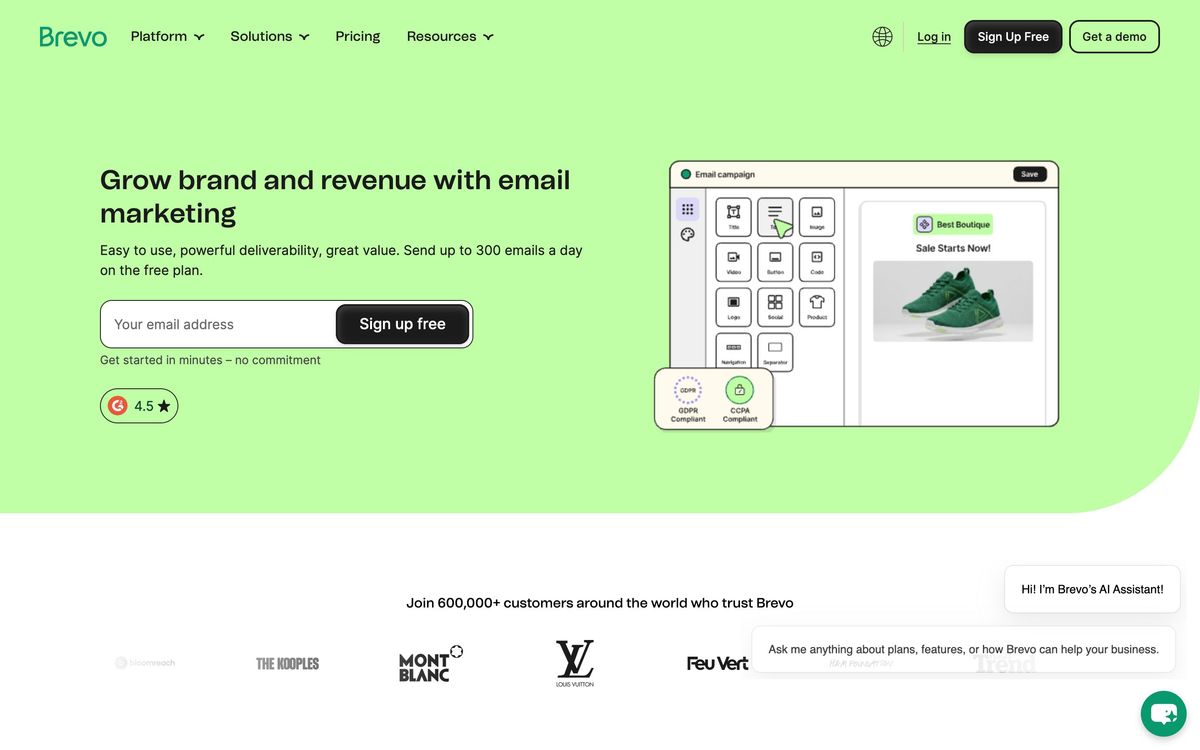
What sits on top of that model is broad rather than deep. Email campaigns with a drag-and-drop builder, segmentation and scheduling form the core. Around it are SMS and WhatsApp campaigns against the same contact record, on-site chat, signup forms, landing pages, and a CRM with deal pipelines, tasks and meeting booking. Automation ties them together through workflows triggered by site behavior, form submissions or purchases. There is also a transactional sending service over SMTP and API, included in the same account rather than sold separately, which is unusual and useful for a small team that would otherwise buy a second product for receipts and password resets.
Key features
The modules a small team is most likely to use in the first month.
- Drag-and-drop email builder with segmentation, scheduling and send-time controls
- Automation workflows triggered by behavior, form fills and purchase events
- SMS and WhatsApp campaigns sharing the contact record with email
- CRM with deal pipelines, task assignment and a meeting booking page
- Transactional email over SMTP and API with per-message delivery logs
- Landing pages, embeddable forms and on-site chat
Who it's for
Brevo makes most sense for a business with a big list and a small send calendar: a membership body, a local retailer, a professional services firm with years of accumulated contacts. It also suits a founder consolidating three subscriptions into one, since the CRM and transactional sending are competent enough to retire cheap standalone tools even though neither would win on its own merits.
It is a bad fit for a high-volume ecommerce sender, where the volume model stops being cheap and the automation library cannot match a purpose-built rival. It is also frustrating for a design-led brand, because the template set is dated and the editor resists precise layouts. Teams that need genuinely complex branching, revenue attribution per flow, or predictive segmentation should budget for a specialist instead.
How it compares
Mailchimp is the obvious reference point and now costs considerably more at the same list size, with better templates and a much larger integration ecosystem. Klaviyo is the right answer for ecommerce specifically, where its purchase-data segmentation and flow reporting are in a different class, and its price reflects that. ActiveCampaign beats Brevo on automation logic and CRM depth while charging on contact count, which reverses the economics for a large quiet list. MailerLite is the closest challenger on price with a nicer editor, fewer channels and no transactional service. Brevo's argument against all four is the same: more channels for less money, at the cost of polish.

Verdict
Brevo is a rational purchase rather than a pleasurable one. The volume pricing genuinely saves money for the specific shape of business it targets, the channel spread is unusually wide for the price, and having transactional sending in the same account removes a recurring nuisance. What it does not do is feel modern: the template library is tired, the automation builder runs out of room quickly, and reporting answers fewer questions than a marketer will eventually ask. The branding removal charge on the entry tier is a small irritation that reads worse than it costs. For a team whose priority is covering several channels affordably, it is a sound choice; for a team whose growth depends on sophisticated lifecycle marketing, it will become the constraint within a year.
Ready to try Brevo?
There's a free tier, so you can test it before committing.
More marketers tools like Brevo
GetResponse
4.3All-in-one email marketing platform with automation, AI tools, webinars, and creator monetization features.
Read GetResponse review →CleverTap
4.2Behavioural analytics and cross-channel campaigns for teams whose customers live inside a mobile app.
Read CleverTap review →RGE Studio
4.1Drag-and-drop email and landing page builder that exports into whichever platform you already send from.
Read RGE Studio review →Sender
4.1Email and SMS marketing for small stores and newsletters, with automation included on the free plan.
Read Sender review →InboxAlly
4.0Deliverability repair service that rebuilds sender reputation with seed inboxes, placement tests and DNS checks.
Read InboxAlly review →Moosend
4.0Email marketing and automation priced per contact, with unlimited sends and a strict list policy.
Read Moosend review →