
ActiveCampaign review
Email marketing and automation platform with a built-in CRM, contact scoring, and SMS and WhatsApp sending.
The deepest automation builder in its price band for non-retail businesses, though contact-based pricing climbs faster than most teams plan for.
Pros
- Automation canvas handles branching conditions, goals, waits and split tests that simpler senders cannot express
- Built-in CRM means lead scoring, deal creation and follow-up tasks happen in the same tool as the email
- Independent inbox-placement testing puts deliverability among the stronger mainstream senders
- Around a thousand native app connections, including order-level syncs for Shopify and WooCommerce
- Prebuilt automation recipes shorten setup for onboarding, cart recovery and re-engagement flows
Cons
- Billing counts contacts stored, not emails sent, so an unpruned list raises the invoice even when send volume is flat
- The entry plan caps automations at five actions and one user, which pushes most real use up at least one tier
- Reviewers repeatedly report friction cancelling or claiming refunds at the trial-to-paid boundary
ActiveCampaign pricing
List prices in USD per month, taken from the vendor at review time.
| Plan | Per month | What it covers |
|---|---|---|
| Starter | $15 | 1,000 contacts, billed annually |
| Plus | $49 | 1,000 contacts, billed annually |
| Pro | $79 | 1,000 contacts, 3 users, billed annually |
| Enterprise | $145 | 1,000 contacts, 5 users, billed annually |
What ActiveCampaign actually does
ActiveCampaign is an email marketing and automation platform with a light CRM attached. The centre of it is a visual automation canvas: a contact enters on a trigger, such as a form submission, a purchase, a tag or a page visit, then moves through conditions, waits, splits and actions until they exit. Around that canvas sit the pieces that feed it, including campaign sending, landing pages and forms, contact scoring, site and event tracking, and SMS and WhatsApp as additional channels on the higher plans. The sales side adds pipelines, deal stages and automated task creation, which is enough for a founder-led sales motion but not a substitute for a full CRM once several representatives work the same accounts.
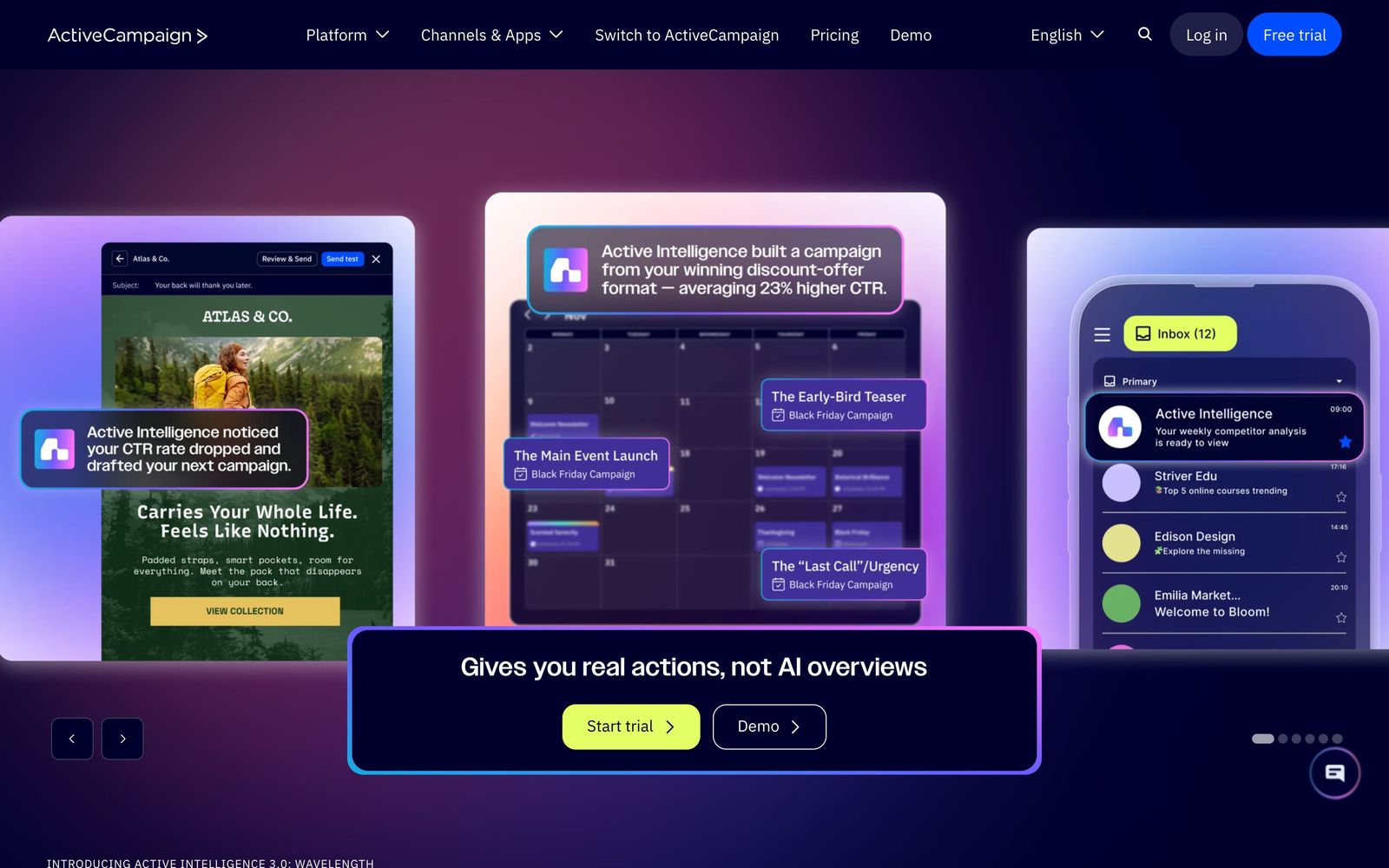
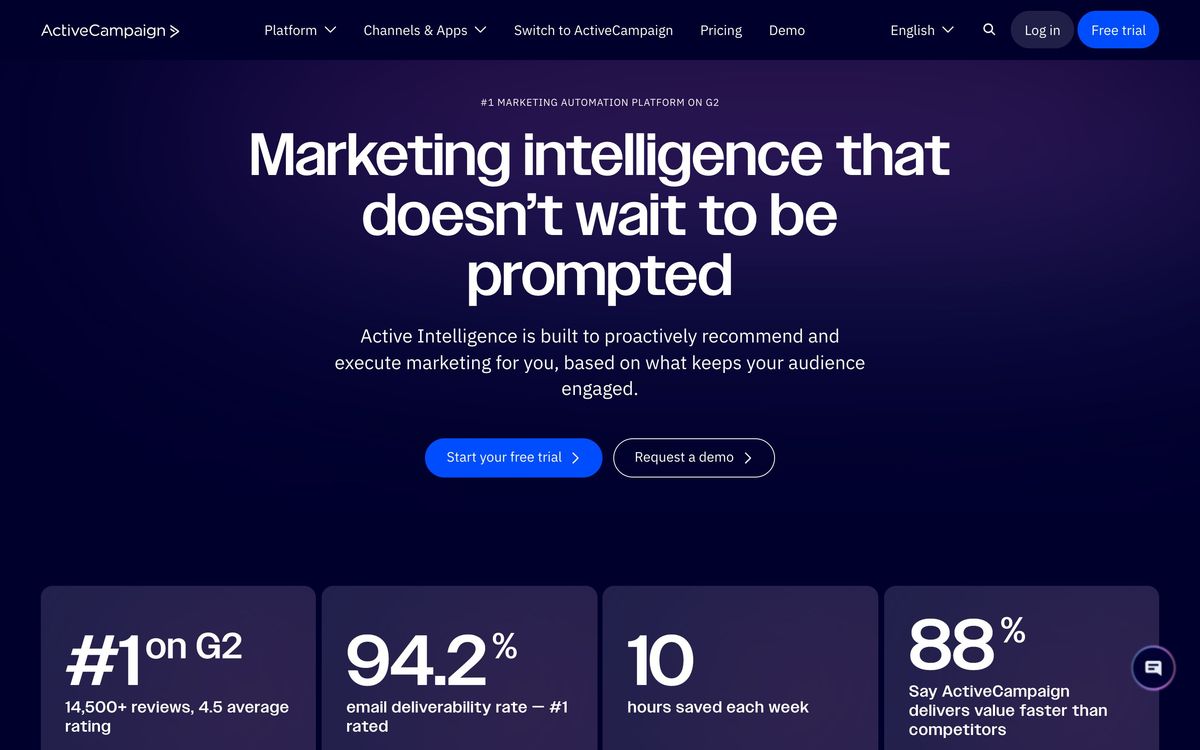
The company has spent the past two years pushing AI into the product under the Active Intelligence name: drafting campaigns against a stored brand kit, carrying instructions between workflows, and running scheduled tasks without a person starting them. How much of that is available depends on the plan, since the entry tier caps automation actions and segmentation while the AI features are metered above it. Everything runs in the browser, and billing is based on the number of contacts stored rather than the number of emails sent, which is the single most important thing to understand before signing up.
Key features
The parts that carry the daily work:
- Visual automation builder with branching conditions, goals, waits and split tests
- Contact scoring and behavioural site tracking that feed segmentation rules
- CRM with pipelines, deal stages and automated task creation
- SMS and WhatsApp sending from inside the same automations as email
- Landing pages, forms and a library of prebuilt automation recipes
- Order-level e-commerce syncs with Shopify and WooCommerce
Who it's for
ActiveCampaign suits a small marketing team, or a founder doing the marketing, that has outgrown broadcast newsletters and wants behaviour to decide what gets sent. The natural fit is B2B, SaaS and considered-purchase service businesses, where a lead's page visits and email replies should change the next message and open a deal record. Agencies get on well with it too, because one login can hold several client accounts and automation recipes travel between them.
Two groups should look elsewhere. A business that sends one newsletter a week will pay for a machine it never starts, and a plain sender does that job for less. A store whose revenue depends on product-level behaviour, such as browse abandonment by item, predicted lifetime value or catalogue blocks inside the email, will find the retail reporting thinner than a dedicated commerce platform even with the Shopify sync running.
How it compares
Mailchimp is easier to learn and cheaper at the bottom, but its automation stops short of the conditional branching and goal tracking ActiveCampaign treats as ordinary. Klaviyo wins for online stores, because its data model is built around orders and catalogues and its revenue attribution is native rather than approximated. HubSpot has the genuinely better CRM and the cleaner interface, and charges several times more once marketing automation is included. ActiveCampaign occupies the gap between them: most of HubSpot's automation logic at a fraction of the cost, with a CRM that is adequate rather than central.
Verdict
For a team that will actually build multi-step flows, ActiveCampaign still offers the most automation per dollar on the market, and its deliverability record supports putting real revenue through it. The caveat is the bill. Contacts are counted whether or not they are mailed, the entry tier's limits are tight enough to force an upgrade within months, and the cancellation process has a long public record of complaints. Buy it because automation is the point; skip it if the job is a newsletter with a nice template.
Ready to try ActiveCampaign?
More marketers tools like ActiveCampaign
Brevo
4.0Email, SMS, WhatsApp and a light CRM on one bill, priced by messages sent rather than contacts stored.
Read Brevo review →CleverTap
4.2Behavioural analytics and cross-channel campaigns for teams whose customers live inside a mobile app.
Read CleverTap review →RGE Studio
4.1Drag-and-drop email and landing page builder that exports into whichever platform you already send from.
Read RGE Studio review →Sender
4.1Email and SMS marketing for small stores and newsletters, with automation included on the free plan.
Read Sender review →InboxAlly
4.0Deliverability repair service that rebuilds sender reputation with seed inboxes, placement tests and DNS checks.
Read InboxAlly review →Moosend
4.0Email marketing and automation priced per contact, with unlimited sends and a strict list policy.
Read Moosend review →