
Bïrch review
Rule-based automation and bulk campaign management for Meta, Google, TikTok and Snapchat ad accounts.
The strongest automated-rules engine for paid social buyers managing real spend, though pricing tracks ad spend and the rules that justify the product only appear on the second tier.
Pros
- Automated rules run continuously against live account data and can pause, scale, duplicate or rebudget campaigns without a person watching a dashboard
- Official partner status with Meta, Google, TikTok and Snapchat means the API access is sanctioned rather than scraped
- Bulk creation tools launch and duplicate campaigns across accounts and networks in one pass instead of one interface at a time
- Slack alerts and scheduled reports push performance changes to where the team already works
- Custom metrics and timeframes let rules act on blended or downstream numbers rather than only on platform-reported cost per action
Cons
- Automated rules, the reason most buyers evaluate the product, are absent from the entry plan and only start on the middle tier
- Pricing scales with total monthly ad spend across connected accounts, so a good quarter raises the software bill even when the workload is unchanged
- Below roughly five figures of monthly spend the subscription rarely pays for itself, and the native rule engines inside Meta and Google cover the simple cases free
Bïrch pricing
List prices in USD per month, taken from the vendor at review time.
| Plan | Per month | What it covers |
|---|---|---|
| Essential | $49 | up to $10K monthly ad spend; workspaces, post boosting, reports, Slack, no automated rules |
| Pro | $99 | adds automated rules, Explorer, Launcher, custom metrics and Audience Builder; overage charged as spend grows. Enterprise is quote-only. 14-day trial on all plans |
What Bïrch actually does
Bïrch, which spent most of its life as Revealbot, automates the repetitive parts of buying paid social. The centrepiece is a rules engine: conditions written against live account data, cost per acquisition over a window, return on ad spend, frequency, spend pace, that trigger actions on campaigns, ad sets and ads. A rule can pause an ad set that has spent past a threshold without converting, raise budget on one clearing a target return, duplicate a winner into a new audience, or reset a bid. Rules run on a schedule against connected accounts, so the account keeps being managed at three in the morning without anyone logged in.
Around that sit the tools a media buyer needs to work at scale. Bulk creation launches and duplicates campaigns across networks in a single pass. Creative reporting groups performance by asset so a team can see which images and videos are carrying an account. Dashboards and scheduled reports cover multiple accounts at once, with custom metrics and timeframes for numbers the ad platforms do not report natively. Slack integration pushes alerts and rule actions into a channel. The company holds official partner status with Meta, Google, TikTok and Snapchat, and a separate server-side gateway forwards conversion events, priced by event volume rather than by seat.
Key features
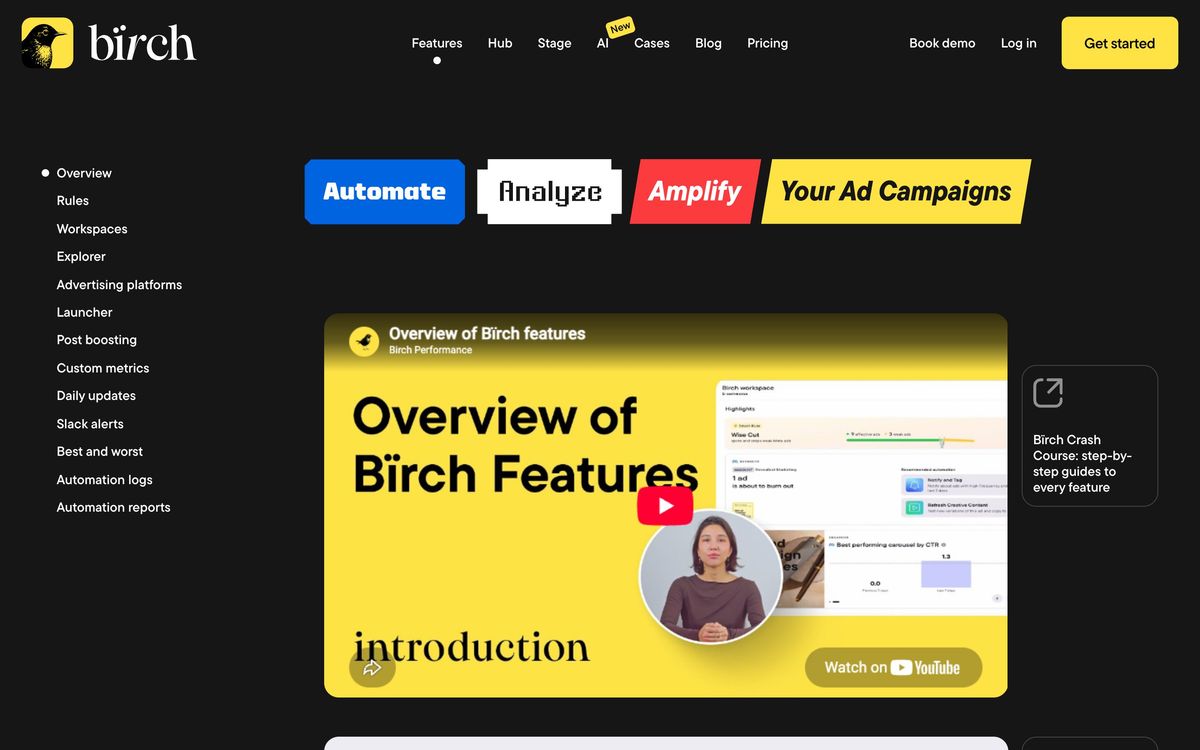
The product is organised around doing the same thing to many campaigns at once.
- Automated rules and chained strategies that scale, pause, duplicate or rebudget on performance conditions
- Bulk campaign, ad set and ad creation across Meta, Google, TikTok and Snapchat
- Creative performance analysis grouping results by asset rather than by campaign
- Custom metrics, custom timeframes and cross-account dashboards
- Slack alerts and scheduled report delivery covering rule actions and account changes
- Audience building and post boosting for organic content that performs
Who it's for
This is a tool for people whose job title includes media buying. Agencies running many client accounts, in-house performance teams with several markets, and affiliate or ecommerce operators managing continuous spend all hit the same wall: the number of manual checks per day grows faster than the team. Rules absorb that work, and the value is proportional to how many accounts and how much budget are under management. Buyers running structured tests with disciplined naming conventions get the most out of it, because rules depend on being able to target the right objects reliably.
It is not for a small advertiser. A business spending a few thousand a month across one Meta account can get most of the benefit from the rule features built into Ads Manager, which cost nothing, and will not recover a subscription that rises with spend. It is also a poor fit for teams whose problem is creative rather than operational: Bïrch will manage budgets efficiently around weak assets without improving them. And because the entry plan omits rules entirely, anyone evaluating on price alone risks buying the tier that does not solve their problem.
How it compares
Madgicx bundles automation with creative analysis and an AI recommendation layer, which suits smaller ecommerce advertisers who want opinions as well as controls, but its rule logic is less granular. AdEspresso is simpler and cheaper, aimed at split-testing Meta campaigns for small businesses, and does not attempt cross-network automation at Bïrch's depth. Smartly.io covers similar ground for enterprise buyers with creative production built in, at contract sizes that put it in a different market entirely. Against these, Bïrch's argument is the rules engine itself: more conditions, more actions, more networks, and pricing that starts well below the enterprise tools.
Verdict
Bïrch does the specific thing it claims, and reviewers consistently report the same benefit, hours of manual account babysitting removed, with budget controls that behave predictably. For an agency or an in-house team past the point where manual management scales, that is worth paying for. Two caveats keep the rating where it is: the pricing is tied to ad spend rather than to usage, which makes the cost of a good month feel like a penalty, and the entry plan is missing the automation that defines the product, so the real starting price is the second tier rather than the advertised one.
Ready to try Bïrch?
More marketers tools like Bïrch
WhatConverts
4.3Tracks calls, forms, chats and transactions back to the campaign that produced them, in one lead log.
Read WhatConverts review →Databox
4.2Analytics platform pulling 130+ data sources into dashboards, automated reports, goals, AI-queried metrics.
Read Databox review →Survicate
4.1Customer feedback platform for website, in-product, email and link surveys with AI theme analysis.
Read Survicate review →CallRail
4.0Call, text and form tracking that ties every inbound lead back to the campaign, keyword or page that produced it.
Read CallRail review →Similarweb
4.0Estimated traffic, channel mix and audience data for any website or app, used for competitive and market research.
Read Similarweb review →Crazy Egg
3.9Heatmaps, scrollmaps and session recordings for finding out where a page loses visitors before they convert.
Read Crazy Egg review →