
Survicate review
Customer feedback platform for website, in-product, email and link surveys with AI theme analysis.
A well-built multichannel survey tool that gets NPS and in-product feedback running in an afternoon, though the response caps and shallow cross-analysis show up quickly once a programme gets serious.
Pros
- One survey can run across a website widget, an in-product prompt, an email and a shared link, and all of the answers land in the same report
- Built-in email sending means a survey campaign does not have to be routed through a separate marketing tool to reach a list
- The Research Hub clusters open-text answers into themes automatically, which is the part of feedback work that usually gets skipped
- Survey targeting by user attributes and product events comes on the entry plan rather than being reserved for enterprise tiers
- Results can be filtered by CRM attributes, so NPS can be read by plan, segment or account owner rather than in aggregate
Cons
- The entry plan is capped at 250 responses and 1,000 data points a month, which a single well-placed website survey can exhaust in days
- There is no standing free plan, the only free access is a ten-day trial limited to 25 responses
- Reviewers consistently describe the analytics as thin on larger datasets: limited cross-analysis, limited filtering, and one dashboard on the entry tier
Survicate pricing
List prices in USD per month, taken from the vendor at review time.
| Plan | Per month | What it covers |
|---|---|---|
| Growth | $114 | from, billed annually; 250 responses a month, 10 seats, 25+ integrations |
| Pro | $349 | from; custom annual response pool, CSS branding, 10 dashboards |
| Enterprise | $569 | from; custom response pool, SAML SSO, access logs, custom terms |
What Survicate actually does
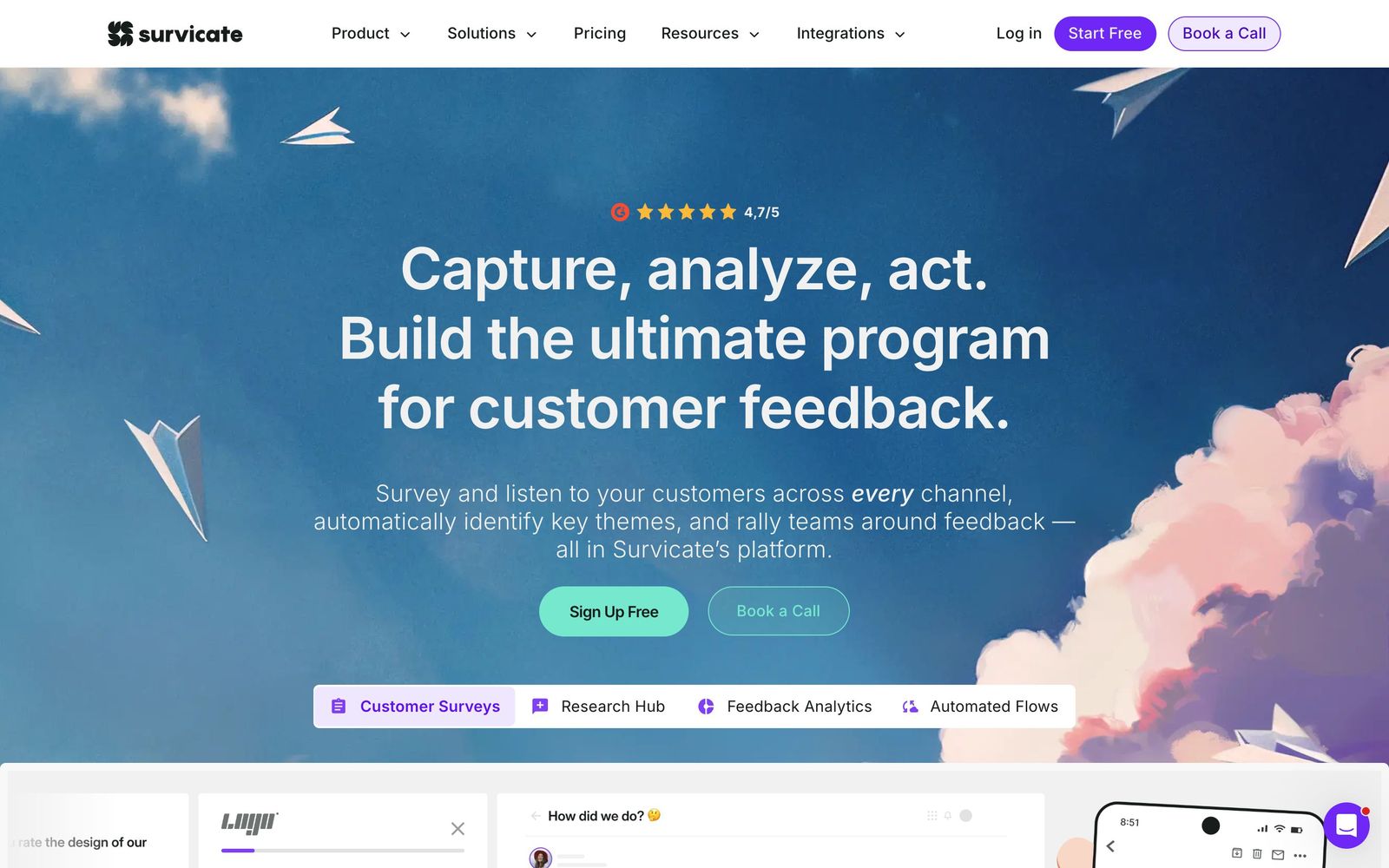
Survicate collects customer feedback in the places where customers already are, rather than asking them to visit a survey page. The same questionnaire can appear as a website pop-up, as a prompt inside a product, as questions embedded in an email, or as a plain shared link, and every response lands in one report regardless of route. The company sends survey email itself, so a list campaign does not need to be handed to a marketing platform first, and targeting can key off user attributes or product events rather than page URLs alone.
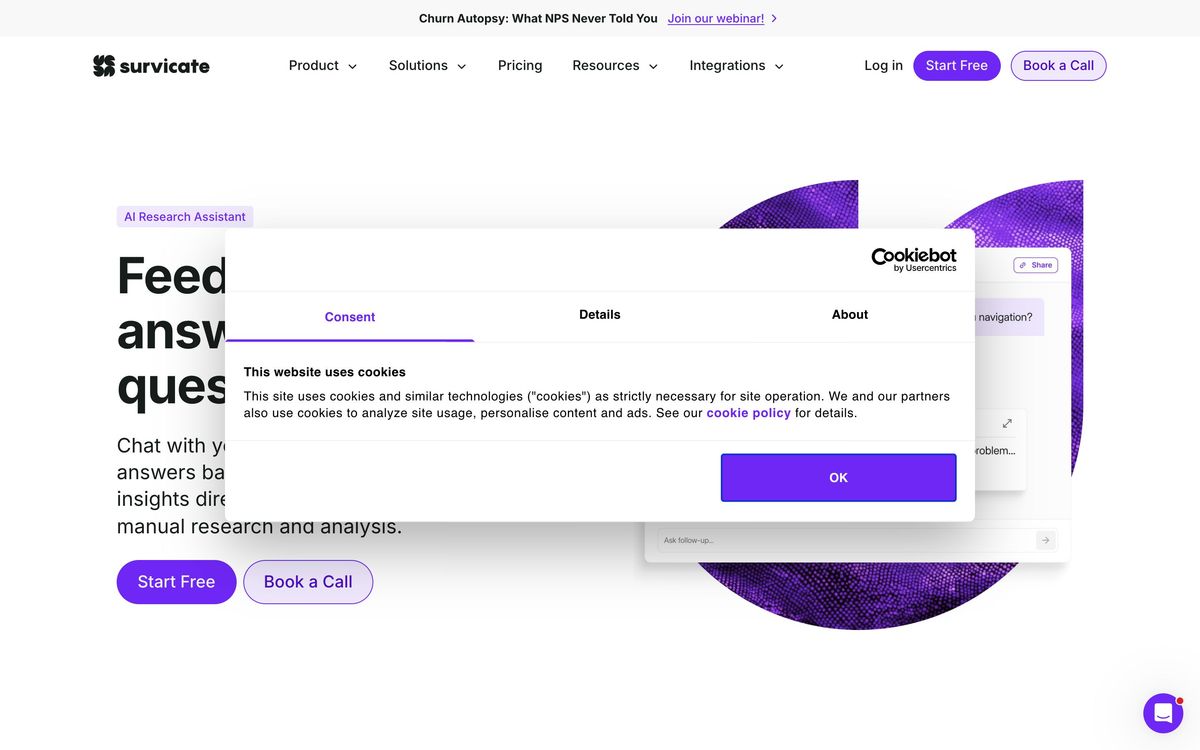
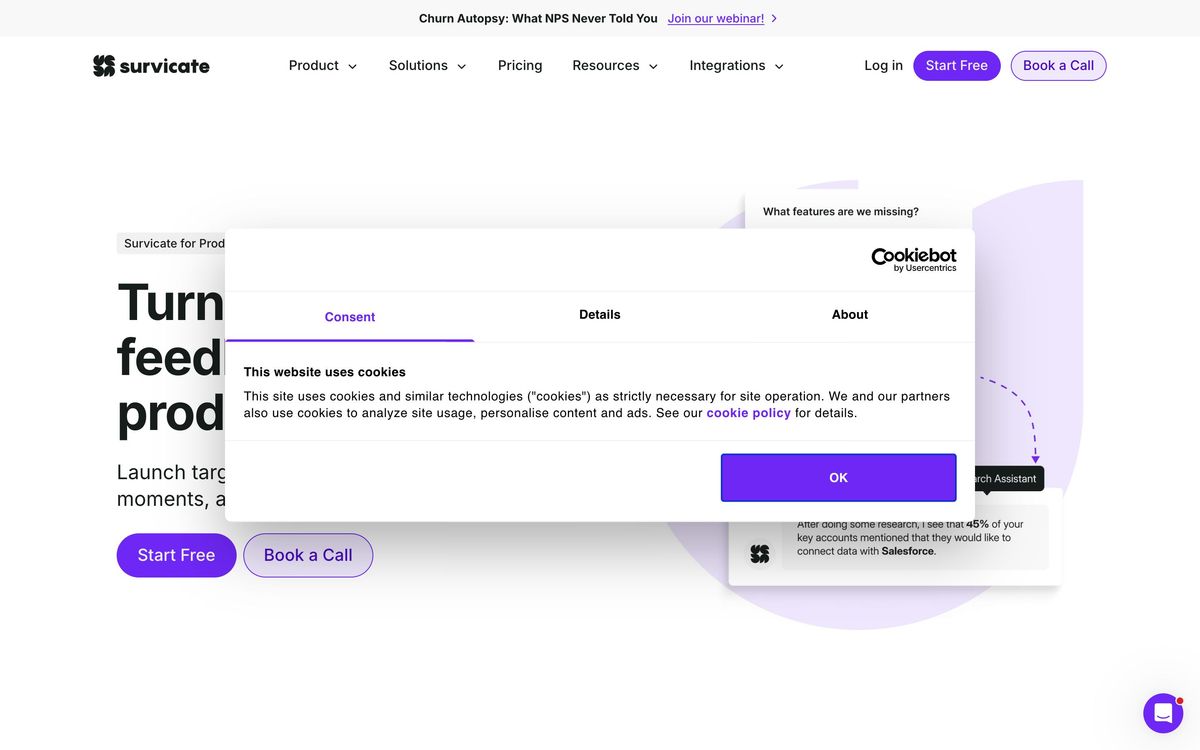
The second half of the product is what happens to the answers. Open text is the part of feedback work most teams collect and then never read; Survicate's Research Hub clusters it into themes automatically, scores sentiment, and lets an assistant summarise across studies. Results can be filtered by attributes pulled from a CRM or marketing automation tool, which turns a single aggregate score into something a team can act on, an NPS reading per plan, per segment, per account owner. The platform reports use by several thousand teams, including Spotify, Automattic and Vercel.
Key features
The design assumes a continuous feedback programme rather than an occasional research project.
- Website, in-product, mobile, email and link surveys, unified into one response set
- Pre-built NPS, CSAT, CES and product-market-fit templates, plus an AI builder that drafts questions and imports existing surveys
- Research Hub theme categorisation and sentiment analysis over open-text answers
- Targeting by user attribute and product event, with branching logic based on earlier answers
- Filtering of results by CRM and marketing-automation attributes for segment-level reading
- Webhooks, an export API and native connections to HubSpot, Salesforce, Zendesk, Slack, Mailchimp and Klaviyo
Who it's for
The natural buyer is a mid-sized software or ecommerce company where one team owns customer feedback across the lifecycle: onboarding surveys, in-app prompts, churn questionnaires, a rolling NPS. Setup is fast enough that a non-technical marketer can have something live the same day, and the CRM filtering makes results readable by people who do not want to open a research tool.
It is a bad match for formal research. Anyone running structured studies with quotas, panels and statistical rigour will find the analysis layer too shallow, cross-tabulation and filtering are where reviewers consistently run out of road. It also does not suit a high-traffic consumer site on a small budget, because the entry plan's monthly response cap will be reached long before the month is. Teams that need a permanently free option should look elsewhere: the only free access is a short trial.
How it compares
Typeform makes better-looking standalone surveys and has the stronger brand, but it is form-first and weak at in-product triggering and continuous measurement programmes. Hotjar bundles feedback widgets with heatmaps and session recordings at a lower price, and its analysis of open-text feedback is nowhere near the Research Hub. Qualtrics is the serious research platform in this comparison, quotas, advanced statistics, panel management, at a price and implementation weight that puts it out of reach for most teams buying a survey tool this quarter. Survicate is the middle option, and behaves like one.
Verdict
For teams that want feedback flowing continuously into the tools they already use, this is a sensible and quick purchase, and the automatic theme analysis genuinely saves the work it claims to. The rating stops short of the top of the category because the limits arrive early: response allowances that a busy site will breach, analytics that flatten once the dataset grows, and a pricing ladder where the step from the entry plan to real capacity is substantial. Budget by expected response volume, not by seats, before committing to a year.
Ready to try Survicate?
More marketers tools like Survicate
WhatConverts
4.3Tracks calls, forms, chats and transactions back to the campaign that produced them, in one lead log.
Read WhatConverts review →Databox
4.2Analytics platform pulling 130+ data sources into dashboards, automated reports, goals, AI-queried metrics.
Read Databox review →Bïrch
4.0Rule-based automation and bulk campaign management for Meta, Google, TikTok and Snapchat ad accounts.
Read Bïrch review →CallRail
4.0Call, text and form tracking that ties every inbound lead back to the campaign, keyword or page that produced it.
Read CallRail review →Similarweb
4.0Estimated traffic, channel mix and audience data for any website or app, used for competitive and market research.
Read Similarweb review →SurveyMonkey
4.0Survey and form platform with built-in analysis, a paid respondent panel and connectors into CRM and BI tools.
Read SurveyMonkey review →