
Similarweb review
Estimated traffic, channel mix and audience data for any website or app, used for competitive and market research.
The most complete view of a competitor's digital footprint available without their analytics access, though the estimates degrade badly on smaller sites and the pricing is sales-gated.
Pros
- Traffic, channel split, referrers and audience overlap for sites the buyer has no analytics access to
- Roughly a decade of history, which makes trend and seasonality work possible rather than guesswork
- Coverage spans web, mobile apps, retail listings, advertising and AI assistant citations in one account
- Data can be pushed into Snowflake, Databricks, Looker Studio, Tableau and Power BI rather than living in the interface
- The free web view and browser extension are enough for occasional one-off checks
Cons
- Estimates for sites under about a hundred thousand monthly visits are unreliable, with independent studies reporting error rates above fifty percent
- Pricing is not published; even the self-serve tier is presented through a sales conversation, and useful filters such as country breakdowns sit on higher packages
- Trial-to-paid billing and cancellation complaints are a persistent theme on independent review sites
What Similarweb actually does
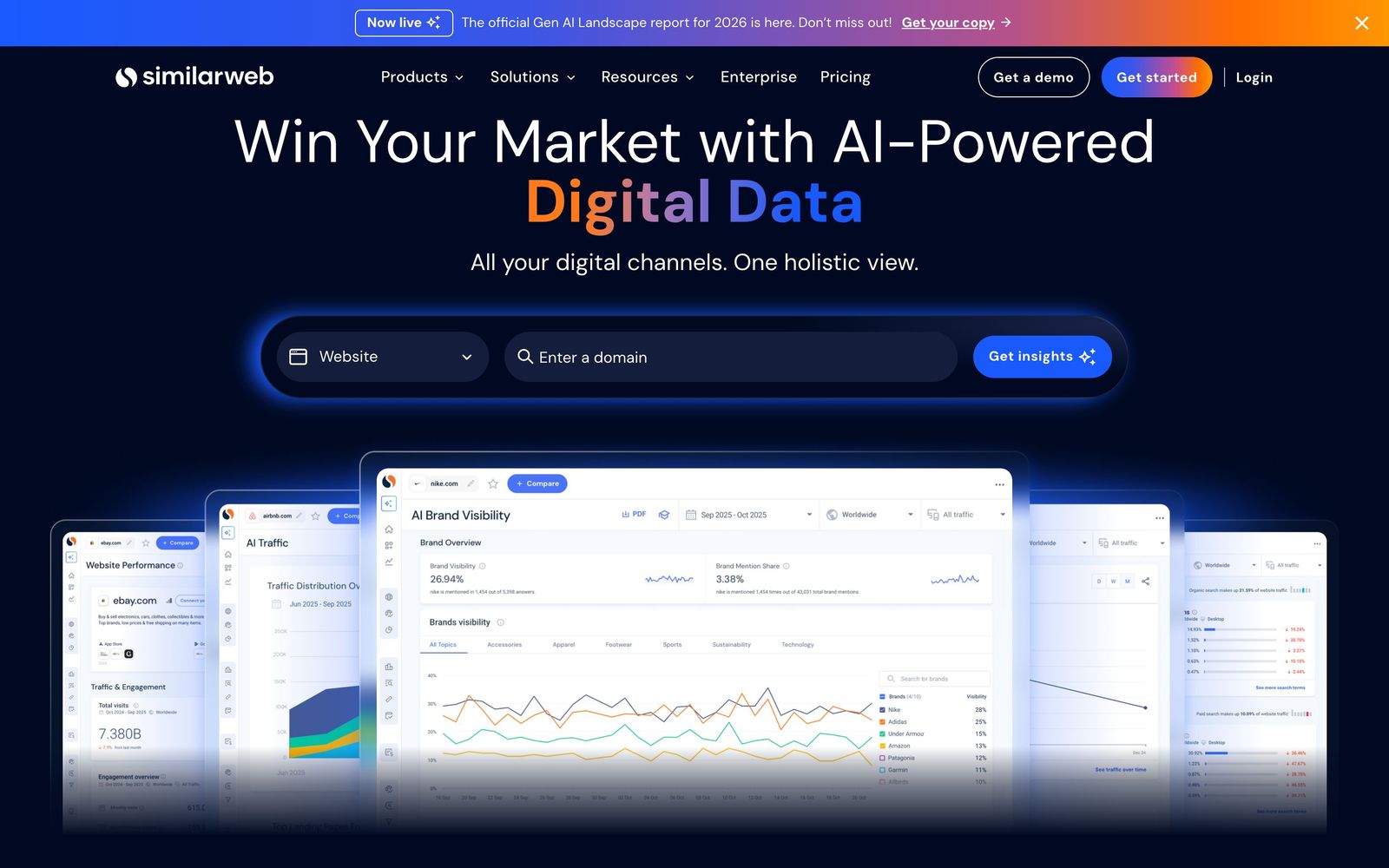
Similarweb estimates what happens on websites and apps that the buyer does not own. Type in a domain and it returns monthly visits, visit duration, pages per visit and bounce rate, then breaks the traffic into channels: organic search, paid search, referrals, social, display, email and direct. It names the top referring sites, the keywords that bring in search traffic, the ads running against them and the audience overlap with other properties. The same treatment extends to mobile apps, to retail categories and marketplace listings, and more recently to brand mentions and citations inside AI assistants.
None of this is measured directly. Similarweb builds a panel from a mixture of clickstream contributions, public data and partnerships, then models a full picture from that sample. That construction is the whole story of the product's usefulness and its limits, and it explains why a well-trafficked consumer site produces figures close to its own analytics while a small B2B site can be out by a large multiple. The platform is sold as a set of modules rather than one product: web intelligence for research, sales intelligence for prospecting and enrichment, app intelligence, retail intelligence, advertising intelligence and a search suite. Data can stay in the interface or be pushed through the API into a warehouse or a business intelligence tool.
Key features
The modules below cover what most subscriptions are actually bought for.
- Traffic and engagement estimates for over a hundred million sites, with about a decade of history
- Channel breakdown across search, referral, social, display, email and direct
- Keyword research, rank tracking and site audits for organic and paid search
- App intelligence with downloads, active usage and audience demographics
- Retail intelligence covering category demand, marketplace share and digital shelf data
- AI search visibility tracking for brand citations inside AI assistants
Who it's for
Similarweb is at its best in market-level and competitor-level work: sizing a category, watching a rival's channel mix change, building a target list of sites by traffic band, or briefing a strategy deck with numbers nobody else can produce. Agencies use it in pitches, corporate strategy teams use it for diligence, and sales teams use the intelligence module to score accounts by digital footprint. Anyone who needs to describe a market they are not inside will get value.
It is a bad purchase for a small site owner checking a handful of niche competitors. Below about a hundred thousand monthly visits the estimates carry error rates that make month-to-month comparison meaningless, and buyers routinely discover this after committing. It is also unsuitable as a substitute for owned analytics, and teams that need country-level or granular segment filtering should confirm which package includes them before agreeing to anything.
How it compares
Semrush and Ahrefs both estimate traffic as a side effect of their keyword databases, and both are far better value if search is the actual question, though neither matches Similarweb on channel mix, direct traffic or app data. Sensor Tower leads on app intelligence specifically and is the better buy for a mobile-only question. Comscore and Nielsen remain the reference for media measurement in some markets and are more defensible in an advertising negotiation, at a much higher price and with narrower coverage. Similarweb's advantage is breadth in one account; its disadvantage is that every number is modelled.

Verdict
Similarweb is the standard answer when someone needs to describe a competitor's digital business from the outside, and no free alternative comes close on channel detail or historical depth. The extension into retail and AI-citation tracking has kept it relevant as search behaviour shifts. Two things hold the rating back. Accuracy falls off sharply on smaller sites, which is exactly where many buyers want to point it, and the commercial process is opaque, with quote-gated pricing, feature gating on things as basic as country filters, and a long trail of trial and renewal billing complaints. Treat the output as directional evidence rather than measurement, and get the package scope in writing.
Ready to try Similarweb?
There's a free tier, so you can test it before committing.
More marketers tools like Similarweb
WhatConverts
4.3Tracks calls, forms, chats and transactions back to the campaign that produced them, in one lead log.
Read WhatConverts review →Databox
4.2Analytics platform pulling 130+ data sources into dashboards, automated reports, goals, AI-queried metrics.
Read Databox review →Survicate
4.1Customer feedback platform for website, in-product, email and link surveys with AI theme analysis.
Read Survicate review →Bïrch
4.0Rule-based automation and bulk campaign management for Meta, Google, TikTok and Snapchat ad accounts.
Read Bïrch review →CallRail
4.0Call, text and form tracking that ties every inbound lead back to the campaign, keyword or page that produced it.
Read CallRail review →Crazy Egg
3.9Heatmaps, scrollmaps and session recordings for finding out where a page loses visitors before they convert.
Read Crazy Egg review →