
Signable review
UK-hosted electronic signatures billed by envelope, with unlimited users on every plan.
A straightforward e-signature service that charges by document rather than by seat, though the integration list is short and it does nothing beyond signing.
Pros
- Every plan includes unlimited users, so adding staff to the account costs nothing
- Billing is per envelope, which suits companies where many people each send a few documents a year
- Data is hosted in the UK on AWS, which settles the residency question for public sector and regulated clients
- Bulk send pushes the same document to a list of signers, with reminders and expiry dates set per envelope
- UK-based telephone support, which reviewers single out as unusually responsive for a product at this price
Cons
- Plans are metered by envelope, so an unexpectedly busy month either exhausts the allowance or forces an upgrade
- The integration list is short next to Docusign and Dropbox Sign, with no native Salesforce or Microsoft 365 connector and Zapier filling the gaps
- It signs documents and stops there: no contract lifecycle management, no clause library, no negotiation or redlining
Signable pricing
List prices in USD per month, taken from the vendor at review time. Custom means quote-only.
| Plan | Per month | What it covers |
|---|---|---|
| Pay as you go | Custom | GBP 1.60 per envelope, unlimited users, no monthly commitment |
| Small | $31 | GBP plus VAT, 50 envelopes a month, unlimited users |
| Medium | $73 | GBP plus VAT, 150 envelopes a month |
| Large | $178 | GBP plus VAT, 400 envelopes a month |
| Corporate | $314 | GBP plus VAT, 750 envelopes a month; annual billing saves about 10% |
What Signable actually does
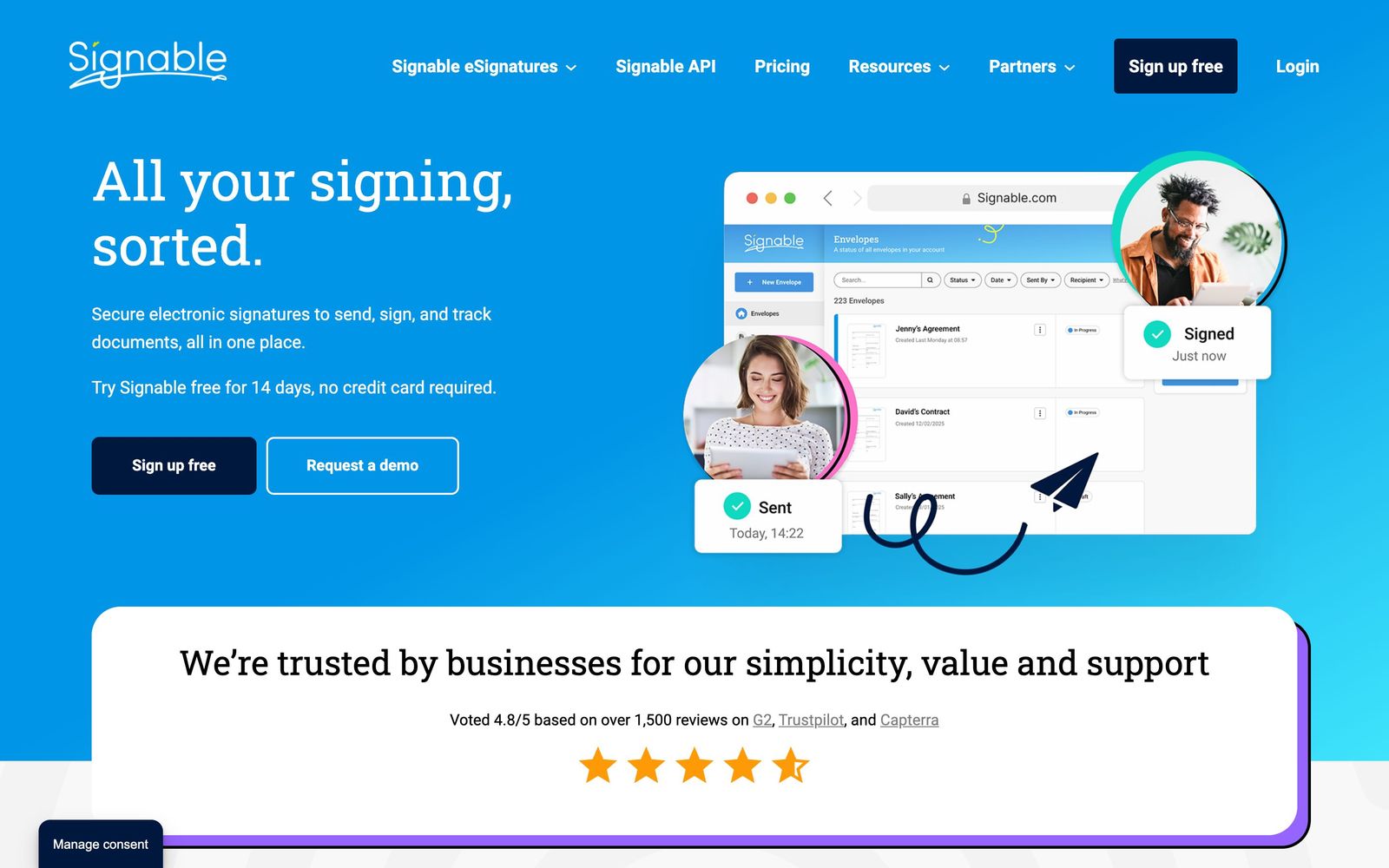
Signable sends documents for electronic signature and tracks what happens to them. The unit of work is an envelope: one or several files, one or several signers, an optional signing order, and fields dropped onto the pages for signatures, initials, dates and free text. Recipients sign in a browser without creating an account. The sender sees when each envelope was delivered, opened and completed, and every step is written to an audit trail that can be produced later if the agreement is challenged.
The commercial model is the interesting part. Most competitors charge per user per month, which punishes the common pattern in a small company where a dozen people each send a handful of documents a year. Signable charges by envelope and includes unlimited users on every plan, including pay as you go. Around that sit reusable templates, bulk send for issuing one document to a list, automatic reminders, and a documented API for embedding signing into another system. Data is held in the UK on AWS, and support is answered by a UK team on the phone, which is a large part of why the company retains its customers in a category dominated by much bigger names.
Key features
The scope is narrow, and each part is aimed at getting a signature back quickly.
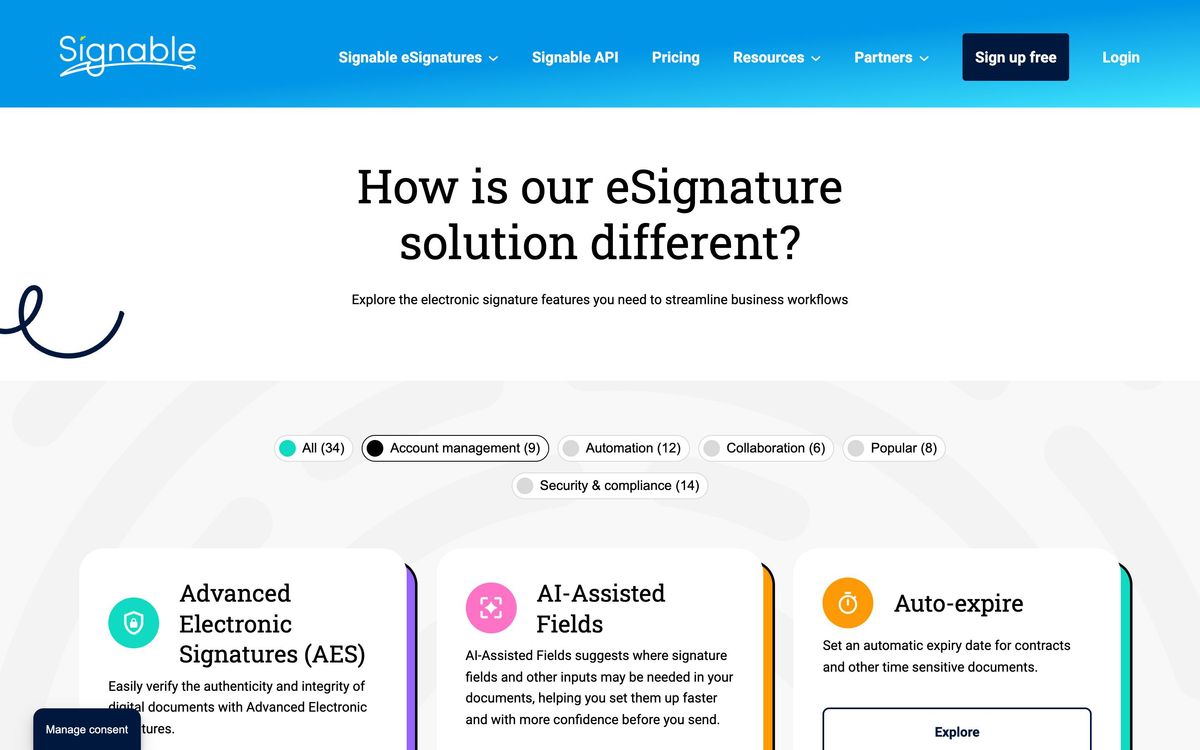
- Envelopes containing several documents and several signers, with a defined signing order
- Templates that remember field positions for contracts sent repeatedly
- Bulk send for issuing the same document to a list of recipients
- Automatic reminders and expiry dates, with delivery, open and completion tracking
- Audit trail on every envelope, recording each action taken and when
- API with published documentation, plus Zapier and Make connections for no-code automation
Who it's for
Signable suits a UK small or mid-sized business with a predictable flow of agreements and more people sending them than a seat-based licence would make affordable: a letting agency, a recruitment firm, a school, an accountancy practice. Companies whose clients or auditors ask where the data lives will value the UK hosting, and teams that dislike being routed to an overseas support queue will notice the difference on the first call.
It is not the right tool for an organisation that wants contract lifecycle management, with negotiation, clause libraries, obligation tracking and reporting on a contract portfolio. Nor does it suit companies whose signing volume swings unpredictably, since the plans are metered and an unusual month means an upgrade. Businesses standardised on Salesforce or Microsoft workflows will find the native connectors missing and have to build through Zapier.
How it compares
Docusign is the default and remains the strongest option for enterprises: more integrations, more advanced field logic, wider international recognition, and prices to match, charged per user. Dropbox Sign is the tidier mid-market alternative with a good API, but it also bills by seat and by document allowance. Adobe Acrobat Sign makes sense for organisations already committed to Adobe. Against all three, Signable competes on price shape rather than features, and on being reachable by telephone in the same time zone.

Verdict
Signable does the ordinary job well: documents go out, signatures come back, the audit trail holds up, and nobody needs training to use it. The envelope-based pricing with unlimited users is genuinely better value than seat licensing for a company where signing is occasional but widespread, and the UK hosting removes a question that comes up often in public sector and regulated work. The limits are clear rather than hidden. There is no contract management layer, the integration catalogue is thin, and the metered allowance means volume growth arrives as a plan change. Within those boundaries it is a sensible, unshowy choice.
Ready to try Signable?
More founders tools like Signable
airSlate
3.8Document suite behind signNow and pdfFiller: e-signature, PDF editing and form workflows.
Read airSlate review →Bitdefender
4.6Enterprise-grade GravityZone security for SMBs: ransomware, phishing, and fileless attack protection.
Read Bitdefender review →1Password
4.5Team password manager and credential vault that has grown into a wider access platform for small IT teams.
Read 1Password review →ClickUp
4.5All-in-one work platform: tasks, docs, goals, chat, whiteboards, and AI agents in a single workspace.
Read ClickUp review →Fireflies.ai
4.5AI meeting teammate that records, transcribes, and summarizes calls, with action items and searchable notes.
Read Fireflies.ai review →Miro
4.5Infinite shared canvas for workshops, diagrams and planning, now wrapped around docs, tables and AI.
Read Miro review →