
Nouswise review
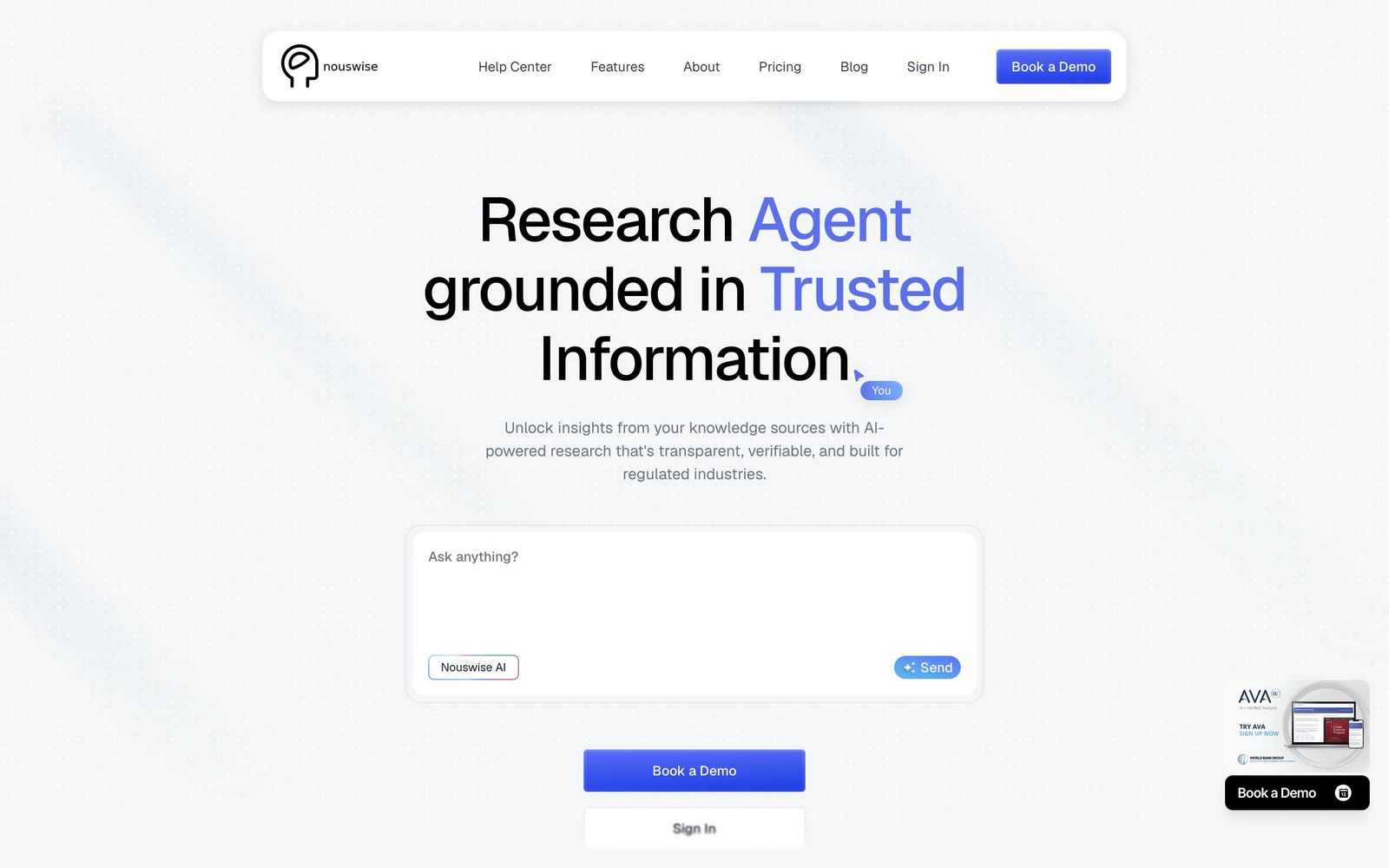
Research agent that answers only from the sources you give it, with a citation behind every claim.
A disciplined alternative to a general chatbot when every answer has to trace back to a document you supplied, though the daily activity caps on the lower plans bite sooner than the source limits do.
Pros
- Answers are restricted to the uploaded library, and every statement carries a citation back to the passage it came from
- Multiple agents cross-check sources and surface conflicts rather than smoothing them into one confident paragraph
- Outputs go beyond chat: reports, data tables, flashcards, quizzes, mind maps, slide decks and short recap videos from the same library
- SOC 1 and SOC 2 Type I and II coverage, with on-premises deployment available for institutions that cannot send documents out
- The free tier allows a hundred sources, which is enough to judge answer quality on real material
Cons
- Every generation type is rate-limited per day, so the paid tiers cap daily reports and deep research well before the source limit matters
- File storage is small outside the enterprise plan, which rules out large scanned archives
- The connector list is short: files, web search and MCP, with anything more bespoke reserved for enterprise contracts
Nouswise pricing
List prices in USD per month, taken from the vendor at review time. Custom means quote-only.
| Plan | Per month | What it covers |
|---|---|---|
| Starter | Custom | 100 sources, 100 MB storage, 5 generations a day |
| Essential | $19.99 | 300 sources, 20 generations a day |
| Pro | $49.99 | unlimited sources, 2 GB storage, 120 generations a day |
What Nouswise actually does
Nouswise is a research assistant with a deliberate constraint: it answers from the library you give it, and nothing else. You upload documents, reports, policies and datasets, it indexes them, and questions are answered with citations pointing at the passages the answer came from. Where a general chatbot fills a gap with something plausible, Nouswise is built to show its working, which is the whole reason regulated bodies buy this shape of tool. The company's most visible deployment is AVA, an interface built with the World Bank Group that lets policymakers query the institution's own research and only its own research.
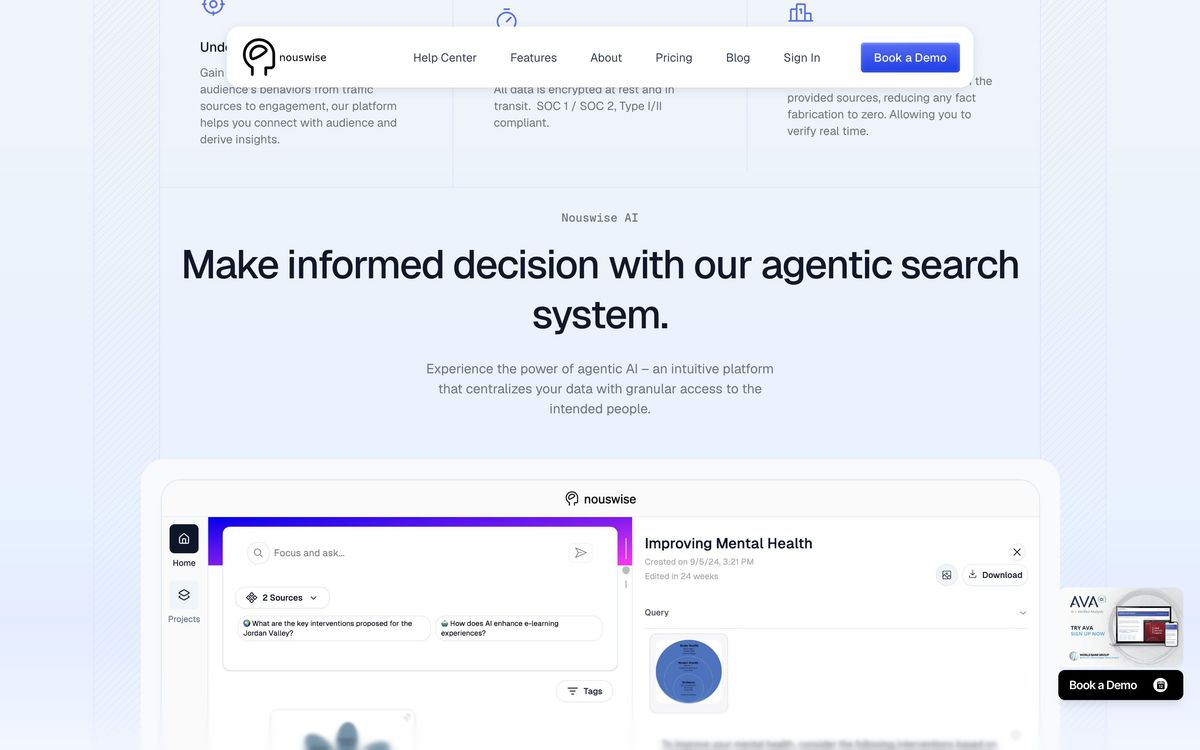
Underneath the chat box the retrieval is agentic rather than a single pass. Several agents query the corpus, cross-check each other, look for gaps and resolve conflicts before an answer is assembled, which slows a response but reduces the confident-and-wrong failure mode. The output side is broader than a chat transcript: the same library can produce a structured report, a data table, a set of flashcards or quiz questions, a mind map, a slide deck, or a Visual Recap, a short video in which two AI voices talk through the findings. Deployment is cloud by default with an on-premises option, and the platform carries SOC 1 and SOC 2 Type I and II compliance.
Key features
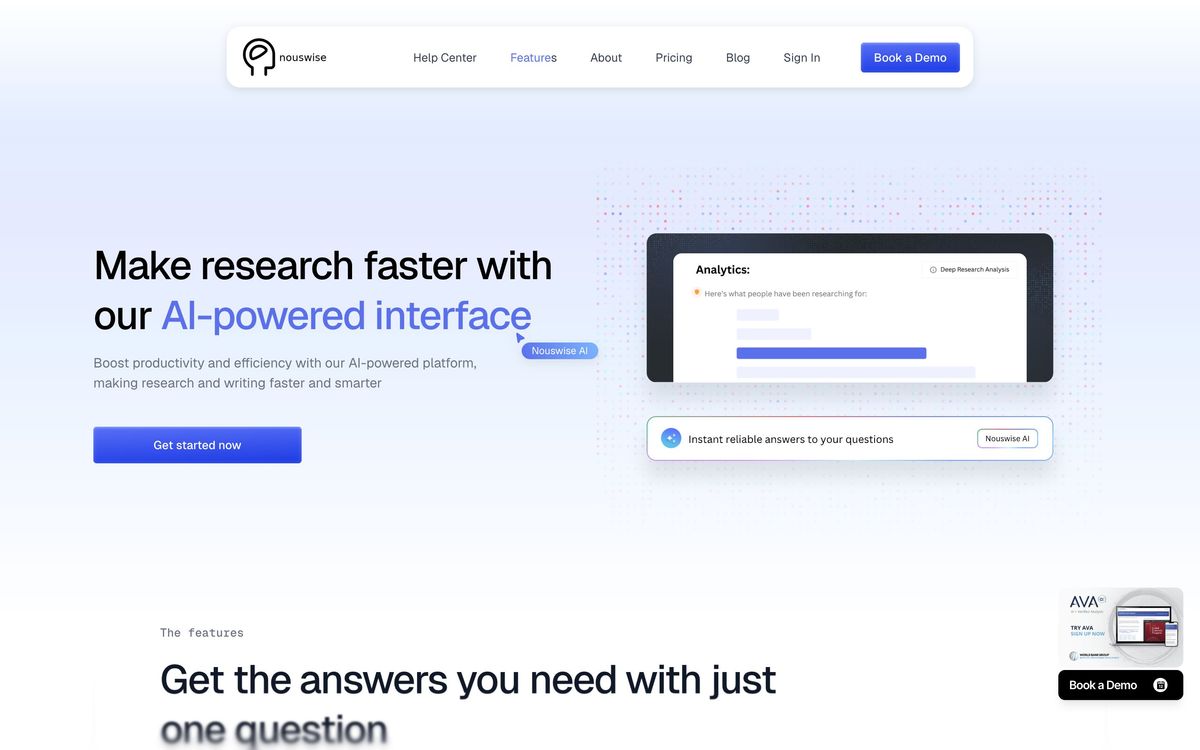
The product is narrow by design, and most of its work happens between the question and the answer.
- Grounded answering restricted to the indexed library, with citations at passage level
- Agentic search in which several agents cross-check sources and flag contradictions
- One searchable library across uploaded documents and structured data
- Generated outputs including reports, tables, flashcards, quizzes, mind maps and slide decks
- Visual Recap, a short two-voice video summary of a chosen set of sources
- An API and Model Context Protocol support for embedding the same search elsewhere
Who it's for
The natural buyer is a small team that owns a body of material and needs colleagues, clients or the public to get accurate answers out of it: a policy unit, a research group, a consultancy with a decade of engagement notes, an association sitting on standards documents. Individual researchers get real use out of the free and entry plans, which are priced closer to a consumer subscription than to enterprise search.
It is a poor fit for anyone who wants a general assistant. Nouswise will not draft marketing copy or reason about the open web unless a source in the library supports it, and the daily generation caps make it unsuitable as an all-day writing companion. Teams whose knowledge lives in Slack, Notion, Google Drive and a helpdesk should also check the connector story first, because the low-tier product mainly expects files to be uploaded.
How it compares
NotebookLM covers similar ground for free, with better audio summaries and a friendlier interface, but no enterprise controls, no on-premises option and no API worth building on. Glean is the enterprise alternative, indexing the systems a company already runs and answering across all of them, at a price and implementation weight that only larger organisations absorb. Perplexity Enterprise sits between the two, faster and broader but happy to answer from the open web, which is exactly what a compliance-bound team is trying to avoid. Nouswise wins on the narrow question of verifiability, and loses on breadth of connectors.
Verdict
Nouswise takes the least glamorous constraint in the category, refusing to answer beyond its sources, and builds a credible product around it. The citation trail is the feature that matters, the multi-agent checking earns its latency, and a World Bank deployment is meaningful evidence that the approach survives contact with serious users. The friction is in the plan design: daily caps on every kind of generation and small storage below enterprise mean a heavy user meets the ceiling faster than expected. Judge it on the free tier with a real corpus, and check the daily limits against how the team actually works before committing.
Ready to try Nouswise?
There's a free tier, so you can test it before committing.
More founders tools like Nouswise
1Password
4.5Team password manager and credential vault that has grown into a wider access platform for small IT teams.
Read 1Password review →ClickUp
4.5All-in-one work platform: tasks, docs, goals, chat, whiteboards, and AI agents in a single workspace.
Read ClickUp review →Fireflies.ai
4.5AI meeting teammate that records, transcribes, and summarizes calls, with action items and searchable notes.
Read Fireflies.ai review →Miro
4.5Infinite shared canvas for workshops, diagrams and planning, now wrapped around docs, tables and AI.
Read Miro review →Reclaim.ai
4.5AI calendar assistant that auto-schedules focus time, tasks, and habits on Google and Outlook calendars.
Read Reclaim.ai review →Activepieces
4.4Open-source, MIT-licensed AI automation platform with a visual builder, AI agents, and 700+ integrations.
Read Activepieces review →