
Pinecone review
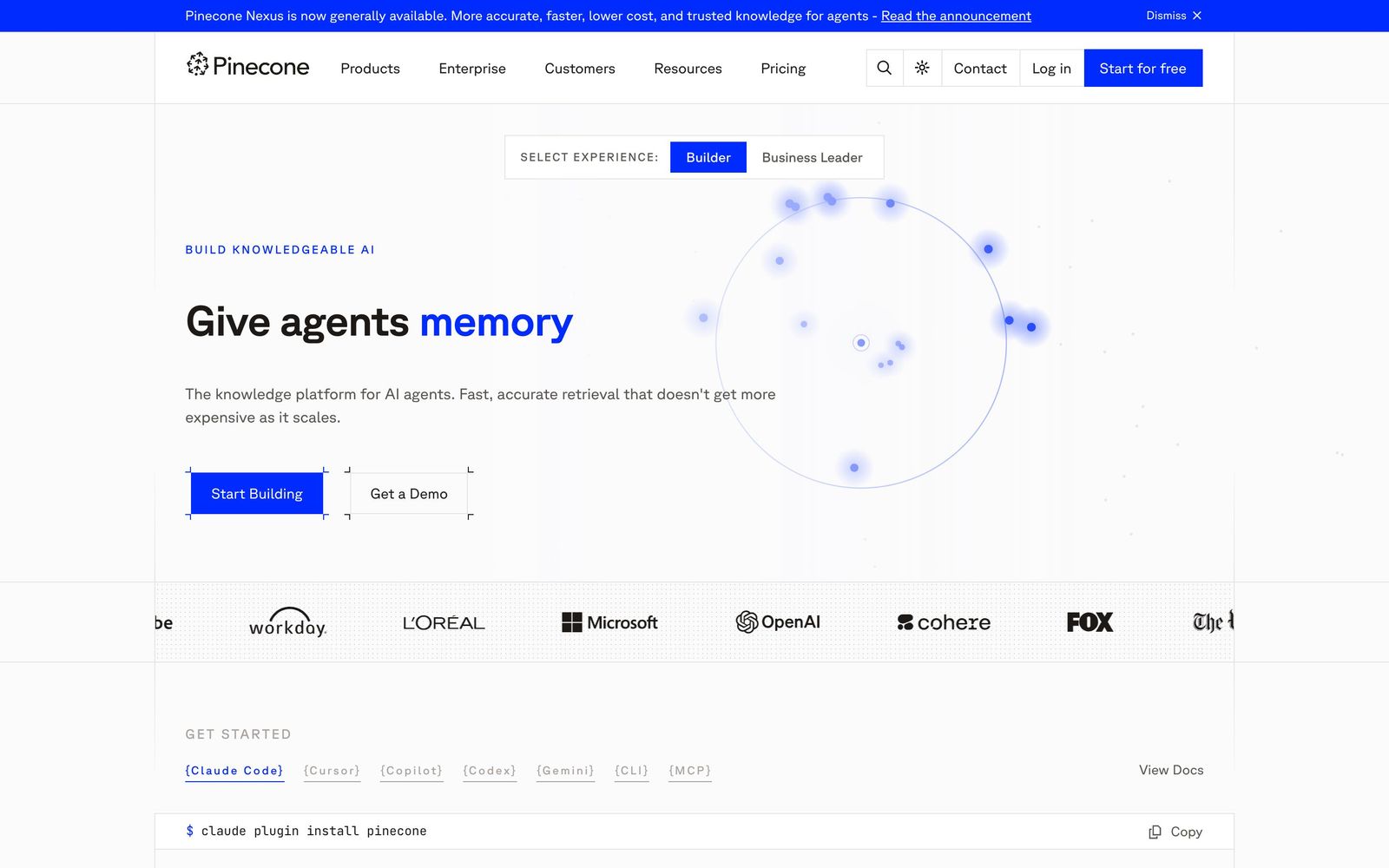
Fully managed serverless vector database for similarity search, RAG, and agent memory at billion-vector scale.
Best at hands-off vector search that scales from prototype to billions of vectors; the tradeoff is a proprietary managed service with no self-hosting option.
Pros
- Serverless architecture separates storage from compute, so you never size clusters
- Hybrid retrieval combines dense vectors, sparse keywords, and full-text search
- Namespaces give clean multitenancy that scales to millions of tenants
- Integrated embedding and reranking models reduce pipeline glue code
- MCP server and agent tooling fit modern RAG and agent stacks
Cons
- No self-hosted or open-source version; you are committed to the managed service
- Consumption-based costs can be hard to forecast for read-heavy workloads
- Fewer low-level tuning knobs than open-source engines like Qdrant or Weaviate
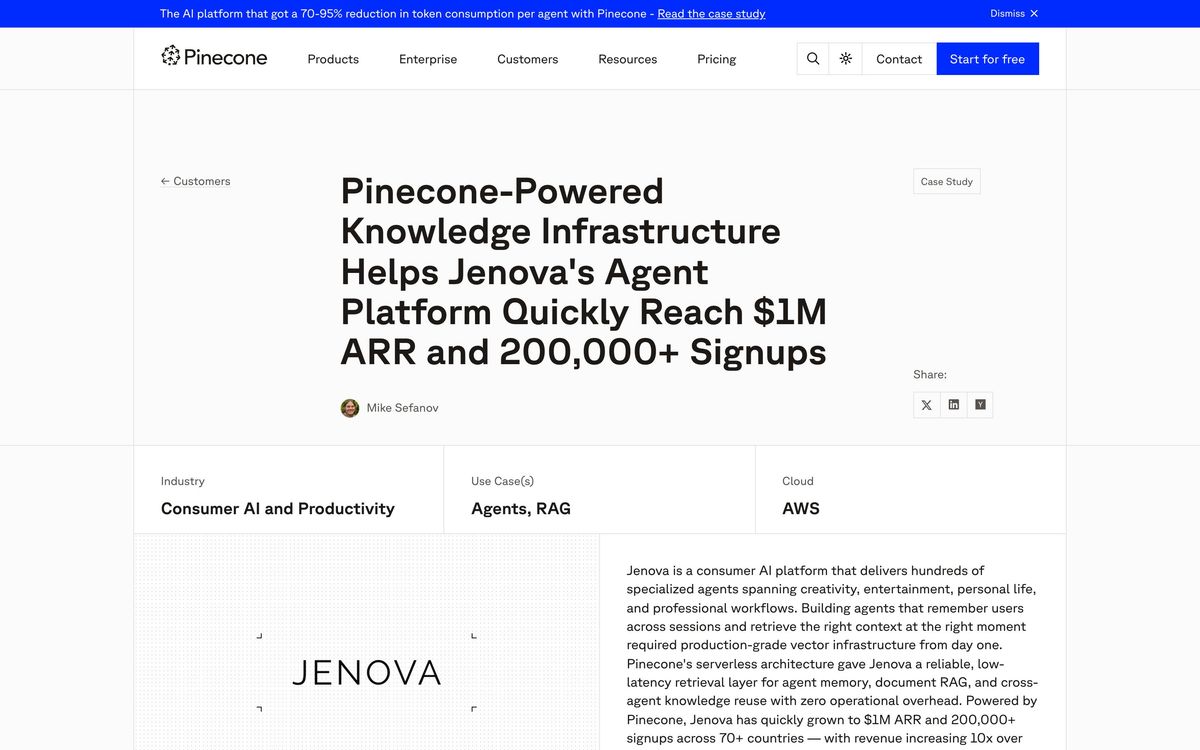
Pinecone is the best-known name in vector databases, the storage layer behind semantic search, retrieval-augmented generation, recommendation systems, and agent memory. With more than 9,000 customers, it effectively defined the managed vector database category, and its serverless architecture remains the main reason teams pick it: you create an index, write vectors, and query, without ever thinking about shards, replicas, or cluster sizing.
What Pinecone actually does
Pinecone stores high-dimensional vector embeddings and retrieves the most similar ones to a query vector in milliseconds, across datasets that can reach billions of records. The serverless design separates storage from compute and reads from writes, so the platform scales each independently and you pay for what you consume rather than for provisioned capacity. On top of raw similarity search, Pinecone layers practical retrieval features: hybrid search that blends dense semantic vectors with sparse keyword signals and full-text matching, metadata filtering, namespace-based isolation for multitenant applications, and freshness guarantees that make new writes searchable within seconds. The platform also hosts embedding and reranking models, which means a complete retrieval pipeline, from raw text to ranked results, can run inside Pinecone without separate model-serving infrastructure. For agent builders there is an MCP server and dedicated tooling for RAG workflows.
Key features
- Serverless indexes with automatic scaling to billions of vectors and millions of namespaces
- Hybrid retrieval: dense vectors, sparse keyword search, and full-text in one query path
- Metadata filtering, TTL, schemas, and metadata-based deletion for operational hygiene
- Integrated hosted embedding and reranking models
- Namespaces for strict multitenant isolation without separate indexes
- Deep ecosystem integrations including LangChain, LlamaIndex, and major cloud marketplaces
Who it's for
Pinecone fits teams shipping production AI features who want retrieval to be someone else's operational problem: RAG over document corpora, semantic search across product catalogs, deduplication, recommendations, and long-term agent memory. The free Starter tier is enough to build and validate a prototype, which makes it a common default for hackathons and early-stage products. It is a weaker fit for teams with strict requirements to run retrieval inside their own infrastructure, or for hobbyists who want to tinker with index internals, because there is nothing to self-host and the engine is a black box by design.
How it compares
Qdrant and Weaviate are the strongest open-source alternatives. Both can be self-hosted or used as managed clouds, expose more tuning surface, and appeal to teams who want an exit path from managed services. Pinecone counters with operational simplicity: there is no version to upgrade, no node to size, and the serverless cost model rewards spiky or unpredictable workloads. The other competitor worth naming is pgvector, the Postgres extension, which is attractive when vector search is a minor feature in an app that already runs Postgres; Pinecone pulls ahead once collections grow past what a single database comfortably handles or when hybrid search quality matters.

Verdict
Pinecone is still the safest choice for teams that want production-grade vector search without owning the infrastructure. The serverless model genuinely removes a class of operational work, hybrid retrieval and integrated reranking measurably improve result quality over naive cosine similarity, and the ecosystem support is unmatched in the category. Accept two tradeoffs going in: you cannot self-host, and consumption billing requires monitoring as query volume grows. If those are acceptable, Pinecone is the vector database to beat in 2026; if self-hosting is non-negotiable, look at Qdrant or Weaviate instead.
Ready to try Pinecone?
There's a free tier, so you can test it before committing.
More developers tools like Pinecone
CrowdStrike
4.4Cloud-delivered endpoint protection with one lightweight agent, sold to small teams as fixed per-device bundles.
Read CrowdStrike review →NinjaOne
4.4Endpoint management and RMM platform for monitoring, patching, backing up and remotely supporting company devices.
Read NinjaOne review →Bright Data
4.3Proxy network and managed scraping APIs for collecting public web data at production scale.
Read Bright Data review →BugHerd
4.3Visual feedback tool that pins client comments to the exact element on a page and turns them into tasks.
Read BugHerd review →EasyDMARC
4.3Email authentication monitoring that takes a domain from DMARC reporting to enforcement without hand-editing DNS.
Read EasyDMARC review →Freshservice
4.3Cloud IT service desk with asset discovery and low-code workflows for teams that want ITSM without a ServiceNow project.
Read Freshservice review →