
Bright Data review
Proxy network and managed scraping APIs for collecting public web data at production scale.
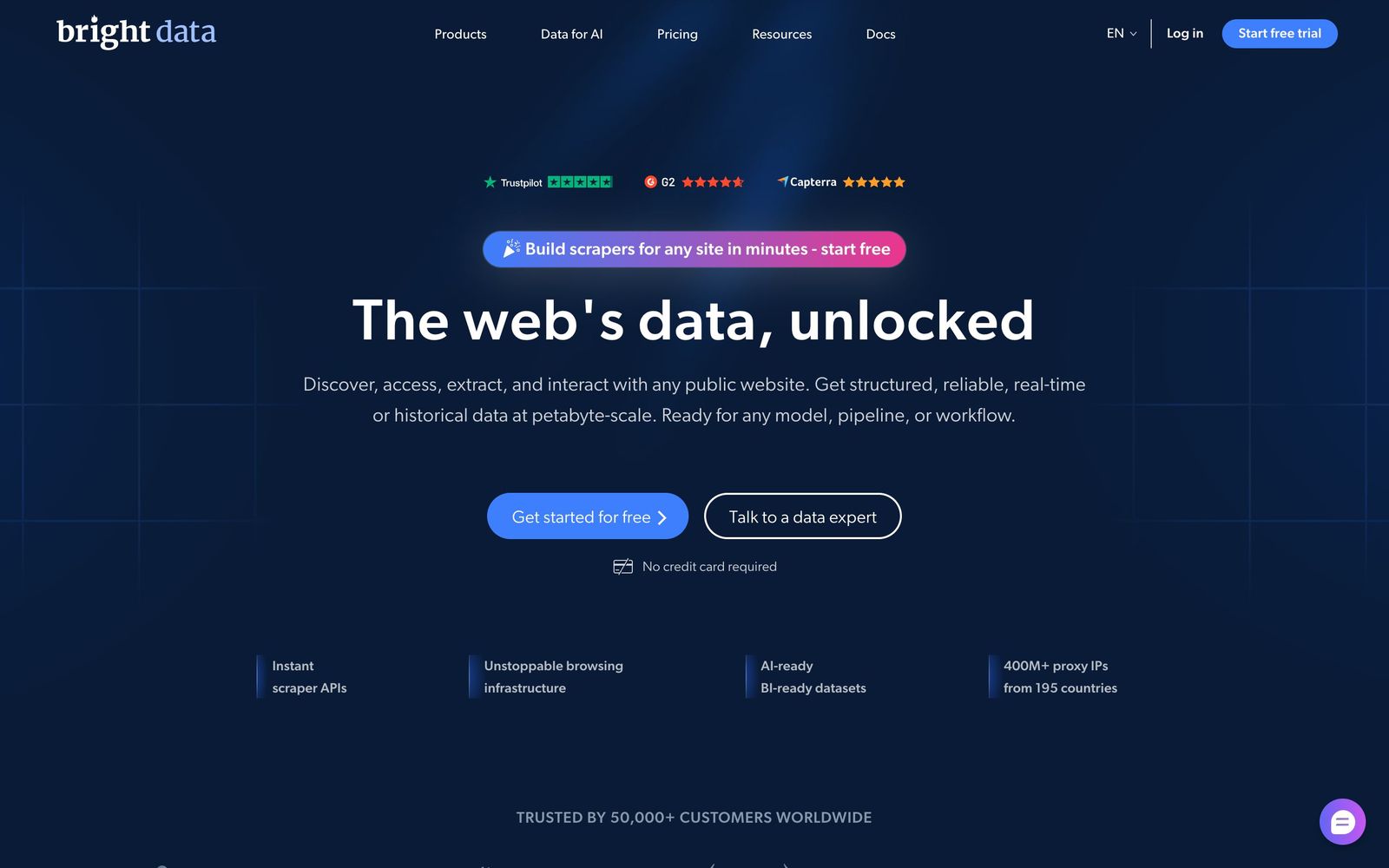
The most complete web data infrastructure available, from raw proxies to finished datasets, though the compliance review before access and the consumption billing make it a poor fit for casual use.
Pros
- The residential pool spans hundreds of millions of addresses across effectively every country, so geo-specific collection works without workarounds
- Managed products sit above the proxies: Web Unlocker, SERP API and Web Scraper API handle blocking, headers and challenges rather than leaving them to the caller
- Ready-made datasets remove the need to build and maintain a crawler for common sources
- Standard tooling connects directly, so existing Puppeteer, Playwright and Selenium code needs only endpoint changes
- Support is consistently described by reviewers as responsive and technically competent
Cons
- Residential access requires a compliance review with company documents, and approval commonly takes days to weeks rather than the stated turnaround
- Rates run several times higher than budget proxy vendors, and the same job costs meaningfully more here than on a smaller network
- Calendar-month commitments, balances that do not roll over and mid-month proration produce surprise top-up charges that reviewers cite repeatedly
Bright Data pricing
List prices in USD per month, taken from the vendor at review time.
| Plan | Per month | What it covers |
|---|---|---|
| Residential, pay-as-you-go | $8 | per GB list price, no commitment; promotional rates run lower |
| Residential Starter | $499 | monthly commitment plan |
| Residential Professional | $999 | monthly commitment plan, lower per-GB rate |
| Residential Enterprise | $1,999 | monthly commitment plan, lowest per-GB rate |
What Bright Data actually does
Bright Data sells the infrastructure underneath web data collection. At the base are proxy networks in four flavours, residential, ISP, datacenter and mobile, with targeting down to country, city and carrier, so a request can be made to look like it originated from a specific place. Above the proxies sit managed products that take over the parts teams usually get wrong: Web Unlocker deals with headers, cookies, user agents and challenge pages and returns a rendered page; SERP API returns structured search results without anyone maintaining a search scraper; Web Scraper API and Scraping Browser run extraction jobs against a managed browser fleet. At the top are prebuilt datasets, sold per record or by subscription, for sources common enough that building a crawler is wasted effort.
The layering is the point. A team can start with raw proxies and its own Puppeteer or Playwright code, then move a fragile target onto Web Unlocker when the blocking gets serious, then abandon a crawler entirely for a dataset when the maintenance stops being worth it, without changing vendors. Access is not open, though. The residential network is gated behind a compliance review: company registration documents, identity verification, and a stated purpose for the collection. Bright Data treats that review as a selling point, and for buyers who need to demonstrate that their data sourcing was lawful, it is one.

Key features
What the account actually provides:
- Residential, ISP, datacenter and mobile proxies with country, city and carrier targeting
- Web Unlocker, handling headers, cookies, user agents and challenge pages to return usable HTML
- SERP API returning structured search results across engines
- Web Scraper API and Scraping Browser for jobs run on a managed browser fleet
- Prebuilt datasets priced per record or by subscription
- Direct compatibility with Puppeteer, Playwright and Selenium, so existing code changes only its endpoint
Who it's for
This is infrastructure for teams whose business depends on collection continuing to work: price intelligence platforms, market research firms, ad verification vendors, and increasingly AI companies assembling training and retrieval corpora. Those buyers care about success rate under blocking, coverage in specific countries, and having a compliance story when a customer or a regulator asks where the data came from. Bright Data is built for exactly that set of concerns, and it is priced for buyers who have them.
It is the wrong choice for almost everyone else. A developer scraping a few thousand pages for a side project will spend days in verification before spending anything, and will pay several times what a smaller provider charges for the same volume. Freelancers without a registered company face additional verification steps. Anyone whose target is a single cooperative site with an available API should not be buying proxies at all. And teams uncomfortable with usage-based billing should note the mechanics before signing up, discussed below.
How it compares
Oxylabs is the closest peer on network quality, compliance posture and price, and the choice between them usually comes down to which account team is more responsive. Smartproxy and Decodo undercut both substantially with a smaller pool and lighter verification, which suits mid-sized jobs where perfect coverage is not required. Apify and ScrapingBee sell the managed layer without the underlying network, and are easier to start with for a team that just wants pages back. Zyte occupies similar ground for engineering-led scraping. Bright Data's advantage is breadth: it is the only vendor where a project can move from raw proxies to a finished dataset without leaving.
Verdict
For collection that has to keep working at volume, Bright Data is the reference implementation: the largest network, managed products that absorb the hard parts, and datasets for when a crawler is no longer worth maintaining. The friction is real and worth planning for. Compliance approval takes days to weeks rather than the advertised window. Rates sit well above budget providers. And the billing mechanics, calendar-month commitments, balances that do not carry forward, proration on mid-month signup, generate the charges most complained about in reviews. Teams with production dependencies and a compliance obligation should accept those terms. Everyone else should start somewhere smaller.
Ready to try Bright Data?
More developers tools like Bright Data
Netlify
4.6Hosting and deployment platform with Git-based CI/CD, deploy previews, serverless functions, and AI workflows.
Read Netlify review →Pinecone
4.5Fully managed serverless vector database for similarity search, RAG, and agent memory at billion-vector scale.
Read Pinecone review →Runpod
4.5GPU cloud for AI workloads: on-demand instances, serverless inference endpoints, and multi-node clusters.
Read Runpod review →CrowdStrike
4.4Cloud-delivered endpoint protection with one lightweight agent, sold to small teams as fixed per-device bundles.
Read CrowdStrike review →NinjaOne
4.4Endpoint management and RMM platform for monitoring, patching, backing up and remotely supporting company devices.
Read NinjaOne review →BugHerd
4.3Visual feedback tool that pins client comments to the exact element on a page and turns them into tasks.
Read BugHerd review →