
Cloro review
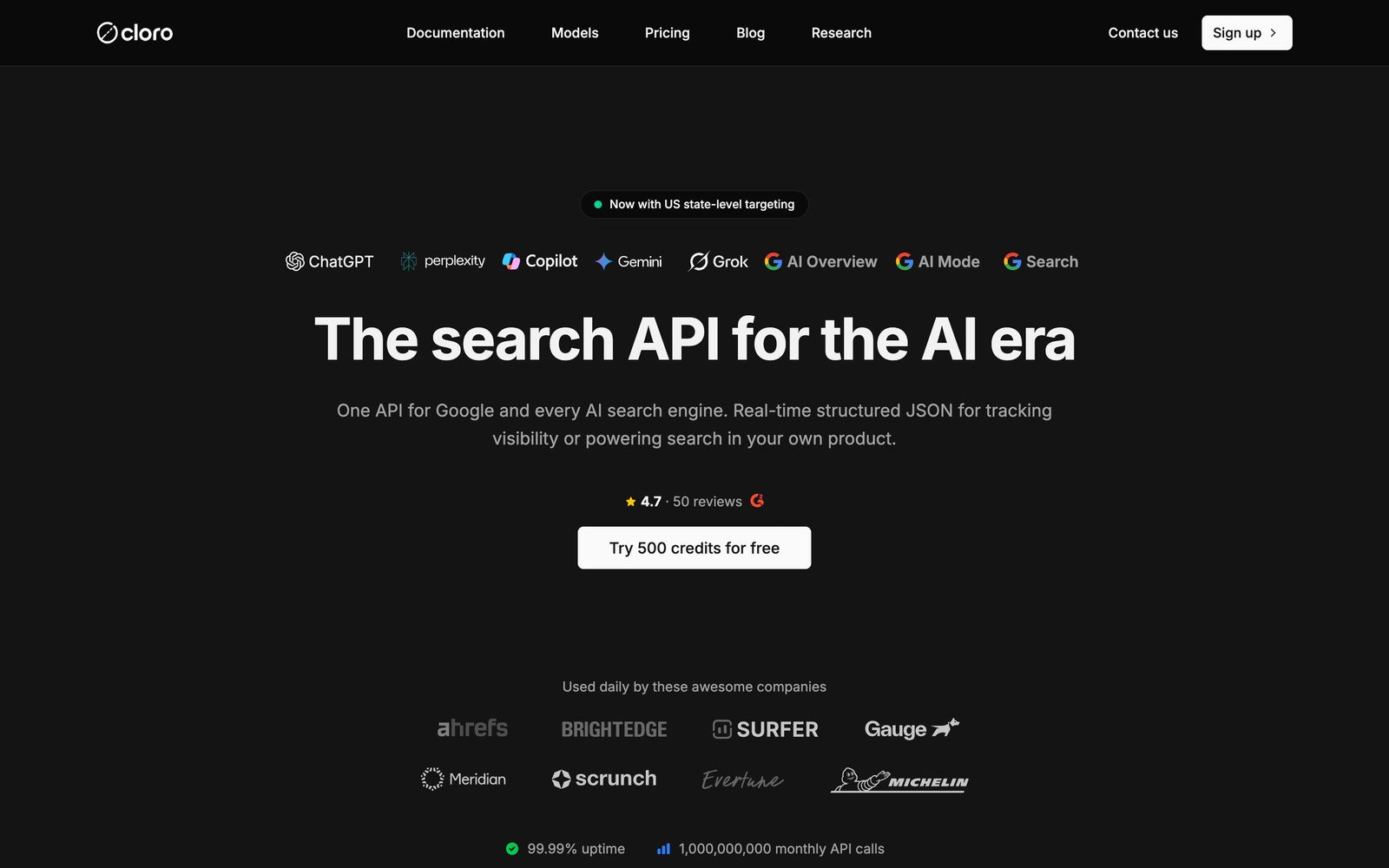
One API that returns structured JSON from Google and the major AI answer engines.
A tidy single endpoint for teams that need Google and AI-assistant results as parsed JSON, though it is a young service with no independent track record yet.
Pros
- Nine search surfaces behind one auth token, including Google AI Overview, AI Mode, ChatGPT, Perplexity, Gemini, Copilot and Grok
- Responses arrive parsed: answer text, cited sources and result links are separate fields rather than HTML
- Full price list published, including how many credits each engine costs per call
- Geographic targeting down to individual US states, which matters for locale-sensitive checks
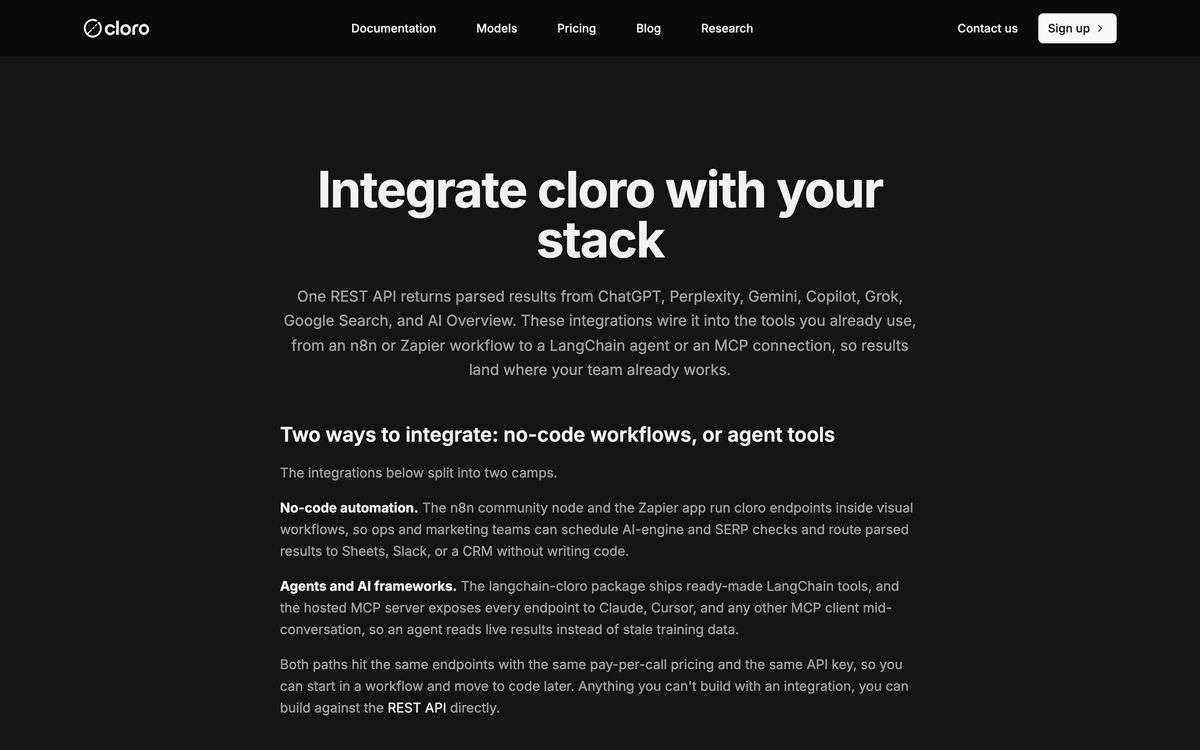
- MCP server plus n8n, Zapier and LangChain connectors, so agents and automations can call it without custom code
Cons
- No dashboards, alerting or reporting: everything above the raw JSON has to be built in-house
- Credit costs vary sharply by engine, and a full ChatGPT response costs more than twice a Google Search call, so budgets are hard to predict from a keyword count alone
- Young service with no independent review base, and its coverage depends on assistant surfaces that vendors change without notice
Cloro pricing
List prices in USD per month, taken from the vendor at review time.
| Plan | Per month | What it covers |
|---|---|---|
| Free | Free | 500 credits a month, 1 concurrent job |
| Lite | $30 | 37,500 credits, 10 concurrent jobs |
| Hobby | $100 | 250,000 credits, 20 concurrent jobs |
| Starter | $250 | 650,000 credits, 50 concurrent jobs |
| Growth | $500 | 1,350,000 credits, 75 concurrent jobs |
What Cloro actually does
Cloro is a hosted search API with one job: turn a query into structured JSON from whichever search surface you name. Alongside Google Search and Google News it covers Google's AI Overview and AI Mode, ChatGPT web search, Perplexity, Gemini, Copilot and Grok, which means one client can put the same question to nine surfaces and compare what came back. Responses are parsed rather than dumped: answer text, the citations the model leaned on, organic links and shopping blocks arrive as separate fields, so nobody on the team maintains selectors against markup that changes weekly.
Two jobs follow from that. The first is visibility tracking, polling a keyword list on a schedule and recording whether a brand appears, which domains the assistants cited, and how that drifts week to week. The second is search inside another product, whether a research agent, a monitoring dashboard or an enrichment pipeline, where the team wants results without running proxy pools and parsers. Requests can be queued asynchronously or made synchronously at a credit surcharge, queries can be pinned to a country or an individual US state, and access runs through client libraries, an MCP server and prebuilt steps in n8n, Zapier and LangChain. Billing is by credits, and the credit cost varies by engine.
Key features
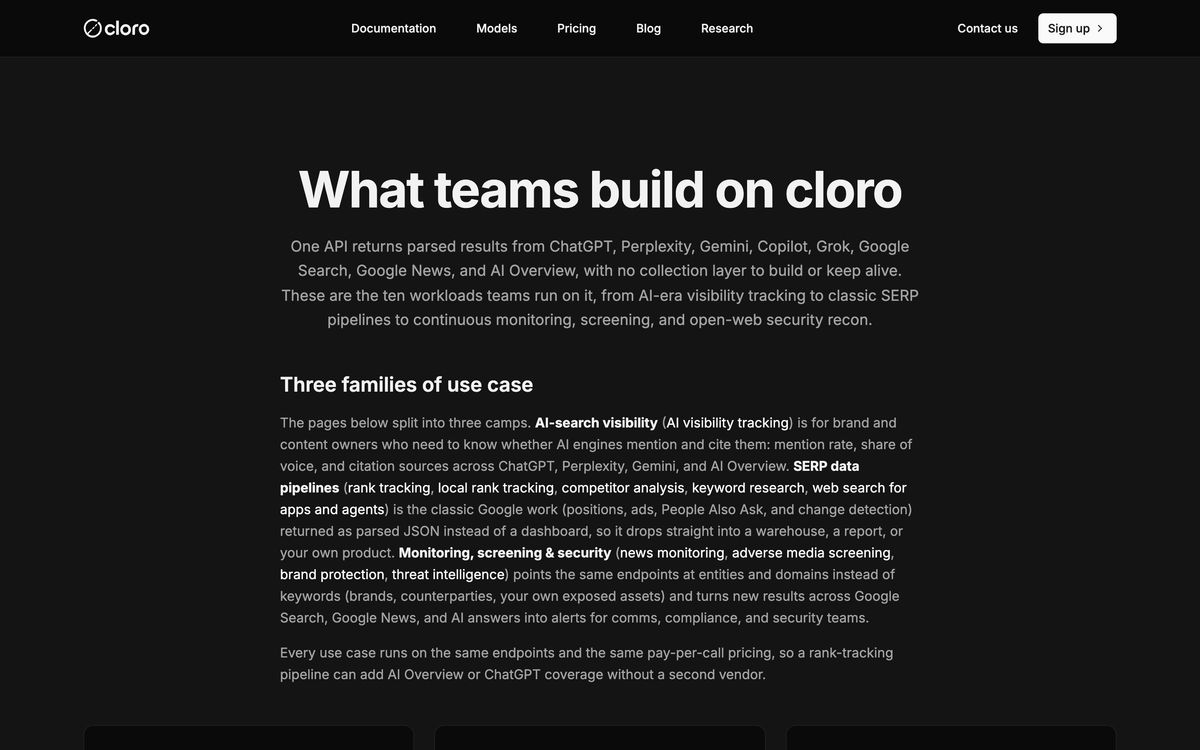
The surface area is deliberately narrow: one endpoint, many engines.
- Coverage of Google Search, Google News, AI Overview and AI Mode, plus ChatGPT, Perplexity, Gemini, Copilot and Grok
- Parsed JSON that separates the answer text, the cited sources and the result links
- Geographic targeting by country and by individual US state
- Asynchronous jobs with per-plan concurrency limits, and a synchronous mode for interactive use
- Per-engine credit pricing on one balance, so routine Google polling and costlier assistant calls draw from the same pool
- An MCP server plus n8n, Zapier and LangChain connectors for agent and automation stacks
Who it's for
Engineering teams building on top of search data: an agency automating AI-visibility reports for clients, a startup adding a research feature, a data team recording what the assistants say about a list of companies. The free tier is small but genuine, and the entry paid plan is cheap enough to prototype against before anyone signs a longer commitment.
It is the wrong purchase for a marketer who wants a finished product. There are no dashboards, no alerts, no share-of-voice charts; someone has to write the code that schedules the calls, stores the results and draws the graph. Teams that only need classic Google results at volume should also price the specialist SERP vendors first, since Cloro's appeal is the breadth of assistant coverage rather than the cost of a single Google call.
How it compares
SerpApi is the incumbent for structured Google results, with a longer operating history and deeper parsers for niche Google verticals, but narrower coverage of the AI assistants. Bright Data sells the layer underneath, proxies and unblocking and a scraping browser, which suits teams that want control over collection and accept the setup and cost that come with it. Dedicated AI-visibility platforms such as Profound sit at the other end of the shelf, shipping prompt sets, reporting and trend lines with no raw API to build on and pricing aimed at brand teams rather than engineers. Cloro occupies the gap between the SERP vendors and the reporting products.
Verdict
Cloro does the unglamorous part well: one contract, one token, consistent JSON across engines that each format their answers differently. Its pricing page is unusually complete for this category, listing per-engine credit costs and concurrency limits rather than hiding them behind a sales call. The caveats are the ones any young API carries, namely a short public record, no independent reviews and a dependence on surfaces the assistant vendors change at will. Run the free tier against the specific engines that matter before wiring a product to it, and keep a fallback in mind for the day one of those engines stops parsing cleanly.
Ready to try Cloro?
There's a free tier, so you can test it before committing.
More developers tools like Cloro
Netlify
4.6Hosting and deployment platform with Git-based CI/CD, deploy previews, serverless functions, and AI workflows.
Read Netlify review →Pinecone
4.5Fully managed serverless vector database for similarity search, RAG, and agent memory at billion-vector scale.
Read Pinecone review →Runpod
4.5GPU cloud for AI workloads: on-demand instances, serverless inference endpoints, and multi-node clusters.
Read Runpod review →CrowdStrike
4.4Cloud-delivered endpoint protection with one lightweight agent, sold to small teams as fixed per-device bundles.
Read CrowdStrike review →NinjaOne
4.4Endpoint management and RMM platform for monitoring, patching, backing up and remotely supporting company devices.
Read NinjaOne review →BugHerd
4.3Visual feedback tool that pins client comments to the exact element on a page and turns them into tasks.
Read BugHerd review →