
Freshservice review
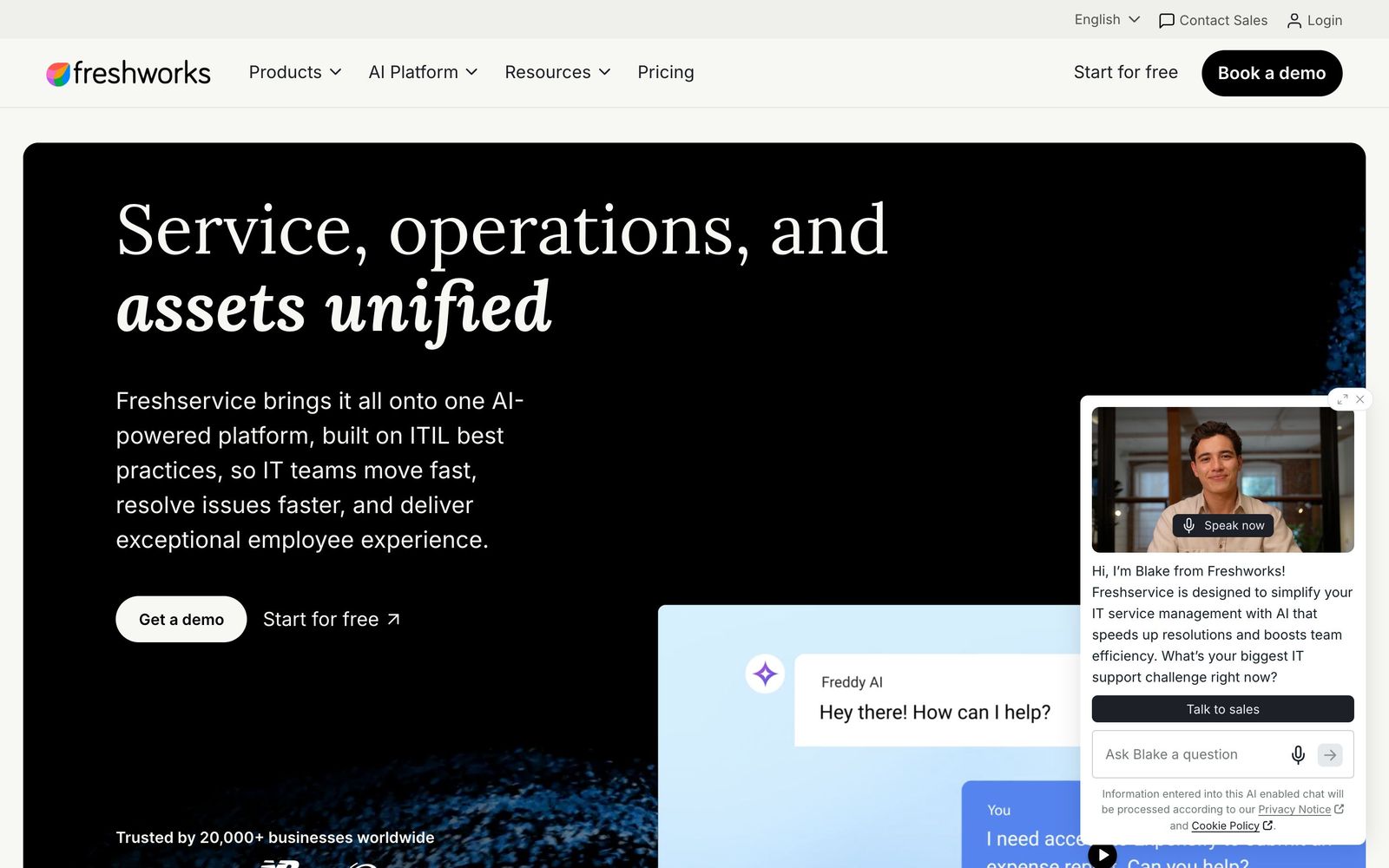
Cloud IT service desk with asset discovery and low-code workflows for teams that want ITSM without a ServiceNow project.
The most approachable ITIL-shaped service desk in the mid-market, though change and problem management sit two tiers up and reporting on custom fields stays rigid.
Pros
- Configuration is done in the UI: service catalogue items, approval chains and SLA policies do not need a partner or a scripting language
- Asset discovery and the CMDB are part of the same product rather than a separate purchase, so tickets carry the device and its dependencies
- The low-code orchestration builder reaches into Azure AD, Okta and cloud consoles, which covers most joiner-mover-leaver automation
- Employee service management extends the same catalogue to HR and finance requests without a second tool
- The agent and portal interfaces are clean enough that staff outside IT will actually raise tickets instead of sending direct messages
Cons
- Change, problem and release management are gated to the Pro tier, and the jump from the mid tier is steep for teams that only need change control
- Reporting on custom fields is rigid: reviewers repeatedly report analytics that cannot be shaped to the way their team tracks work
- AI is stacked awkwardly, the classic Freddy agent sits on Enterprise while the Copilot is a per-agent add-on charged on top of the seat
Freshservice pricing
List prices in USD per month, taken from the vendor at review time.
| Plan | Per month | What it covers |
|---|---|---|
| Starter | $19 | per agent, billed annually |
| Growth | $49 | per agent, billed annually |
| Pro | $99 | per agent, billed annually |
| Freddy AI Copilot add-on | $29 | per agent, billed annually, on Pro and Enterprise |
What Freshservice actually does
Freshservice is Freshworks' IT service desk. It takes the ITIL vocabulary, incidents, service requests, problems, changes, releases, configuration items, and delivers it as browser software that an internal IT team can configure in a week rather than a quarter. Employees raise requests through a portal, a chat channel or plain email; those become tickets with an owner, an SLA clock and, where the catalogue calls for it, an approval chain. Agents work them from a queue that also shows the asset involved and what else depends on it.
The part that separates it from a generic help desk is the asset side. Discovery agents and network scans populate a CMDB, so a laptop, its warranty, its assigned user and the services it touches are all one click from the ticket. On top of that sits a low-code orchestration builder that can reach into identity and cloud systems to act rather than just record, creating an account, granting a group, reclaiming a licence when someone leaves. Freshworks has layered Freddy over the whole thing: a conversational agent that interprets requests and resolves the easy ones, and an agent-side copilot that drafts responses and summarises noisy tickets. Both carry their own commercial terms rather than arriving with the seat.
Key features
The scope is broad but the depth varies sharply by tier, which is the main thing to check before buying.
- Incident, service request and on-call management with SLA policies, business hours and escalation paths
- Asset discovery and a CMDB with dependency mapping, sold in asset units with expansion packs
- A service catalogue with per-item forms, approval chains and cost tracking
- Low-code orchestration that provisions and deprovisions accounts in connected identity and cloud systems
- Problem, change and release management with change advisory routing on the upper tier
- Employee service management journeys that carry onboarding tasks across IT, HR and finance
Who it's for
Freshservice fits an internal IT function of roughly five to a hundred agents that has outgrown a shared mailbox and a spreadsheet of laptops, and wants ITIL structure without hiring an implementation partner. It is a particularly good match for companies where IT also inherits onboarding and offboarding: the same catalogue and the same orchestration flows cover HR requests, which is cheaper than running a second tool for people ops.
It is the wrong choice for two groups. Teams that live inside Atlassian will find Jira Service Management closer to their existing boards and permissions. And organisations with heavy custom process, bespoke objects, unusual approval mathematics, regulator-driven audit trails, will hit the customisation ceiling, which shows up first in reporting: custom fields are easy to add and awkward to analyse.
How it compares
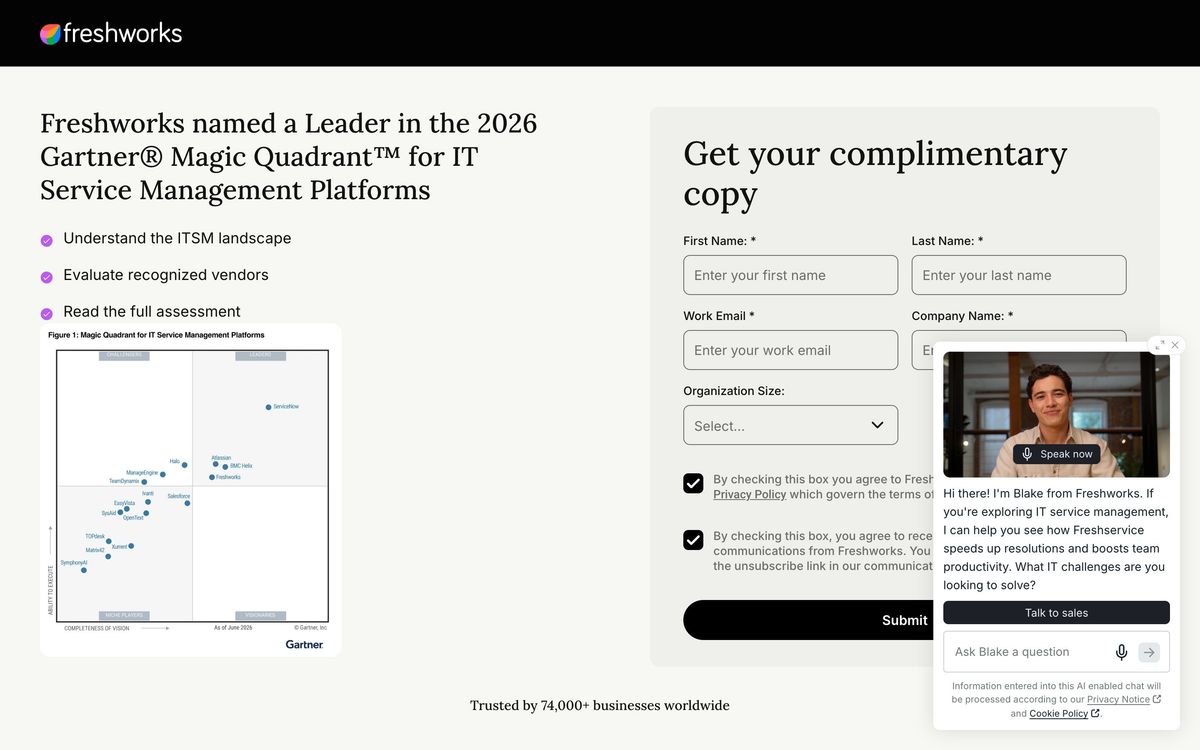
ServiceNow is the deeper platform and the honest comparison at the top of the market: anything can be modelled, and the cost and consulting load reflect that. Jira Service Management wins on price and on proximity to engineering work, but its asset management is younger and its portal is less friendly to non-technical staff. SolarWinds Service Desk sits close to Freshservice on scope and is generally rated behind it on interface quality. Against all three, Freshservice's argument is time to value: it is the one most likely to be live and useful in the first month.

Verdict
Freshservice is a well-judged service desk for the middle of the market, and the asset and orchestration pieces genuinely reduce the number of tools an IT team has to run. The reservations are commercial and structural rather than technical. Change and problem management, the features that turn a help desk into ITSM, sit on the upper tier, and the AI story is split across an Enterprise-only agent and a paid copilot. Reporting is the recurring complaint in user reviews and it is a fair one. Buy it for speed of adoption and breadth; do not buy it expecting to bend the data model to an unusual process.
Ready to try Freshservice?
More developers tools like Freshservice
Velory
4.1IT lifecycle platform that ties hardware procurement, asset tracking and offboarding to the HR system.
Read Velory review →IDrive
3.9Cloud backup covering computers, phones, servers and NAS devices under one account and one storage pool.
Read IDrive review →Passpack
3.9Zero-knowledge password manager for small teams and the MSPs that administer their credentials.
Read Passpack review →Netlify
4.6Hosting and deployment platform with Git-based CI/CD, deploy previews, serverless functions, and AI workflows.
Read Netlify review →Pinecone
4.5Fully managed serverless vector database for similarity search, RAG, and agent memory at billion-vector scale.
Read Pinecone review →Runpod
4.5GPU cloud for AI workloads: on-demand instances, serverless inference endpoints, and multi-node clusters.
Read Runpod review →