
Velory review
IT lifecycle platform that ties hardware procurement, asset tracking and offboarding to the HR system.
One of the tidiest ways to run device procurement and asset records off HR events, though pricing is quote-only and the offboarding flow still leaves devices to reconcile by hand.
Pros
- New hires pick equipment from a company-approved store with budgets and policy already applied
- Directory and HR integrations start onboarding and offboarding from the employee record, not a ticket
- Hardware, accessories, software licences and mobile subscriptions sit in one asset register
- Orders go straight to suppliers with delivery tracking visible to IT and to the employee
- Refurbishment, redeployment and recycling are handled inside the same lifecycle rather than bolted on
Cons
- Pricing is quote-only and tiered by headcount, so a small team cannot size the cost without a sales call
- Offboarding drops returned hardware into an unknown-devices bucket instead of letting an admin reassign it directly
- Payroll teams still export salary deductions manually each month, and reviewers report occasional wrong hardware prices in the catalogue
What Velory actually does
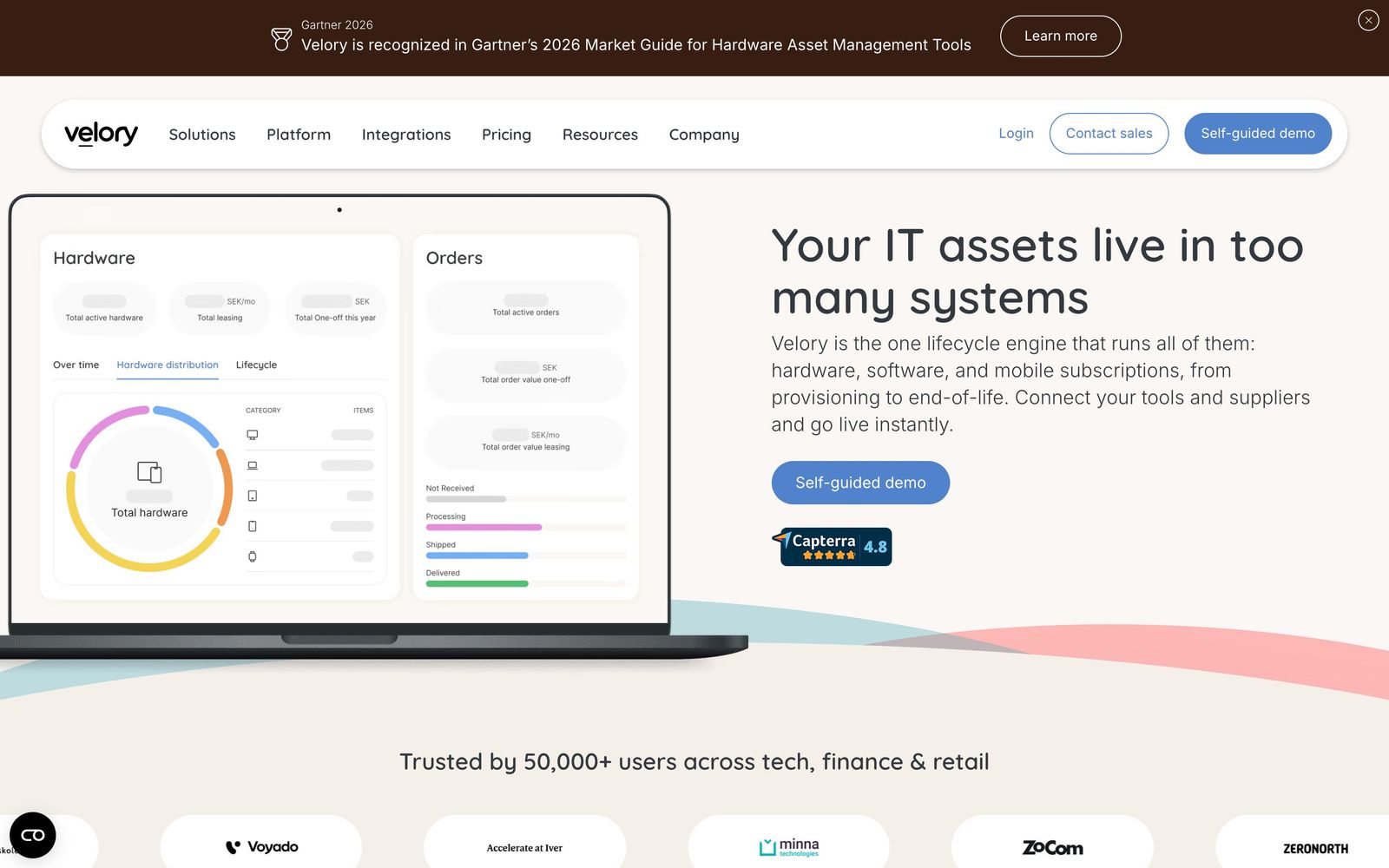
Velory is an IT lifecycle platform: one system for buying hardware, tracking it, and getting it back. The asset register covers laptops, phones, accessories, software licences and mobile subscriptions, and every item carries an owner, a cost and a place in its own lifecycle. What distinguishes it from a plain asset database is the front end pointed at employees. Rather than IT fielding a request for a machine, a new hire opens a company store limited to approved models within a set budget, chooses, and the order goes to a supplier with tracking attached.
The events that drive all of this come from systems that already exist. Velory connects to HR platforms, directory services and device management tools, so a start date triggers procurement and an end date triggers return and wipe. Finance gets the cost side, including leasing and monthly subscription commitments. At the end of a device's working life the platform handles redeployment to another employee, refurbishment, or recycling through its circular IT flow, which is the part that appeals to companies with reporting obligations on electronic waste. It is browser-based, sold as a subscription, and priced by headcount on request.
Key features
The product covers procurement, tracking and disposal rather than device configuration, which stays with the MDM.
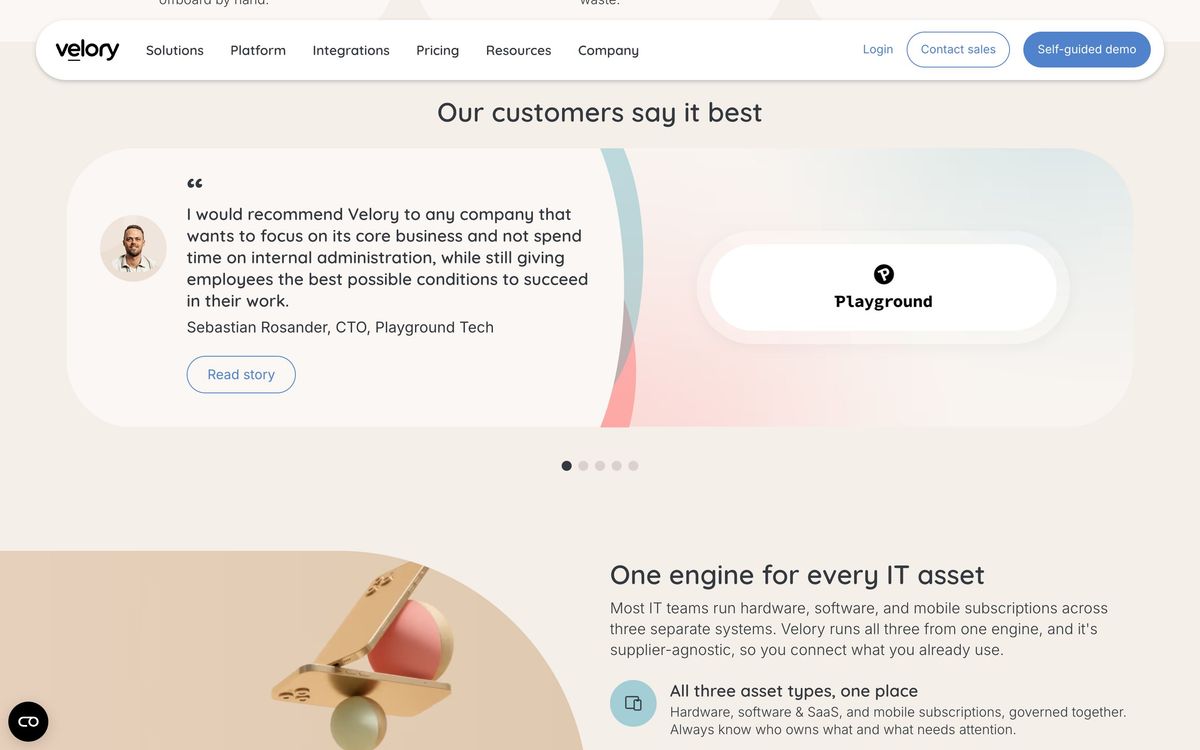
- Central register of hardware, accessories, licences and mobile subscriptions with owner and cost
- Employee store constrained by company policy, budget and approval rules
- Automated onboarding, upgrade, repair and offboarding workflows driven by HR events
- Direct supplier ordering with delivery tracking for IT and the employee
- Redeployment, refurbishment and recycling paths for end-of-life equipment
- Dashboards and an API for cost reporting into finance systems
Who it's for
Companies between roughly fifty and a few thousand employees, hiring steadily across more than one country, get the most out of this. At that size a spreadsheet has already failed, the MDM knows which machines are enrolled but not who paid for them or when the lease ends, and IT spends more time on procurement admin than on infrastructure. Velory sits in that gap. It suits organisations where IT, finance and people ops all need the same view of a device, and where employee choice is part of the offer.
It is overkill for a team of fifteen with a cupboard of MacBooks and no leasing arrangements, and it is not a device management tool: it will not push configuration or enforce disk encryption, so it must sit alongside Jamf or Intune rather than replace them. Companies buying nearly all hardware through one large reseller with its own portal may find the procurement layer duplicates what they have.
How it compares
Hofy and Firstbase go further into logistics, holding stock and shipping equipment worldwide as a service, which suits fully remote teams but costs more and gives up supplier choice. Workwize sits close to Velory in scope with a stronger global warehousing story. Traditional asset tools such as Snipe-IT are cheap or free and track devices well, but have no procurement flow, no employee store and no HR triggers, so the data goes stale exactly where Velory keeps it current. Against all of them Velory's clearest advantage is the employee-choice store combined with the circular disposal path.
Verdict
Velory earns its place for teams whose device fleet has outgrown a spreadsheet but does not justify a service-management suite. Reviewers consistently describe a setup that takes hours rather than weeks, and the budget control is real: someone in finance can see committed spend per employee without asking IT. Two things temper the recommendation. Quote-only pricing means evaluation starts with a sales conversation, which is friction for a mid-sized buyer comparing options, and the offboarding path still requires manual reconciliation of returned hardware. Neither is disqualifying, but both are worth testing in a trial before signing a year.
Ready to try Velory?
More developers tools like Velory
Getscreen.me
4.1Browser-based remote desktop for IT teams, billed per technician seat plus per managed device.
Read Getscreen.me review →IDrive
3.9Cloud backup covering computers, phones, servers and NAS devices under one account and one storage pool.
Read IDrive review →Passpack
3.9Zero-knowledge password manager for small teams and the MSPs that administer their credentials.
Read Passpack review →Netlify
4.6Hosting and deployment platform with Git-based CI/CD, deploy previews, serverless functions, and AI workflows.
Read Netlify review →Pinecone
4.5Fully managed serverless vector database for similarity search, RAG, and agent memory at billion-vector scale.
Read Pinecone review →Runpod
4.5GPU cloud for AI workloads: on-demand instances, serverless inference endpoints, and multi-node clusters.
Read Runpod review →