
Devs.ai review
Enterprise platform for building governed AI apps and agents on company data, with 2,000+ integrations.
Best at rolling out AI agents across an organization with IT-grade governance and model flexibility; the tradeoff is an enterprise focus that gives solo builders less value.
Pros
- LLM-agnostic: build once and switch between 20+ models as better ones ship
- Governance built in: SSO, role-based access control, and approval before agents ship
- Usage analytics and spend visibility across every app and agent
- 2,000+ prebuilt integrations connect agents to the existing tech stack
- Uploaded data stays private and is not used to train public models
Cons
- Enterprise-shaped product; individuals and tiny teams won't use most of it
- Smaller community and thinner public documentation than major agent platforms
- Younger vendor competing against hyperscaler-backed alternatives
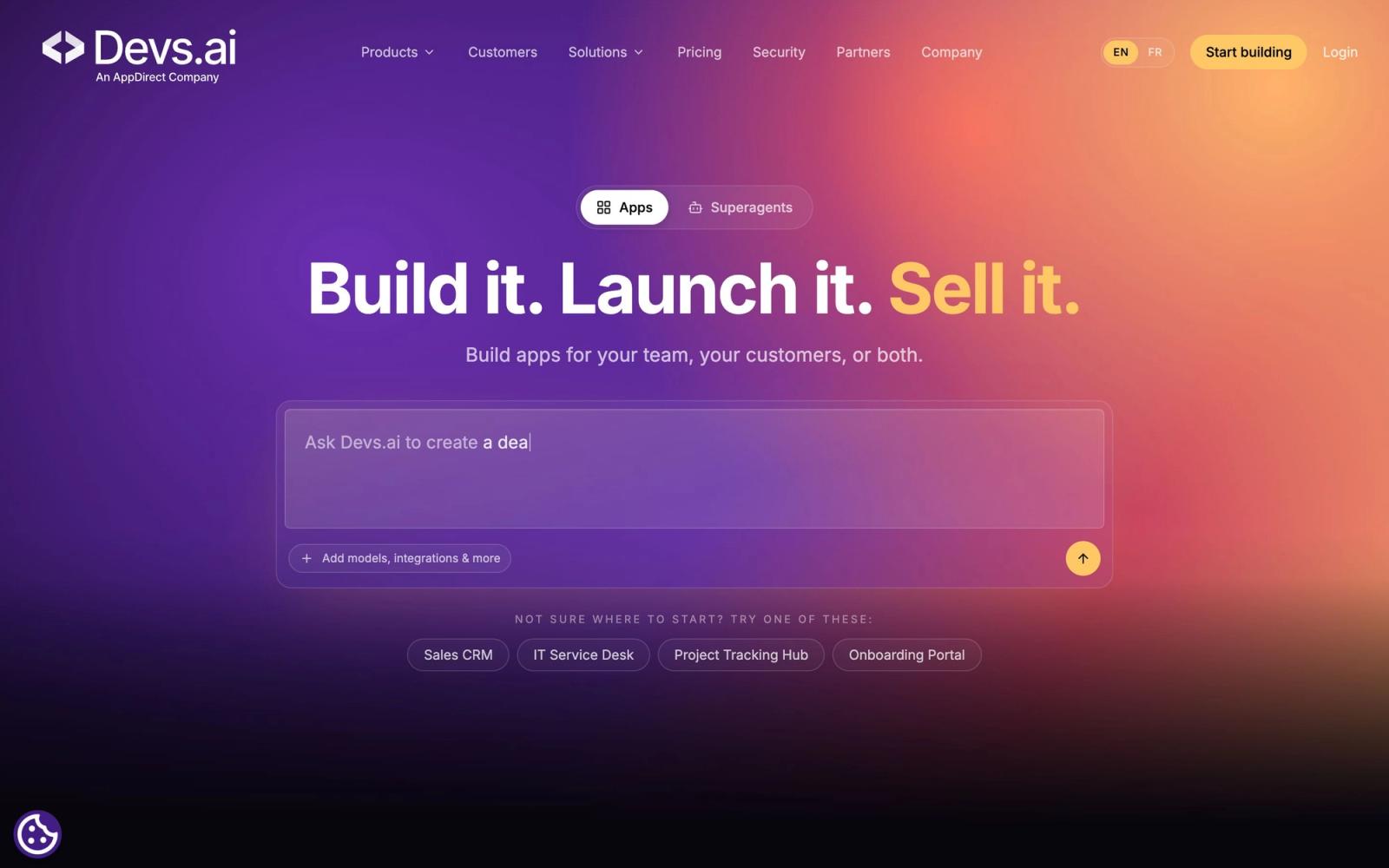
Devs.ai is an enterprise AI app builder for creating, deploying, and governing AI applications and custom agents inside an organization. Where consumer-facing builders optimize for speed from prompt to prototype, Devs.ai optimizes for the questions IT departments actually ask: who is allowed to build agents, what data can they touch, which models are they calling, what is it costing, and who approved this before it shipped. That governance-first framing is the product's identity.
What Devs.ai actually does
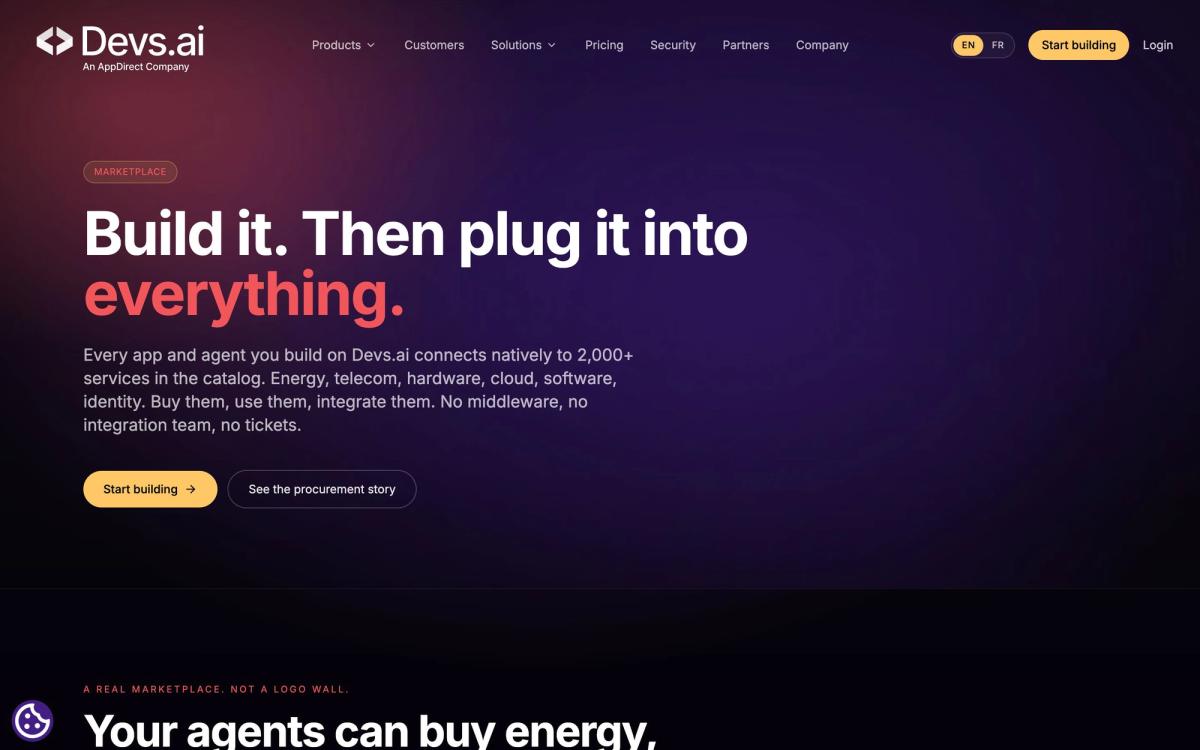
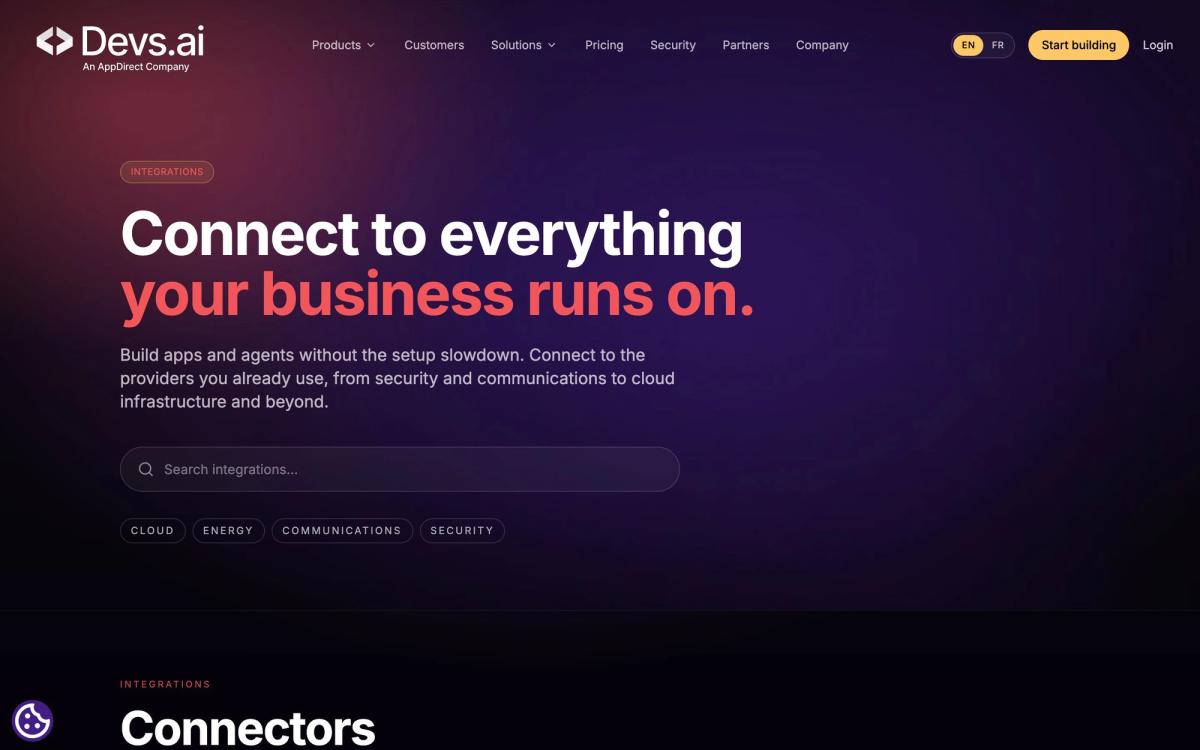
The platform lets teams build AI apps and agents on top of their own company data, then distribute them internally to teams or externally through marketplaces. Building is no-code and conversational, in the vibe-coding style, but every app and agent operates inside policies that IT defines and the platform enforces. Single sign-on and role-based access control determine who builds, who uses, and who sees what; agents require approval before they ship; and usage analytics with spend visibility cover the whole deployment. The model layer is deliberately agnostic: rather than binding you to one provider, Devs.ai exposes a library of more than twenty LLMs that updates as new models emerge, so an agent built today can switch to a better model later without re-integration work. Connectivity is the other pillar, with over 2,000 prebuilt integrations spanning tools like GitHub, Jira, Confluence, and OneDrive, letting agents read from and act on the systems a business already runs. Data uploaded to the platform stays in private workspaces and is not used to train public models.
Key features
- No-code building of AI apps and custom agents grounded in company data
- LLM-agnostic model library with 20+ models and automatic catalog updates
- SSO and role-based access control over building, usage, and visibility
- Approval workflows so agents are vetted before deployment
- Usage analytics and spend visibility across all apps and agents
- 2,000+ integrations with business systems, plus distribution to teams or marketplaces
Who it's for
Devs.ai fits mid-size and large organizations that want to move past scattered, unsanctioned AI experiments to a managed program: IT leaders consolidating agent sprawl, operations teams automating workflows over internal data, and companies that want employees building AI tools without each one becoming a security review. A free sign-up makes initial evaluation easy. It is a poor match for solo developers and hobbyists, who will find the governance machinery irrelevant overhead, and for engineering teams that want code-level control of agent behavior rather than a managed no-code layer.
How it compares
MindStudio is the closest comparable: also no-code, also multi-model, with a strong template ecosystem and a friendlier on-ramp for individual builders, but lighter on the enterprise governance stack that defines Devs.ai. Botpress comes from the conversational-agent side with deeper developer extensibility and an open-source heritage, at the cost of more assembly work for enterprise controls. Against both, Devs.ai's differentiators are the approval-and-policy layer, spend visibility, and the breadth of stack integrations; its weakness is a smaller public footprint, community, and documentation base than its rivals have built.
Verdict
Devs.ai makes a credible case for being the sanctioned way a company does AI agents: model flexibility prevents lock-in to any single LLM vendor, the governance layer answers the questions that stall enterprise AI rollouts, and the integration catalog means agents can do real work in real systems from day one. The rating reflects honest uncertainty: it is a younger vendor in a crowded category, and public evidence of large-scale deployments is thinner than for the established platforms. For organizations whose blocker is governance rather than capability, it deserves a serious pilot; for individual builders, lighter tools will serve better.
Ready to try Devs.ai?
There's a free tier, so you can test it before committing.
More developers tools like Devs.ai
CrowdStrike
4.4Cloud-delivered endpoint protection with one lightweight agent, sold to small teams as fixed per-device bundles.
Read CrowdStrike review →NinjaOne
4.4Endpoint management and RMM platform for monitoring, patching, backing up and remotely supporting company devices.
Read NinjaOne review →Bright Data
4.3Proxy network and managed scraping APIs for collecting public web data at production scale.
Read Bright Data review →BugHerd
4.3Visual feedback tool that pins client comments to the exact element on a page and turns them into tasks.
Read BugHerd review →EasyDMARC
4.3Email authentication monitoring that takes a domain from DMARC reporting to enforcement without hand-editing DNS.
Read EasyDMARC review →Freshservice
4.3Cloud IT service desk with asset discovery and low-code workflows for teams that want ITSM without a ServiceNow project.
Read Freshservice review →