
Demodesk review
AI agents for sales conversations: recording, transcription, coaching, CRM updates, and pipeline insights.
Demodesk is best at automating the admin around sales calls, notes, CRM updates, follow-ups, and coaching, though teams wanting a full revenue intelligence suite may outgrow it.
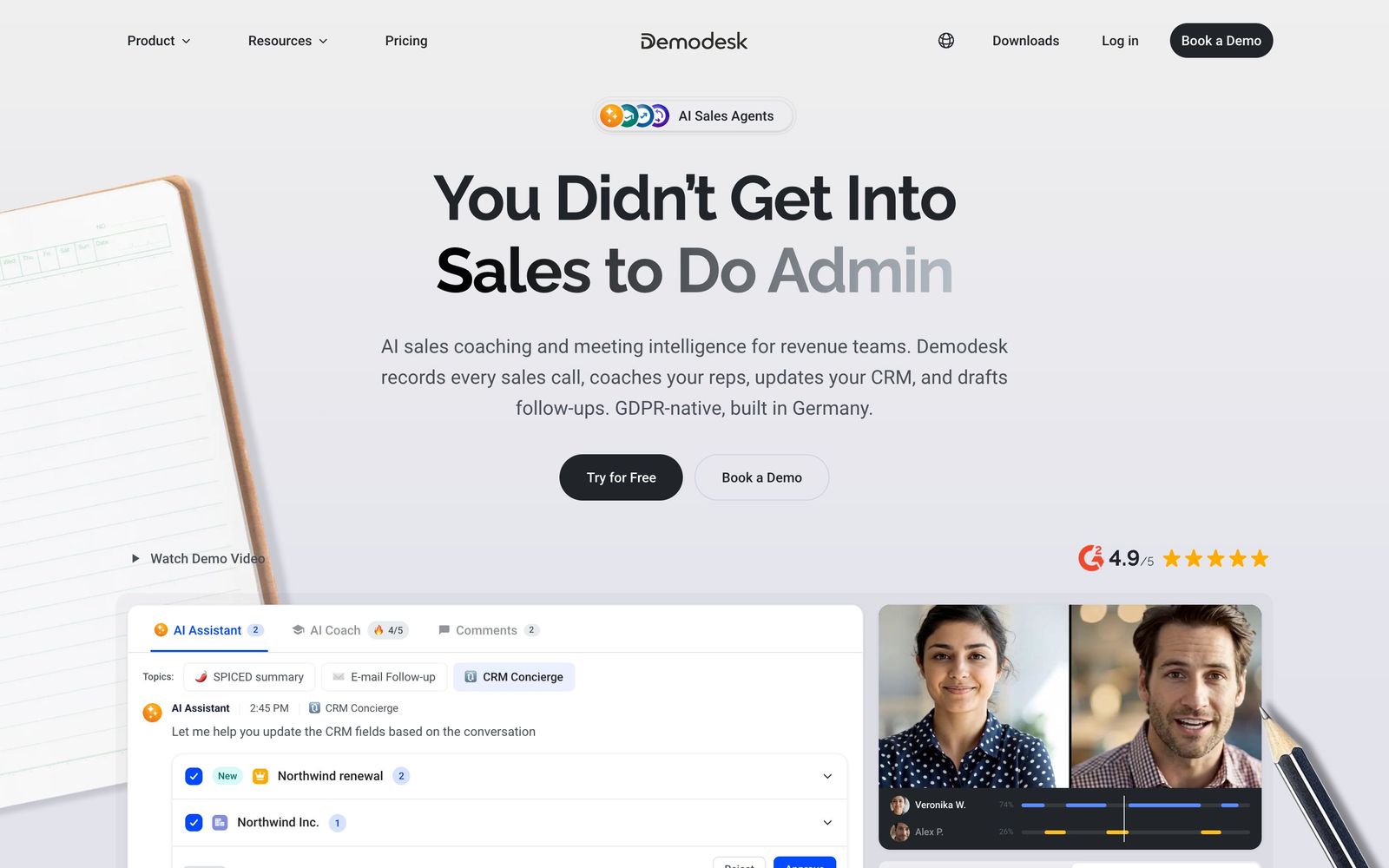
Pros
- Five specialized AI agents cover notes, coaching, CRM updates, pipeline analysis, and workflow automation
- Transcription supports 98 languages, a real advantage for international teams
- AI Coach scores calls against custom scorecards and flags deal risks
- CRM Concierge updates HubSpot, Salesforce, or Pipedrive fields with zero setup
- Free tier available, plus a 14-day trial of paid plans
Cons
- Smaller ecosystem and community than category leaders like Gong
- Coaching depth depends on configuring scorecards well, which takes upfront effort
- Less suited to teams that only want a lightweight notetaker
Demodesk started as a meeting platform for sales demos and has rebuilt itself around AI agents for sales conversations. Today the product records, transcribes, and analyzes your calls, then puts a crew of specialized AI agents to work on everything that normally eats a rep's afternoon: writing notes, updating the CRM, drafting follow-ups, scoring calls against coaching frameworks, and surfacing pipeline insights. It competes in the conversation intelligence category, but its emphasis is less on dashboards and more on doing the work.
What Demodesk actually does
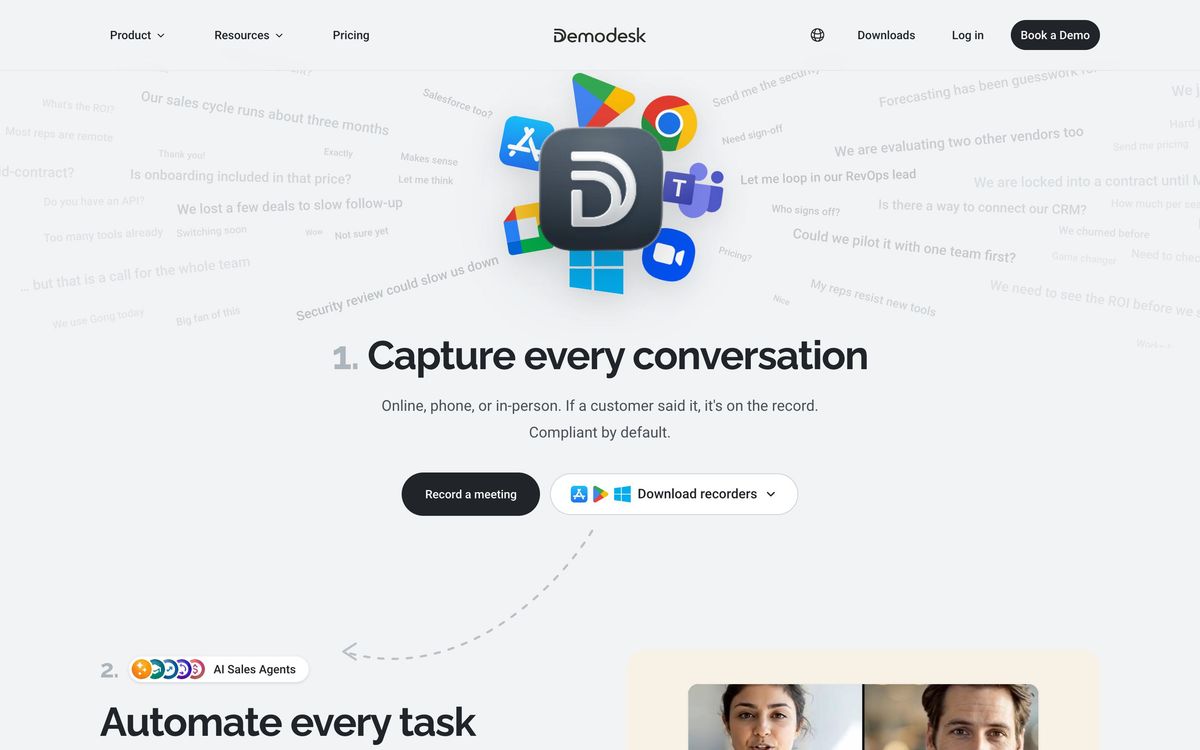
The platform joins your meetings on Zoom, Microsoft Teams, or Google Meet, with a mobile app to capture phone and in-person conversations. Transcription covers 98 languages, which immediately sets it apart for global teams whose calls are not in English.
On top of the recordings sit five named AI agents. The AI Assistant handles summaries, personalized follow-up drafts, and CRM data entry. The AI CRM Concierge updates CRM fields automatically with what Demodesk claims is zero setup. The AI Coach reviews every call against custom scorecards, identifies deal risks, and feeds manager dashboards, so coaching stops being limited to the handful of calls a manager has time to shadow. The AI Analyst aggregates conversations into pipeline insights, go-to-market analysis, and product feedback. Finally, AI Crew runs background workflows such as follow-up chasing, pipeline updates, and deal escalation. The framing matters: instead of one assistant doing a bit of everything, each agent has a job, and together they aim to remove the administrative layer between conversations and a clean CRM.
Key features
- Automatic recording, transcription, and summaries in 98 languages
- AI Coach with custom scorecards, deal risk flags, and performance dashboards
- Automated CRM field updates for HubSpot, Salesforce, and Pipedrive
- AI-drafted personalized follow-up emails after every call
- AI Analyst for pipeline insights and product feedback extraction
- Mobile app for capturing in-person and phone conversations
- Free tier plus trial, unusual in this category
Who it's for
Demodesk fits B2B sales teams from startup to mid-market where reps run a steady volume of video calls and managers lack time to coach systematically. RevOps teams get value from the CRM hygiene automation alone, since unreliable CRM data undermines every downstream report. Multilingual teams are an especially good match given the language coverage. It is less compelling for enterprises wanting a full revenue intelligence platform with years of benchmark data, or for solo founders who only need a notetaker.
How it compares
The giant in conversation intelligence is Gong, which offers deeper revenue analytics, forecasting, and a larger integration ecosystem, at enterprise pricing and enterprise sales cycles. Demodesk positions underneath that: faster to deploy, cheaper to start, and more focused on automating rep workflows than on executive analytics. Against Spiky.ai, another challenger we review, Demodesk leans harder into CRM automation and its agent crew, while Spiky emphasizes real-time in-call guidance. Teams using engagement platforms like Apollo or Reply.io for outbound will find Demodesk complementary rather than overlapping: those tools get meetings booked, Demodesk handles what happens on and after the call.
Verdict
Demodesk has found a sensible lane in a crowded category: instead of competing with Gong on analytics depth, it competes on how much manual work disappears. The 98-language transcription, scorecard-based coaching, and zero-setup CRM updates are concrete, verifiable strengths, and the free tier lowers the risk of finding out whether it fits. The trade-offs are a smaller ecosystem than the category leader and coaching quality that depends on the effort you put into scorecards. For sales teams whose real problem is admin overhead and inconsistent coaching rather than missing dashboards, Demodesk is a strong, pragmatic choice.
Ready to try Demodesk?
There's a free tier, so you can test it before committing.
More sales tools like Demodesk
Claap
4.1Records sales calls without a bot, writes the notes, fills the CRM and scores the deal against your methodology.
Read Claap review →Apollo.io
4.3The default B2B contact database and SDR prospecting suite: huge data reach paired with built-in sequencing and dialing.
Read Apollo.io review →Blinq
4.3Digital business cards and event lead capture that push enriched contacts with context into the CRM.
Read Blinq review →PandaDoc
4.3Proposal, quote and e-signature software that tracks what a buyer reads before they sign.
Read PandaDoc review →Storylane
4.3Interactive product demos captured from a browser, embedded on a site or sent after a sales call.
Read Storylane review →Cognism
4.2B2B contact database with human-verified mobile numbers and compliance-checked records, strongest across Europe.
Read Cognism review →