
Blinq review
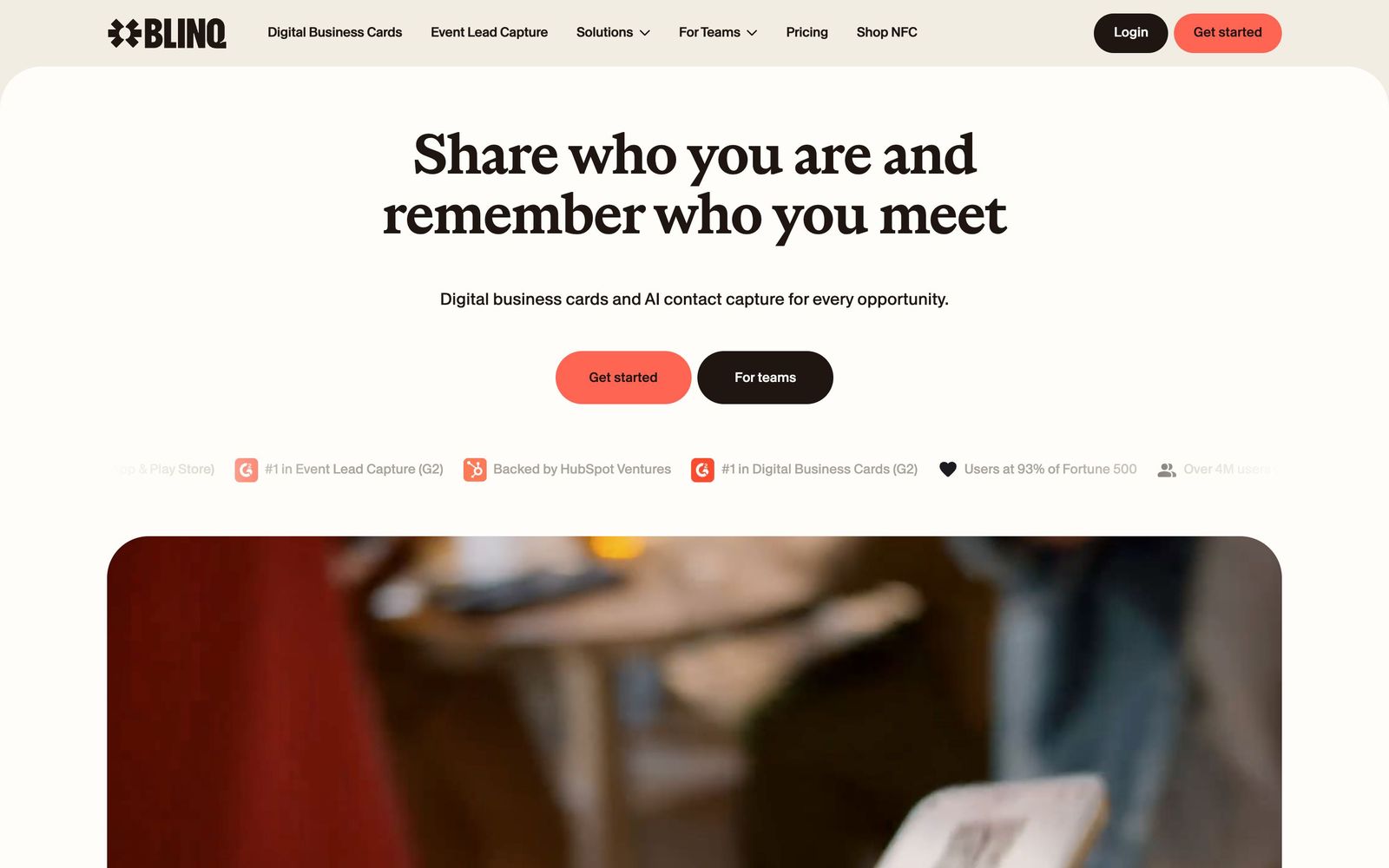
Digital business cards and event lead capture that push enriched contacts with context into the CRM.
The most polished digital business card product, and a credible event lead capture tool on the team plan, though it solves a narrow slice of the pipeline.
Pros
- Recipients open a card in the browser with no app to install, over QR code, NFC tap, link, wallet pass or text
- The scanner reads badges and paper cards and enriches missing fields, which is faster than typing a stack of cards after an event
- An AI notetaker attaches conversation context to the contact, so follow-up references something specific rather than a name
- Admin controls cover team card templates, email signatures, automated provisioning through Entra and a shared corporate contact book
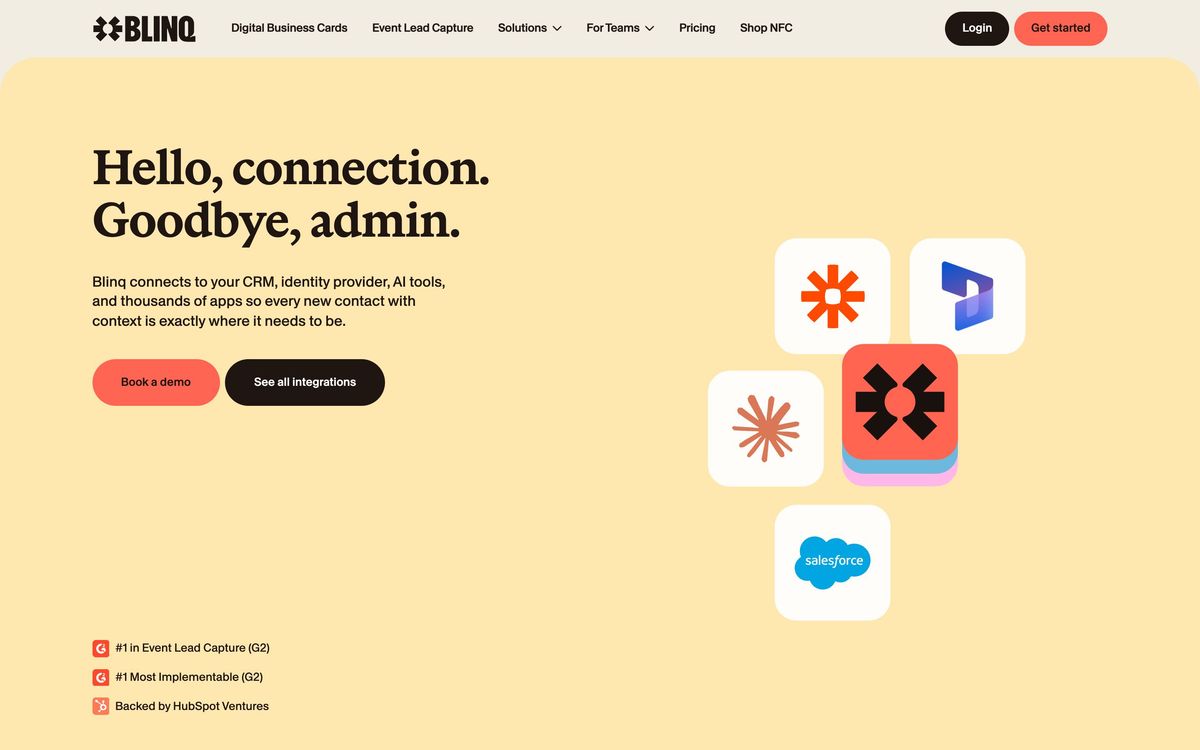
- Native CRM writes into HubSpot, Salesforce and Dynamics mean captured contacts land where the pipeline lives
Cons
- The free tier is a personal card with no scanner, no enrichment and no export, so any real use requires a paid plan
- Users report limits on how many links a single card can carry, which is awkward for anyone maintaining separate offers for different audiences
- The scope is narrow: it captures and routes contacts but does nothing about sequencing, qualification or the follow-up itself
Blinq pricing
List prices in USD per month, taken from the vendor at review time.
| Plan | Per month | What it covers |
|---|---|---|
| Free | Free | two personal cards, unlimited sharing, wallet passes |
| Premium | $9.99 | per user, billed monthly; scanner, AI notetaker, enrichment, export |
| Business | $6.99 | per user, billed monthly for teams; adds admin controls, lead capture and CRM integrations |
What Blinq actually does
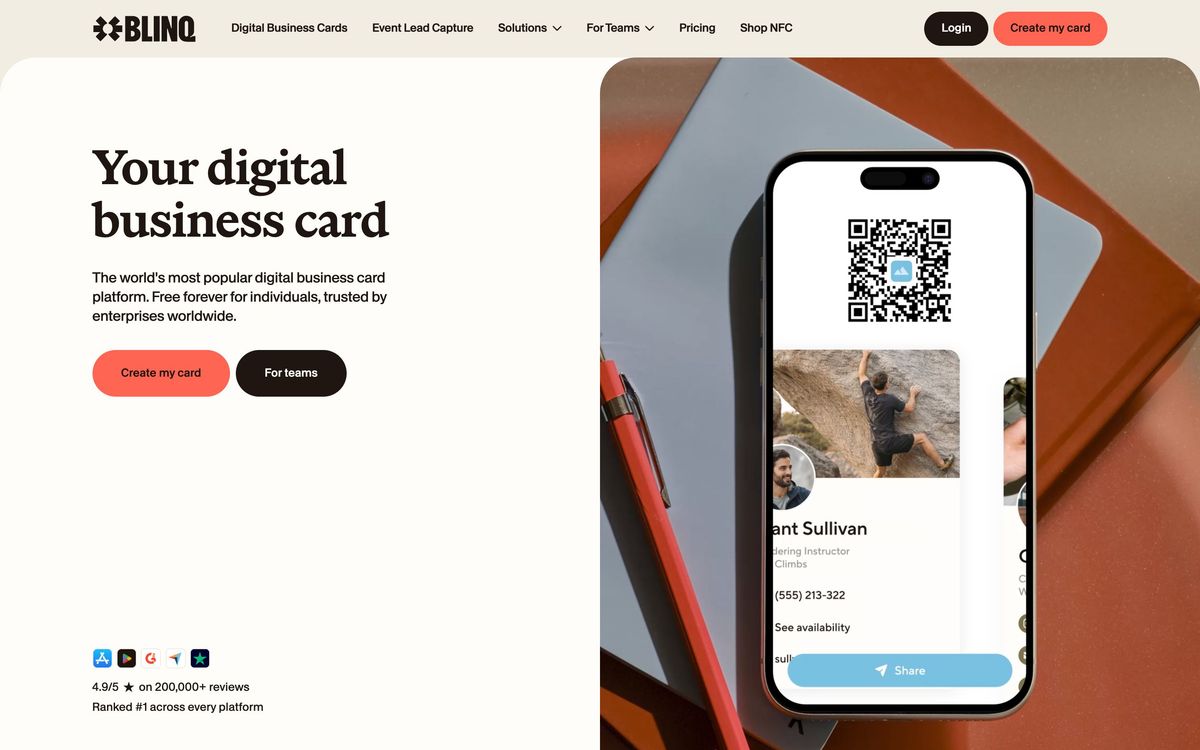
Blinq started as a digital business card and has grown into a contact capture system for people who meet prospects in person. The card itself is a hosted page carrying a name, role, photo, links and contact details, shared by QR code, a tap from an NFC card, a link, a wallet pass, an email signature or a text message. Nothing is installed on the recipient's phone, which is the whole point: the person on the other side of the handshake gets a page in their browser and a contact they can save in one action.
The part that changes what the product is for sits on the team plans. A universal scanner reads conference badges and paper cards and fills in details the scan missed using enrichment data. An AI notetaker captures what was discussed and saves it against the contact rather than leaving it in someone's memory of a busy afternoon. Captured contacts can be tagged by event or campaign, qualified with custom fields, and written straight into HubSpot, Salesforce or Dynamics. Administrators control card templates, email signatures and provisioning centrally, so a large sales organisation presents one identity and its contact data lands in one place.
Key features
What the paid tiers add over a well-formatted contact page:
- Cards shared by QR code, NFC tap, link, email signature, wallet pass or text, with no app on the recipient's side
- Universal contact scanner for badges and paper cards, with automatic enrichment of missing fields
- AI notetaker that converts a conversation into notes attached to the contact record
- Event lead capture with campaign tagging, custom qualifiers and branded capture forms
- Native writes into HubSpot, Salesforce and Microsoft Dynamics, with follow-up triggers
- Admin platform covering card templates, managed email signatures, Microsoft Entra provisioning and team analytics
Who it's for
The strongest case is a sales or partnerships team that spends real money on conferences and then loses the contacts. A rep who scans thirty badges over two days and arrives home with enriched records, notes on each conversation and everything already in the CRM has recovered more of that budget than any amount of post-event data entry would. Field teams, recruiters working career fairs and account managers at client sites get the same benefit at smaller scale.
It is unnecessary for anyone whose selling happens entirely over email and video, where a link in a signature covers the need. The free tier is also worth reading carefully before recommending it internally: it gives an individual a card, but the scanner, the enrichment, the notes and contact export all sit behind a paid plan, so a team evaluating it for lead capture is evaluating the paid product. And it should not be mistaken for a sales tool in the wider sense - it captures and routes, and stops there.
How it compares
Popl and HiHello are the closest competitors on digital cards. Popl leans hardest on physical NFC accessories and team pricing, HiHello has the friendlier free tier and better manual card design, and both are lighter on enrichment and event capture than Blinq's business plan. Dedicated event lead retrieval tools, the kind rented from the conference organiser, capture badge data reliably but cost per event, expire with it and rarely integrate anywhere useful. Blinq sits between the two, which is a good position as long as a team attends enough events to justify a standing subscription.
Verdict
Blinq is the most polished product in a small category and has moved past it: the card is the entry point, and the reason to pay is the capture, enrichment and CRM plumbing behind it. Adoption is easy, since sharing a card requires no explanation, and the admin controls are genuinely enterprise-grade. The caveat is scope. It fixes one gap - the distance between meeting someone and having a usable record in the CRM - and does nothing about what happens next. Buy it for the teams who are in the room with prospects, not as a line item for everyone.
Ready to try Blinq?
There's a free tier, so you can test it before committing.
More sales tools like Blinq
Springbolt ID
3.1Site pixel that names individual US visitors and hands the contact record to Clay or a CSV.
Read Springbolt ID review →CrankWheel
4.0Screen sharing a prospect can open on a phone in seconds, with no download, account or install.
Read CrankWheel review →ZoomInfo
4.0B2B contact and company database with buying-intent signals, sold as an annual platform to full sales teams.
Read ZoomInfo review →Bitscale
3.9Spreadsheet-style GTM data layer that runs enrichment waterfalls and buying signals into a CRM.
Read Bitscale review →Bookyourdata
3.9Self-serve B2B contact database sold in credit packs instead of seats, with verification run at export.
Read Bookyourdata review →SalesRabbit
3.9Field sales platform for door-to-door teams: territory canvassing, lead tracking, contracts and rep performance.
Read SalesRabbit review →