
FullEnrich review
B2B waterfall enrichment that cascades 20+ data vendors to find verified emails and mobile numbers.
FullEnrich delivers some of the highest contact find rates available by cascading 20+ providers and charging only for results, but it is an enrichment layer, not a prospecting database.
Pros
- Waterfall approach queries 20+ premium vendors (Clearbit, Hunter, ContactOut, and more) instead of one database
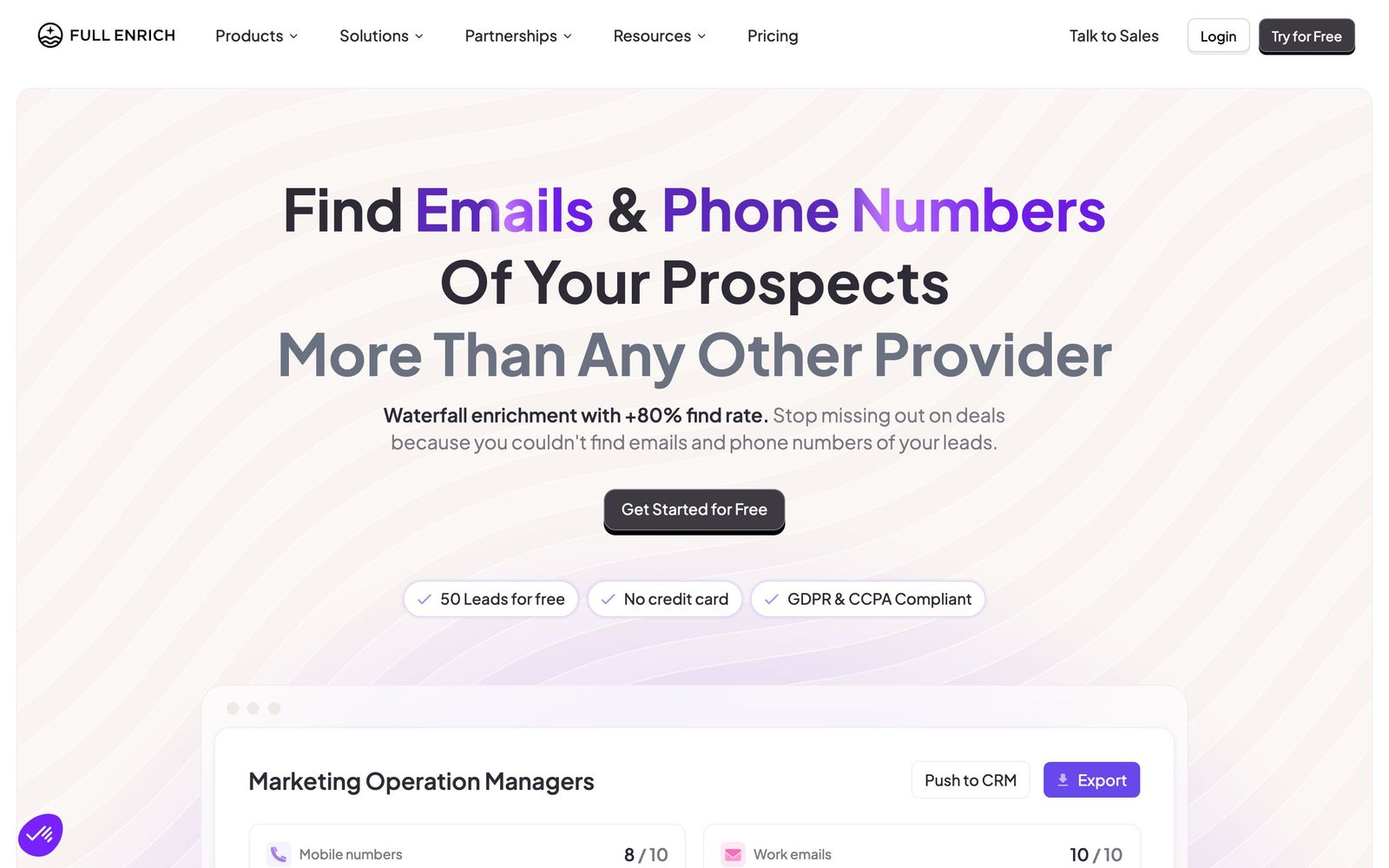
- Strong advertised find rates, around 80% for mobile numbers, with email verification across multiple sources
- Credits are only consumed when valid contact data is actually found
- Coverage holds up outside the US, with solid results across EMEA, LATAM, and APAC
- Connects to CRMs, Zapier, Make, and a direct API for automated workflows
Cons
- No ongoing free plan, just starter credits to test the service
- Enrichment only: you bring your own lead lists, there is no prospecting database
- Credit costs add up at high volume compared with flat-rate single-source tools
FullEnrich is a B2B data enrichment tool built around a simple insight: no single contact database is good enough. Instead of selling you access to one dataset, FullEnrich runs waterfall enrichment, cascading your lookup through more than twenty premium data vendors, including names like Clearbit, Hunter, ContactOut, Wiza, and Snov, until it finds a verified work email or mobile number. You pay per result found, not per attempt, which aligns the pricing model with what sales teams actually care about: reachable contacts.
What FullEnrich actually does
You feed FullEnrich a list of people, from a CSV, your CRM, or an automation tool, and it works each record through its vendor cascade. For emails, it cross-checks results across multiple sources and verifies deliverability before charging a credit. For mobile numbers, the waterfall is the whole point: phone data is fragmented across providers, and querying twenty of them is how FullEnrich advertises find rates around eighty percent, well above what most single-source tools achieve. Coverage is notably consistent across regions, with the company publishing find rates in the seventies and eighties across the US, EMEA, LATAM, and APAC rather than only performing well on American data.
The product is deliberately narrow. There is no prospecting database, no sequencer, no dialer. FullEnrich sits between your list-building step and your outreach step, turning names and companies into verified contact details, then handing them off via native CRM integrations, Zapier, Make, or a direct API. Teams notably use it inside Clay workflows and CRM automations, and customers include companies like Aircall, Autodesk, and MongoDB.
Key features
- Waterfall enrichment across 20+ premium B2B data vendors in one query
- Verified work emails cross-checked against multiple sources
- Mobile number discovery with advertised find rates around 80%
- Pay-per-result credit model: failed lookups do not consume credits
- Bulk CSV enrichment plus real-time API for automated pipelines
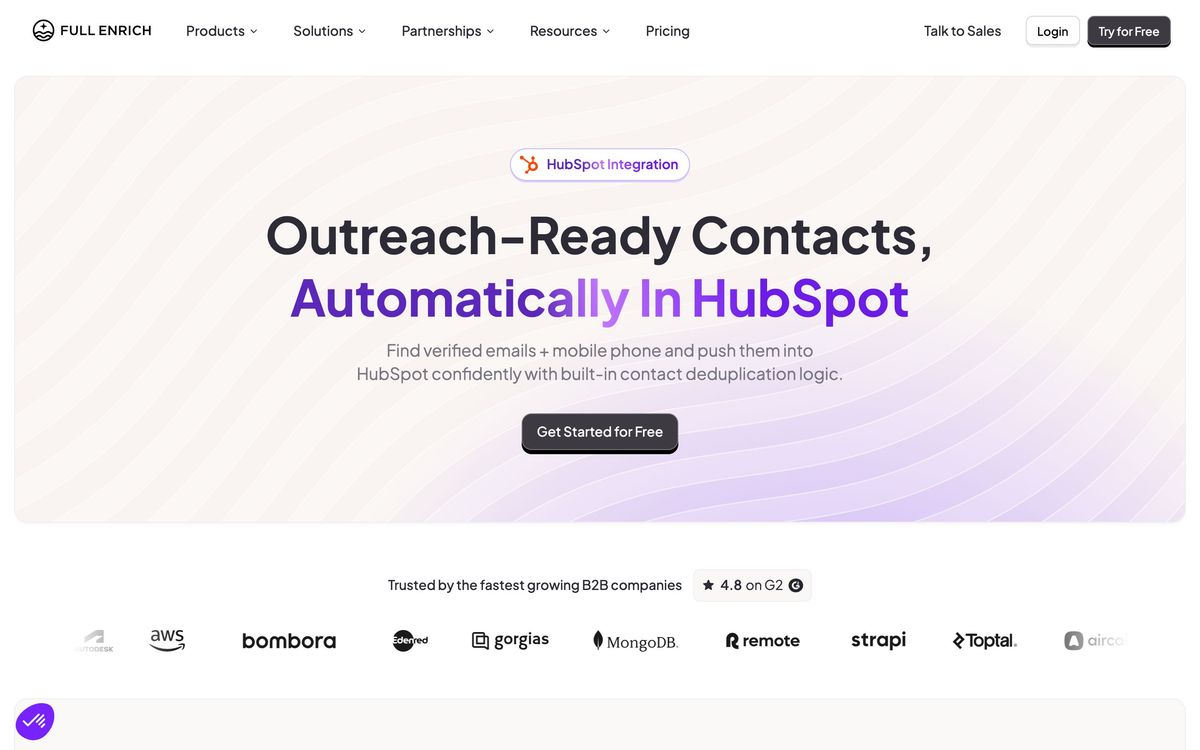
- Native HubSpot and Salesforce connections, plus Zapier and Make
Who it's for
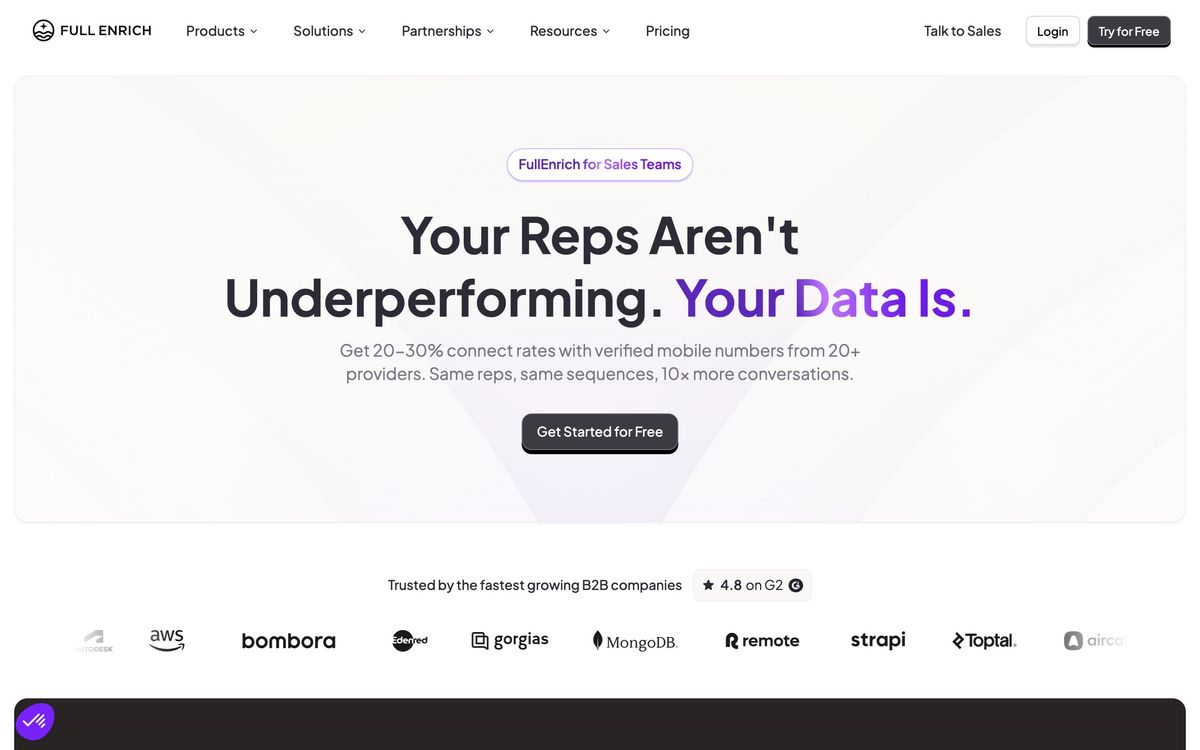
FullEnrich is for outbound sales teams, SDR agencies, and growth engineers who already know who they want to reach and need the highest possible hit rate on emails and especially mobile numbers. Cold-calling teams get the clearest payoff, since mobile coverage is the hardest data problem in outbound. It also suits RevOps teams enriching CRM records at scale through the API. It is not the right tool if you need a database to discover prospects in the first place, or if you only send low volumes where a single cheap source is good enough.
How it compares
The natural comparison is Clay, which also orchestrates multiple data providers. Clay is a flexible workflow canvas where enrichment is one capability among many, with a real learning curve; FullEnrich is a focused enrichment engine that does one thing with minimal setup, and many teams actually run FullEnrich as a provider inside Clay. Against Apollo, the difference is architecture: Apollo is one large proprietary database bundled with engagement tools, strong for discovery but limited to its own coverage, while FullEnrich aggregates the market and typically finds contacts Apollo misses, particularly mobiles and non-US records. A common stack is Apollo or Clay for list building, FullEnrich for the contact data, and a sender like Smartlead or lemlist downstream.
Verdict
FullEnrich earns its positioning as a top waterfall enrichment tool: the find rates are credible because the architecture makes them possible, the pay-per-result model is honest, and the integrations meet teams where they already work. The trade-offs are inherent to the design: it is a single-purpose layer in your stack, not a platform, and heavy usage costs more than a flat single-source subscription. If reachability is your bottleneck, especially for phone-first outbound, FullEnrich is one of the safest picks in the data enrichment category.
Ready to try FullEnrich?
More sales tools like FullEnrich
Blinq
4.3Digital business cards and event lead capture that push enriched contacts with context into the CRM.
Read Blinq review →Cognism
4.2B2B contact database with human-verified mobile numbers and compliance-checked records, strongest across Europe.
Read Cognism review →ZoomInfo
4.0B2B contact and company database with buying-intent signals, sold as an annual platform to full sales teams.
Read ZoomInfo review →Bitscale
3.9Spreadsheet-style GTM data layer that runs enrichment waterfalls and buying signals into a CRM.
Read Bitscale review →Bookyourdata
3.9Self-serve B2B contact database sold in credit packs instead of seats, with verification run at export.
Read Bookyourdata review →Springbolt ID
3.1Site pixel that names individual US visitors and hands the contact record to Clay or a CSV.
Read Springbolt ID review →