
Clay review
A credit-based GTM data workbench that chains 100+ enrichment providers and AI into one spreadsheet.
The most powerful list-building and enrichment tool on the market, but it has a real learning curve and credit costs that punish sloppy workflows.
Pros
- Waterfall enrichment chains many providers per row, pushing email/phone match rates well above single-source tools
- Replaces a whole stack of point tools and scrapers with one programmable spreadsheet-style workbench
- Claygent AI agents handle custom research and personalization that no fixed-schema database can do
Cons
- Steep learning curve and credit-based pricing mean costs are unpredictable and failed lookups still burn credits
- Native Salesforce/HubSpot sync sits on higher tiers, so cheaper plans need manual exports or middleware
Key features
- Waterfall enrichment across 100+ data providers in sequence for higher coverage
- Claygent AI research agents for company/contact research and copy generation
- Spreadsheet-style table interface with formulas, conditional logic, and HTTP/webhook calls
Clay pricing
List prices in USD per month, taken from the vendor at review time. Custom means quote-only.
| Plan | Per month | What it covers |
|---|---|---|
| Free | Free | 100 data credits + 500 actions/mo; no phone enrichment, no CRM sync |
| Launch | $185 | ~2,500 data credits + 15,000 actions/mo; ~$167/mo billed annually |
| Growth | $495 | ~6,000 data credits + 40,000 actions/mo; includes CRM sync; ~$446/mo annual |
| Enterprise | Custom | Custom; reportedly starts ~$30k/yr and scales to six figures for high volume |
What it is and who it's for
This is a go-to-market data workbench that looks like a spreadsheet but behaves like a no-code automation platform. Each row is a person or company, and each column can call out to one of 100+ data providers, run a formula, or fire an AI agent. It's aimed at RevOps and the emerging 'GTM engineer' role, not at reps who just want to pull a list and hit send. If your team wants to design bespoke enrichment and outbound pipelines, this is the category leader; if you want a clean point-and-click prospecting database, you'll find it overbuilt.
Strengths and where it falls short
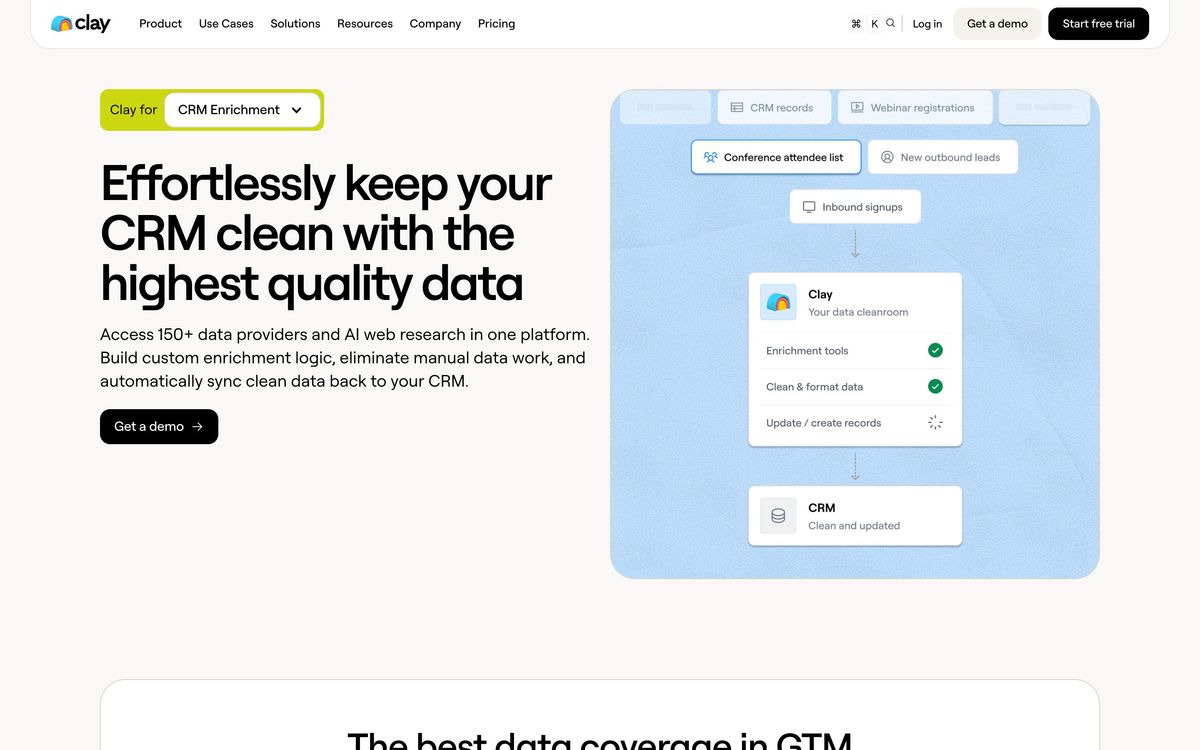
The signature feature is waterfall enrichment: ask for an email or mobile and it queries Provider A, then B, then C until something lands, pushing match rates well past what any one vendor returns alone, and you only pay providers that actually hit. Layered on top, Claygent AI agents can scrape a website, summarize a LinkedIn profile, or draft a personalized opener as just another column, so one tool replaces a tangle of scrapers and subscriptions. The cost is complexity: the learning curve is genuine and most teams need weeks or a consultant to get fluent. The credit model is the bigger gotcha, since actions consume credits at wildly different rates and failed lookups still cost you, so a poorly structured run can drain a month's allotment fast.
Pricing and value
After the March 2026 overhaul, the self-serve lineup is a free tier, Launch around $185/mo, and Growth around $495/mo, with annual billing shaving roughly 10%. The upside of that change is that marketplace data costs dropped sharply and CRM sync moved down to the Growth tier rather than the old $800 Pro plan. Still, both credits and actions are metered, so the sticker price is a floor, not a ceiling. Existing customers on legacy Starter/Explorer/Pro plans should model the new actions system before migrating, because usage patterns translate unevenly.
Compliance and verdict
It's standard US-hosted SaaS, usable worldwide, with SOC 2 Type II and ISO 27001 audits and a published DPA. The honest caveat is data sourcing: because it aggregates 100+ third-party providers, the lawful basis and consent status of any given prospect record varies by provider, and you inherit that exposure, so treat legitimate-interest documentation and suppression as your own responsibility. Overall, for teams that treat outbound as an engineering problem, nothing else matches this combination of provider breadth, AI, and programmability. Go in clear-eyed: you're buying a platform to build on, and the credit meter rewards discipline and punishes guesswork, so skip it if you lack the time to learn it or a clear use case to justify the spend.
Ready to try Clay?
There's a free tier, so you can test it before committing.
More sales tools like Clay
Cognism
4.2B2B contact database with human-verified mobile numbers and compliance-checked records, strongest across Europe.
Read Cognism review →Leadfeeder
4.0Identifies the companies behind anonymous website traffic and pushes the ones that fit your profile into the CRM.
Read Leadfeeder review →ZoomInfo
4.0B2B contact and company database with buying-intent signals, sold as an annual platform to full sales teams.
Read ZoomInfo review →Bitscale
3.9Spreadsheet-style GTM data layer that runs enrichment waterfalls and buying signals into a CRM.
Read Bitscale review →Bookyourdata
3.9Self-serve B2B contact database sold in credit packs instead of seats, with verification run at export.
Read Bookyourdata review →Volza
3.8Customs shipment data turned into buyer and supplier lists, searchable by HS code, product or company.
Read Volza review →