
Leadfeeder review
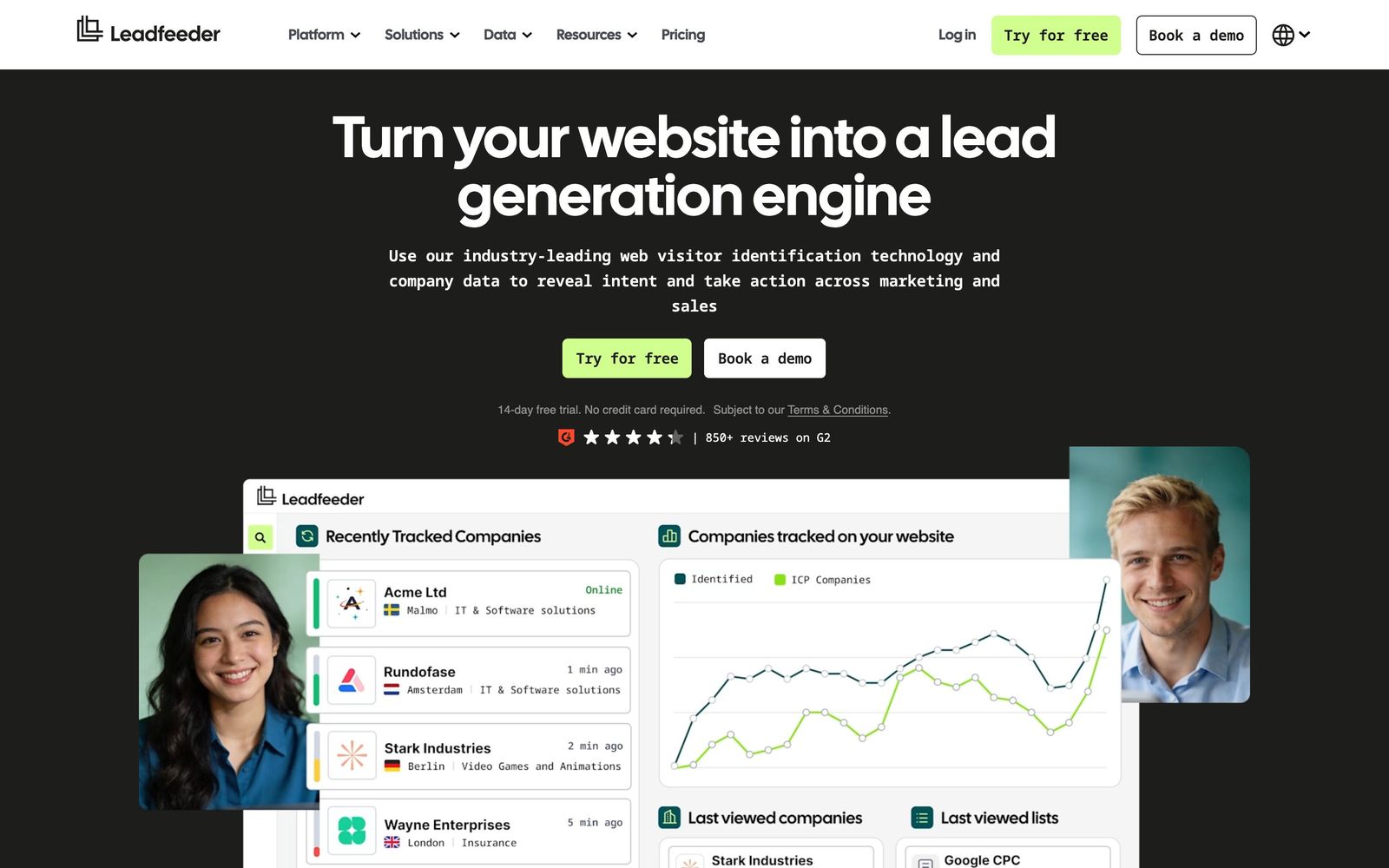
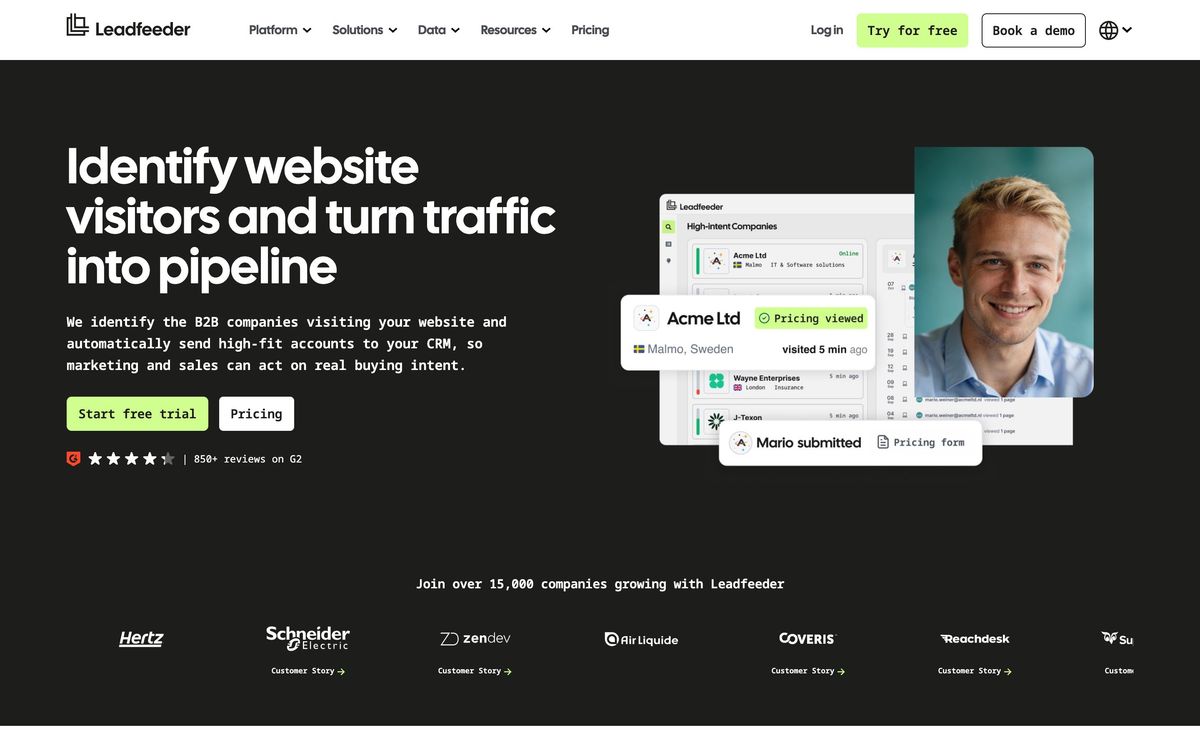
Identifies the companies behind anonymous website traffic and pushes the ones that fit your profile into the CRM.
The strongest option for European B2B teams who want named companies out of their web analytics, though IP-based identification quietly misses remote workers and pricing scales by identified company.
Pros
- Turns anonymous sessions into named companies with the pages they read and how often they return
- More than a hundred filters build a saved audience, so reps see only accounts matching the ideal customer profile
- Two-way CRM sync creates or updates accounts automatically instead of leaving the data in a separate dashboard
- European company data is unusually deep, backed by the Echobot registry the parent company brought in
- The free tier is genuinely usable for validating whether the traffic contains anything worth chasing
Cons
- Identification is IP-based, so anyone browsing from home, a phone network or a coffee shop is never matched, which removes a large share of buyers at remote-first companies
- Coverage outside Europe is noticeably thinner, and teams selling into North America or Asia report weaker matching
- There is no sequencing or cadence tool, so every identified account still needs an outreach product alongside it, and higher tiers are quoted rather than listed
Leadfeeder pricing
List prices in USD per month, taken from the vendor at review time.
| Plan | Per month | What it covers |
|---|---|---|
| Lite | Free | free: last 100 companies a month, 7 days of visitor history, no integrations |
| Discover | $79 | EUR per month billed annually (EUR 113 month-to-month), tiered by identified companies |
| Activate | $369 | EUR per month billed annually (EUR 527 month-to-month), adds contact enrichment and intent filtering |
| Scale | $599 | EUR per month, annual billing only, adds data exports and a customer success manager |
What Leadfeeder actually does
Leadfeeder answers a narrow question with unusual thoroughness: which companies visited the website and what did they read. A tracking script records sessions, the platform resolves the visiting IP address against a business database, and the result is a feed of named organisations with their page history, visit frequency and time on site. Filters then reduce that feed to the accounts worth a rep's attention, matched on industry, size, technology or behaviour, and those accounts are pushed into the CRM or announced in Slack rather than left in a dashboard nobody opens.
The product has a complicated brand history. Leadfeeder merged with the German business data company Echobot, the combined business traded as Dealfront for a period, and the Leadfeeder name has since been put back on the product because visitor identification is what customers recognised. The practical consequence is positive: the European company registry data from that merger sits underneath the identification layer, which is why coverage of German, Nordic and wider EU companies is stronger here than in most American competitors.
Key features
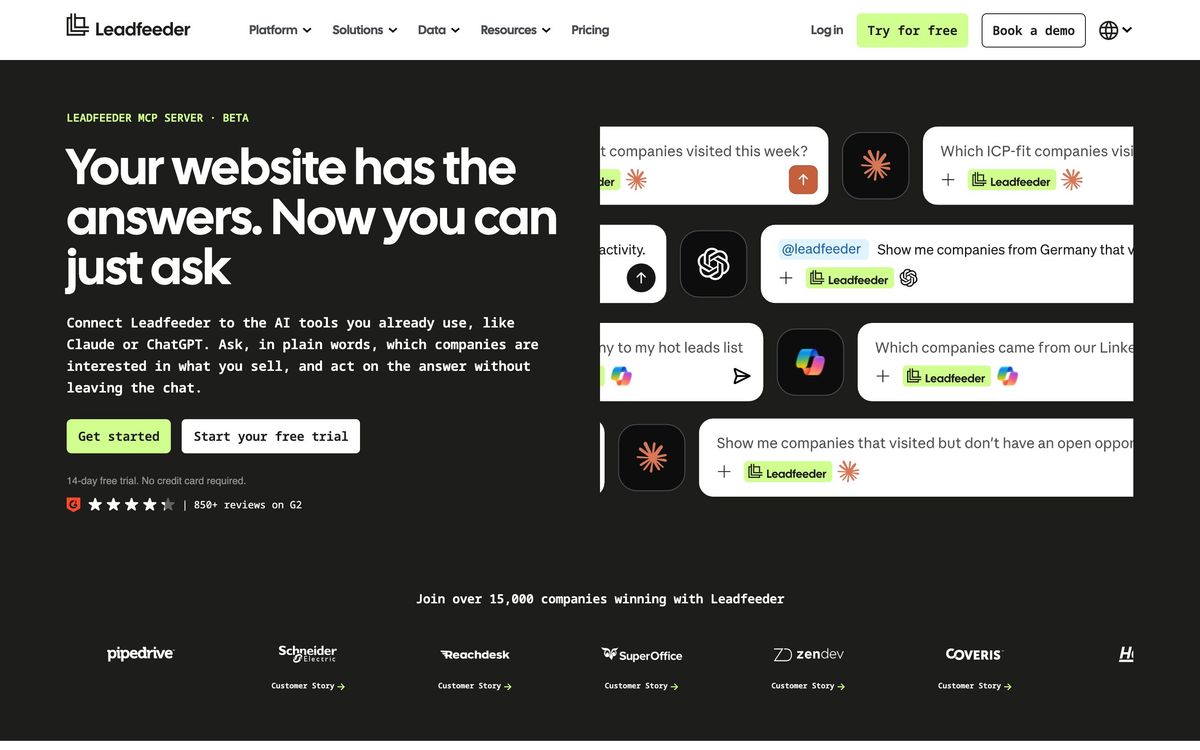
Everything is built around converting one anonymous session into an account a salesperson can act on.
- Company-level identification with the full page history, visit count and recency for each organisation
- More than a hundred filters, saved as feeds, so different reps or territories see different slices of the same traffic
- Automatic creation and updating of accounts in Salesforce, HubSpot, Pipedrive, Dynamics and Zoho, plus Slack alerts
- Contact enrichment and intent filtering on the mid tier, turning an identified company into named people
- Attribution reporting that connects identified companies back to the campaign and landing page that brought them
- Browser extension for checking a company while browsing, and a Looker Studio connector for external reporting
Who it's for
The natural buyer is a B2B company with a considered sales cycle, meaningful organic or paid traffic, and a sales team willing to work outbound from a list of warm accounts. It is at its best in Europe, where the underlying registry data is deepest and where GDPR-conscious buyers appreciate that identification stops at company level rather than naming individuals. Marketing teams also use it to prove that a campaign brought in the right kind of company, not just volume.
It is a bad purchase for businesses selling to consumers, for anyone whose traffic is mostly small or informal organisations that no registry will resolve, and for teams expecting person-level identification. It is also a partial solution by design: nothing here sends an email. Any team buying it needs a sequencing tool and the discipline to work the feed daily, otherwise the alerts become noise within a fortnight.
How it compares
Albacross is the closest European alternative and is often cheaper for straightforward identification, with a lighter feature set around filtering and enrichment. Clearbit, now part of HubSpot, does reveal-and-enrich well inside that ecosystem and is the obvious choice for teams already committed to it, but its European coverage is weaker. RB2B and its peers push toward person-level identification in the United States, which converts better and carries a heavier privacy question that many European legal teams will not accept. Leadfeeder sits between them: company-level, privacy-defensible and strongest on its home continent.
Verdict
Leadfeeder does a real job well. The identification is accurate where the data is good, the filters keep the feed workable, and the CRM integrations mean the insight lands where reps already are. Buyers should go in clear-eyed about two things. The IP-based method structurally misses anyone working from home or a mobile network, so the identified share of traffic will be a fraction of the total rather than most of it, and pricing tiers by identified companies, which means costs climb with traffic rather than with results. As one input into an outbound motion it earns its place; as a lead source on its own it will disappoint.
Ready to try Leadfeeder?
There's a free tier, so you can test it before committing.
More sales tools like Leadfeeder
Lusha
4.1B2B contact data with a LinkedIn extension, sold per seat and metered by credits.
Read Lusha review →RocketReach
4.0Contact-lookup tool covering 700M+ profiles, built for finding emails and phones to fuel outbound lists.
Read RocketReach review →ZoomInfo
4.0B2B contact and company database with buying-intent signals, sold as an annual platform to full sales teams.
Read ZoomInfo review →Bitscale
3.9Spreadsheet-style GTM data layer that runs enrichment waterfalls and buying signals into a CRM.
Read Bitscale review →Bookyourdata
3.9Self-serve B2B contact database sold in credit packs instead of seats, with verification run at export.
Read Bookyourdata review →Volza
3.8Customs shipment data turned into buyer and supplier lists, searchable by HS code, product or company.
Read Volza review →