
Volza review
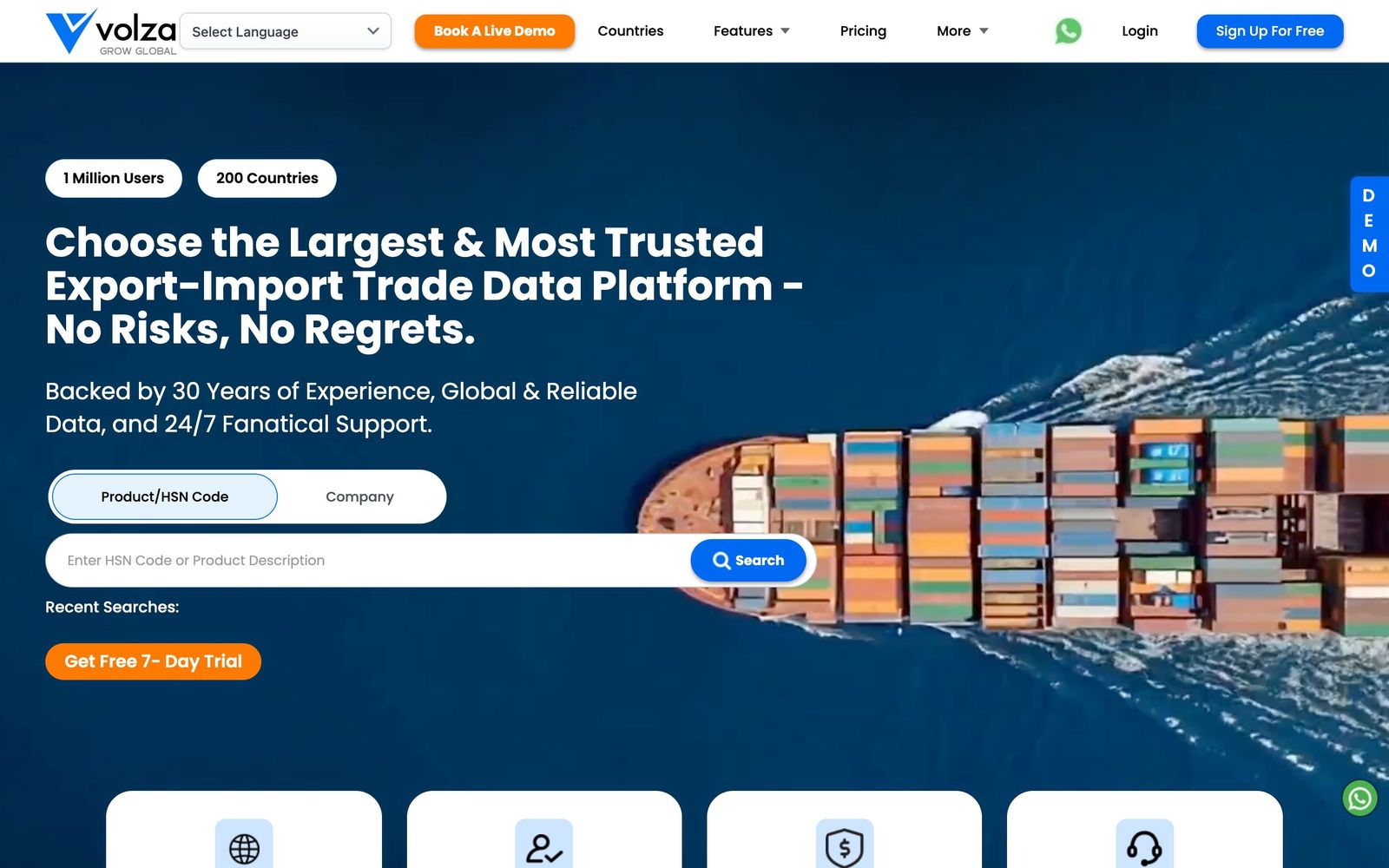
Customs shipment data turned into buyer and supplier lists, searchable by HS code, product or company.
The broadest single subscription for shipment-level trade data and the contacts behind it, though detailed coverage is far narrower than the headline country count suggests.
Pros
- Search runs across shipment-level customs and bill-of-lading records by HS code, product description, company name, country or port
- Many surfaced companies carry decision-maker contacts - direct dials, email, LinkedIn - so a shipment record becomes a callable lead
- Built-in analytics cover trade lanes, time-series comparisons and rising or declining product categories without exporting to a spreadsheet
- Workspaces, saved searches, email alerts and user permissions make it workable for a team rather than a single analyst
- One subscription spans import and export directions instead of buying country databases separately
Cons
- Only around fifty import and forty-odd export databases hold true shipment-level detail; the rest of the advertised country count is mirror, one-sided or statistical data
- Data freshness lags by roughly a month for US records and considerably longer for many other markets, which rules out time-sensitive pricing work
- Reviewers report repeatedly hitting features and markets excluded from their tier, with verified contacts metered separately from search credits
What Volza actually does
Volza is a trade intelligence platform built on customs and bill-of-lading records. Governments in many countries publish, or sell, line-level detail on what crossed their borders: consignor, consignee, product description, HS code, quantity, declared value, port, date, sometimes container number. Volza aggregates those filings into one searchable database and puts an analytics layer on top. A user searches by HS code, product description, company name, country or port, and gets back the shipments that match, along with the companies on either end of them.
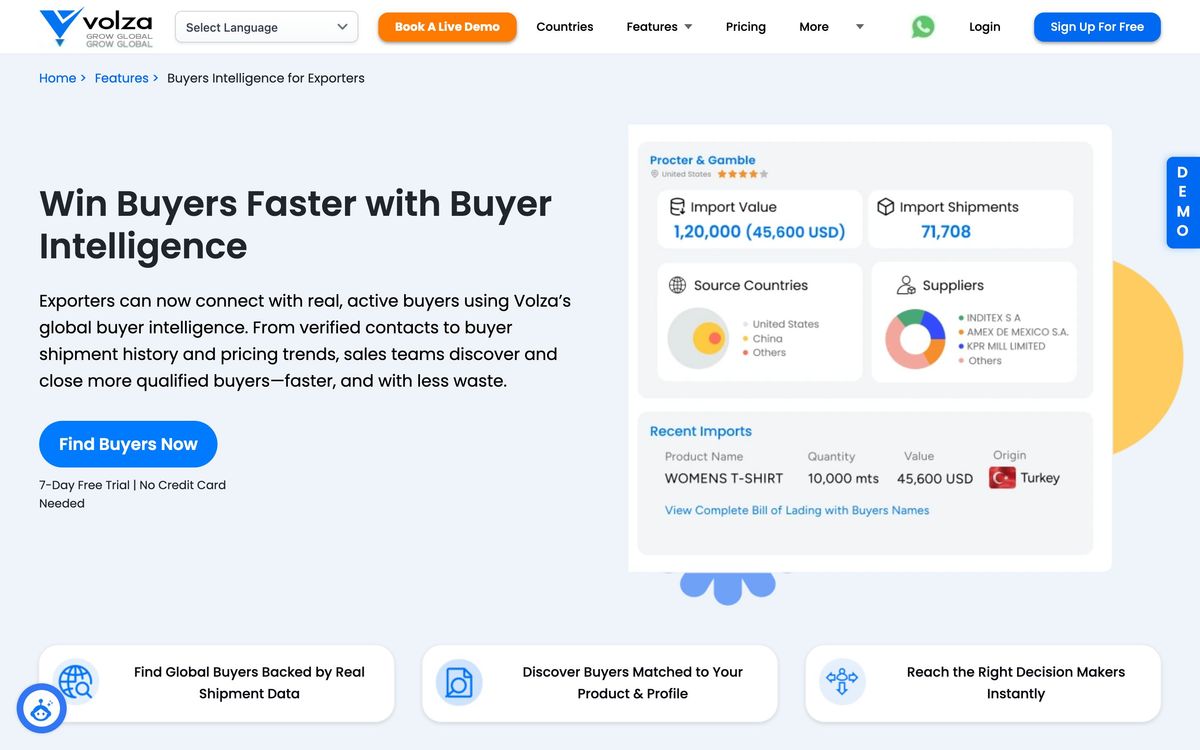
The reason a sales team cares is the second step. A list of importers buying a specific product from a specific origin is a prospect list built from proven purchasing behaviour rather than from firmographics or intent guesswork, and Volza enriches a meaningful share of those companies with decision-maker contacts - direct dials, email addresses, LinkedIn profiles. Around this sits the working furniture: dashboards for trade lanes and volume trends, pivot and time-series analysis, network mapping, saved searches, email alerts when a tracked company or product moves, workspaces with permissions for a team, and a documented REST API on the top tier. Subscriptions run annually and consumption is metered in points, where the cost per record varies by country.
Key features
The platform is a database first and a workflow tool second.
- Shipment search by HS code, product text, company name, origin, destination and port
- Company profiles assembled from trade history, showing what a firm buys, from whom and how often
- Contact enrichment attaching named decision-makers to a portion of surfaced companies
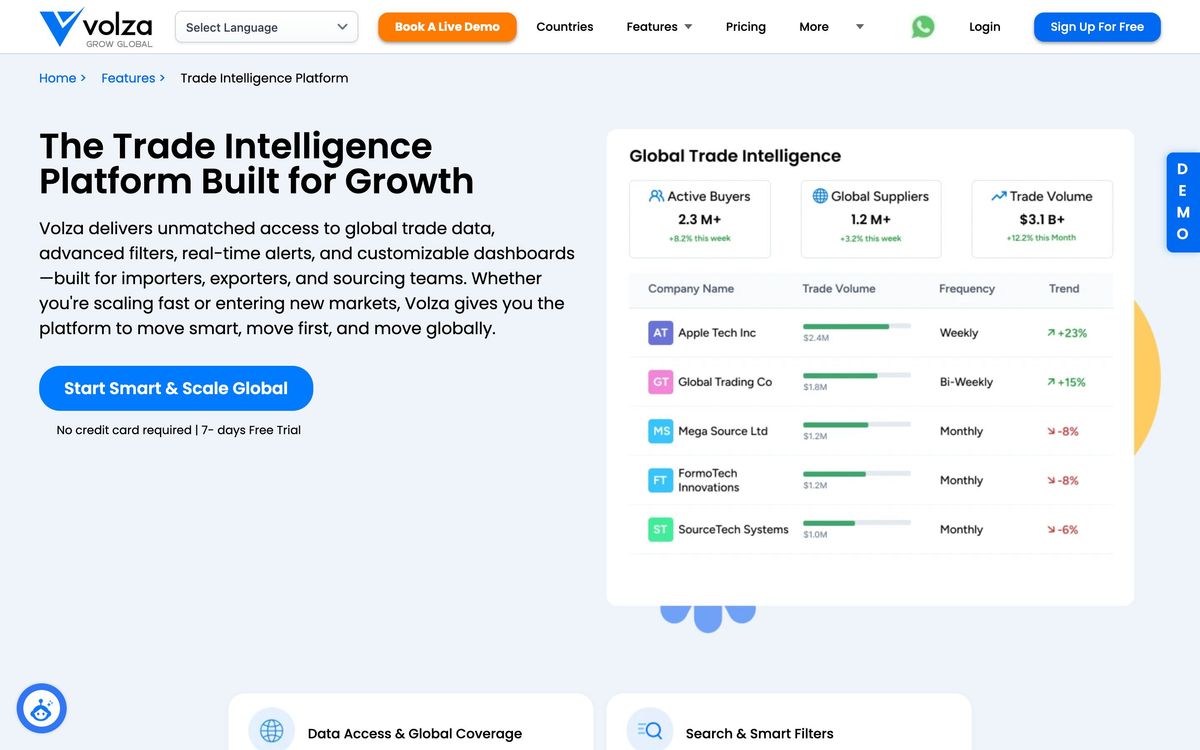
- Analytics for trade lanes, growing and declining categories and year-on-year comparison
- Alerts and saved searches that flag new shipments matching a tracked criterion
- API access to shipments, buyer and supplier insights and contacts for teams building their own tooling
Who it's for
This fits export sales teams selling physical goods into unfamiliar markets, sourcing managers hunting for suppliers who already ship a product at volume, and trade consultants sizing markets for clients. The workflow it supports well is specific: identify who is already buying what you sell, see the volume and frequency, then reach the right person. For that job the data is genuinely hard to replicate.
It is the wrong tool for anyone selling software, services or anything that does not clear customs, and it is a poor fit for a small operator testing an idea, since subscriptions are annual with no cheap monthly entry. Buyers should also be clear about which markets they need before signing, because the entry tier excludes a long list of premium markets and reviewers describe running into that boundary after purchase rather than before.
How it compares
ImportYeti is the free and much shallower option, useful for spot-checking a single US supplier relationship and not much more. Panjiva, now part of S&P Global, has cleaner entity resolution and better analyst tooling but is priced for enterprise research departments and gates far more behind bespoke contracts. ImportGenius sits closer to Volza on price and workflow, with strong US and Latin American records but narrower global reach. Volza's pitch against all three is breadth per subscription plus the contact layer, which none of the others match as directly; its weakness against Panjiva is data hygiene and freshness, and against ImportYeti it is simply that a free tool answers the casual question.
Verdict
Volza is a serious dataset with a real use case and an interface that non-analysts can drive, and the contact enrichment turns research output into something a sales team can actually work. The rating reflects two persistent problems rather than any doubt about the core product. Coverage is uneven in a way the marketing does not make obvious - the countries with true shipment-level detail are a fraction of the advertised total, and the rest is statistical padding. And the commercial experience draws consistent complaints: annual commitment, metered points, contacts counted separately, and features that turn out to sit one tier up. Trial it against the specific markets and HS codes that matter before committing to a year.
Ready to try Volza?
More sales tools like Volza
Lusha
4.1B2B contact data with a LinkedIn extension, sold per seat and metered by credits.
Read Lusha review →Leadfeeder
4.0Identifies the companies behind anonymous website traffic and pushes the ones that fit your profile into the CRM.
Read Leadfeeder review →RocketReach
4.0Contact-lookup tool covering 700M+ profiles, built for finding emails and phones to fuel outbound lists.
Read RocketReach review →ZoomInfo
4.0B2B contact and company database with buying-intent signals, sold as an annual platform to full sales teams.
Read ZoomInfo review →Bitscale
3.9Spreadsheet-style GTM data layer that runs enrichment waterfalls and buying signals into a CRM.
Read Bitscale review →Bookyourdata
3.9Self-serve B2B contact database sold in credit packs instead of seats, with verification run at export.
Read Bookyourdata review →