
Bitscale review
Spreadsheet-style GTM data layer that runs enrichment waterfalls and buying signals into a CRM.
The most sensible Clay alternative for a team that knows its enrichment logic already, though the credit pricing and waterfall depth still trail the category leader.

Pros
- Waterfalls sequence more than eighteen contact data providers, so a single lookup escalates until something returns
- Credits are only consumed when a provider returns a valid hit, and formula columns and CRM syncs are free
- Two-way HubSpot sync from the middle tier keeps enriched records flowing back rather than sitting in an export
- Monitors job changes, email bounces and domain issues continuously instead of only at import time
- The table interface is close enough to Clay's that anyone who has used one can work in the other on day one
Cons
- Waterfall depth, workflow flexibility and AI agent behaviour are all thinner than Clay's, which reviewers consistently note
- Salesforce sync is held back to the second paid tier, so most Salesforce shops start at the higher monthly commitment
- The free tier's 200 credits are exhausted in a single list, which makes it a demo rather than a real evaluation
Bitscale pricing
List prices in USD per month, taken from the vendor at review time.
| Plan | Per month | What it covers |
|---|---|---|
| Free | Free | 200 credits, 10+ data sources, 20 action columns |
| Growth | $349 | 15,000 credits, two-way HubSpot sync, API access |
| Booster | $799 | 50,000 credits, Salesforce sync, curated scraping scripts |
What Bitscale actually does
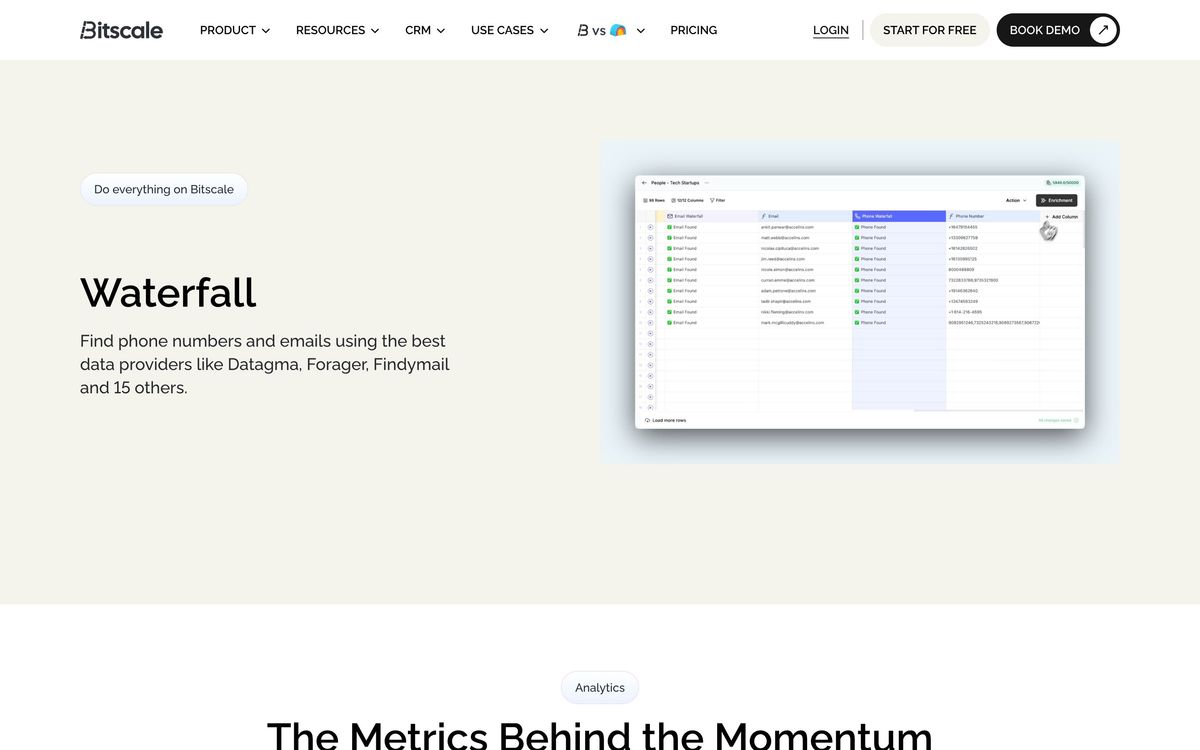
Bitscale is a go-to-market data layer that sits in front of a CRM. A team builds a list in a spreadsheet-style grid, adds enrichment columns, and Bitscale runs each row through a waterfall of contact data providers until one returns a verified email or phone number. On top of that it watches for buying signals, executive hires, funding rounds, tech stack changes, hiring activity, and syncs the enriched, scored records back into Salesforce or HubSpot rather than leaving them in an export. The company's own description, the GTM data layer for your CRM, is accurate: this is plumbing, not a sequencer.
The waterfall design is the substance. Rather than paying one vendor and accepting its coverage, Bitscale sequences more than eighteen contact data providers across a hundred-plus sources, escalating only when the cheaper source misses. Credits are consumed on a valid hit rather than on every attempt, and formula columns and CRM syncs cost nothing, which changes the arithmetic against per-lookup pricing more than the headline monthly figure suggests.
Key features
The product is a grid, a set of enrichment engines behind it, and a sync at the end.
- Spreadsheet-style grids with enrichment columns and step-by-step list building
- Email and phone waterfalls sequencing 18-plus providers across more than a hundred data sources
- Buying signal tracking across roughly fifteen triggers, including funding, hires and tech stack changes
- Two-way CRM sync with HubSpot, and with Salesforce from the higher paid tier
- Prebuilt playbooks for prospecting, competitor targeting, champion tracking and hiring signals
- Webhook and API access, with unused credits rolling over up to three times the monthly allowance
Who it's for
The right buyer already knows what good enrichment logic looks like. A RevOps lead who can specify the ICP, the waterfall order and the signals worth acting on will get most of Clay's outcome at a fraction of the cost, and the interface is familiar enough that the migration is measured in hours. Teams whose main pain is CRM decay, stale titles, bounced addresses, contacts who changed jobs six months ago, get a second and quieter benefit from the continuous monitoring.
It is a poor first purchase for a team still figuring out who to sell to. Bitscale executes enrichment logic; it does not supply the strategy, and a vague ICP will burn credits producing a list nobody works. Teams needing elaborate branching workflows or agentic research will run into the depth gap against Clay that reviewers consistently report. And Salesforce-based organisations should note that the connector sits on the second paid tier, so the real entry price is higher than the published starting plan.
How it compares
Clay remains deeper on waterfall configuration, workflow branching and AI research agents, and it is the right choice for a team that will genuinely use that ceiling, at a cost reported to run several times higher for comparable volume. Apollo bundles its own database with sequencing in a closed system that is simpler and cheaper but limits enrichment to Apollo's own coverage. ZoomInfo sells depth and enterprise contracts, and is a different kind of purchase entirely. Bitscale deliberately occupies the space between Clay's complexity and Apollo's walls.
Verdict
Bitscale is a well-judged product for teams who have outgrown a single data vendor but cannot justify Clay's bill. The waterfall coverage is real, charging only on valid hits is a fairer meter than the category norm, and the two-way CRM sync means enrichment improves the system of record instead of producing another list. The honest caveat is that it is the follower, not the leader: workflow flexibility and agent depth trail Clay, the free tier is too small to evaluate anything properly, and Salesforce shops face a higher effective starting price than the pricing page implies.
Ready to try Bitscale?
There's a free tier, so you can test it before committing.
More sales tools like Bitscale
Cognism
4.2B2B contact database with human-verified mobile numbers and compliance-checked records, strongest across Europe.
Read Cognism review →ZoomInfo
4.0B2B contact and company database with buying-intent signals, sold as an annual platform to full sales teams.
Read ZoomInfo review →Bookyourdata
3.9Self-serve B2B contact database sold in credit packs instead of seats, with verification run at export.
Read Bookyourdata review →Blinq
4.3Digital business cards and event lead capture that push enriched contacts with context into the CRM.
Read Blinq review →Lusha
4.1B2B contact data with a LinkedIn extension, sold per seat and metered by credits.
Read Lusha review →Leadfeeder
4.0Identifies the companies behind anonymous website traffic and pushes the ones that fit your profile into the CRM.
Read Leadfeeder review →