
Capsule CRM review
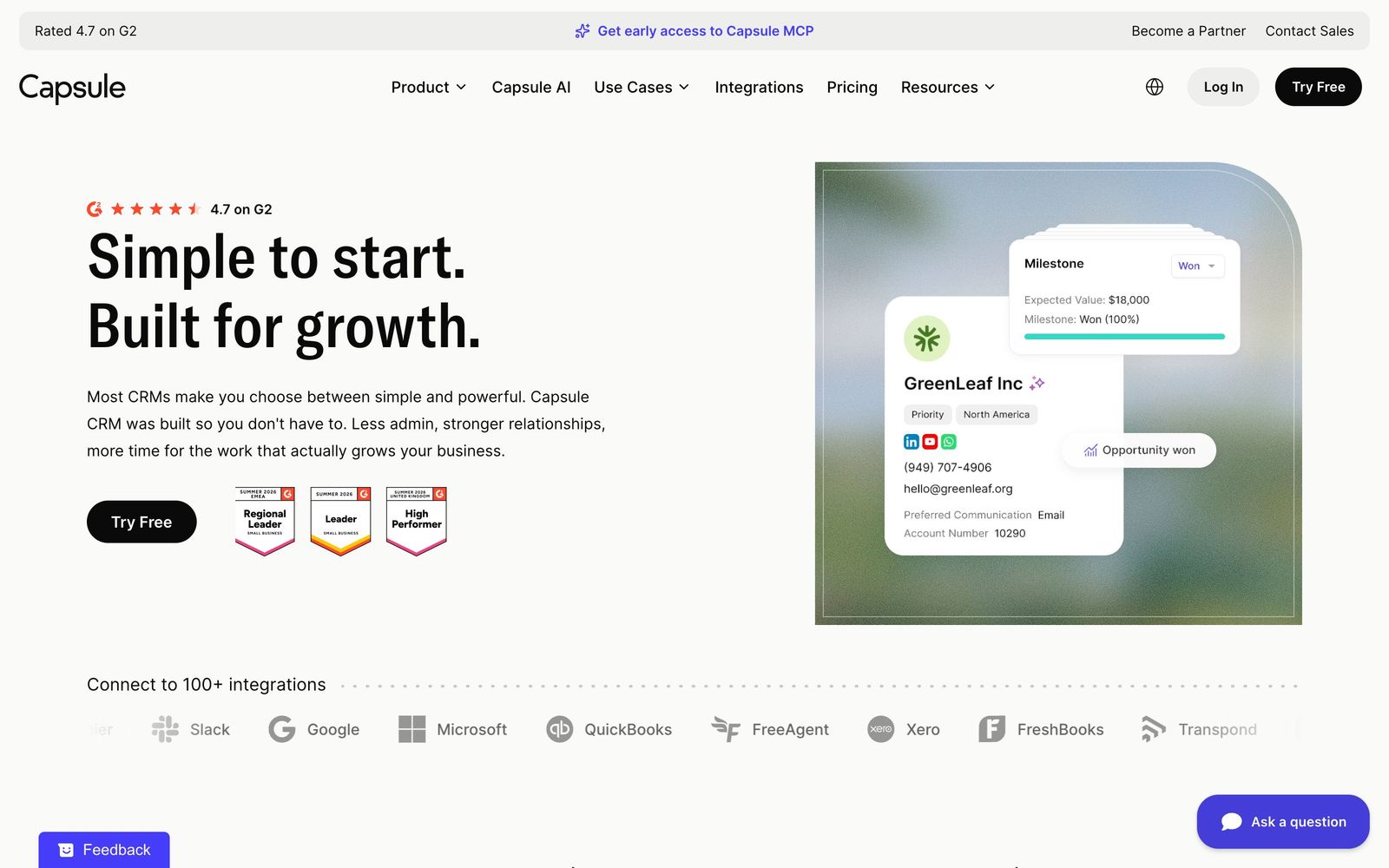
Straightforward CRM for small businesses, with a companion email marketing tool in Transpond.
A calm, quickly adopted CRM for small teams that want pipelines and contact history without a platform project, though its reporting and automation stay modest at every tier.
Pros
- Contact records, tasks and pipelines are understandable on the first day without configuration work
- Accounting integrations with Xero, QuickBooks and FreshBooks put invoice history on the customer record
- Project boards handle post-sale delivery, so small firms avoid a second tool for onboarding work
- A free tier for two users and 250 contacts is a genuine starting point rather than a demo
- Shared mailboxes keep client email threads visible to the whole team instead of trapped in one inbox
Cons
- Reporting is limited to pipeline and activity summaries, with no forecast accuracy or attribution analysis
- Workflow automation, multiple pipelines and the AI assistance only appear from the mid tier upward
- Transpond is a separate product with its own subscription rather than a marketing module inside the CRM
Capsule CRM pricing
List prices in USD per month, taken from the vendor at review time.
| Plan | Per month | What it covers |
|---|---|---|
| Free | Free | 2 users, 250 contacts, 1 pipeline |
| Starter | $21 | per user per month; 30,000 contacts, 1 pipeline, annual billing saves up to 14% |
| Growth | $38 | per user per month; 60,000 contacts, 5 pipelines, automations and AI features |
| Advanced | $60 | per user per month; 120,000 contacts, 50 pipelines and project boards |
| Ultimate | $75 | per user per month; 240,000 contacts, implementation and import assistance |
What Capsule CRM actually does
Capsule is a customer relationship manager aimed squarely at businesses that have never had one. The model is deliberately small: people and companies with custom fields and tags, opportunities moving through a pipeline, tasks and a calendar, and the email history attached to whoever it concerns. Nothing needs to be configured before the first useful day, which is the main reason small teams adopt it and keep using it after the novelty passes.
Two choices distinguish it from other light CRMs. The first is project boards: once a deal is won, the same record can carry a delivery checklist, so a consultancy or an agency tracks onboarding without buying project software. The second is the accounting connection, with Xero, QuickBooks and FreshBooks putting invoices and payment status beside the contact. Alongside the CRM sits Transpond, the company's email and social marketing tool, which shares contact data with Capsule but is bought and priced as its own product.
Key features
Each tier widens the same core rather than introducing a different product.
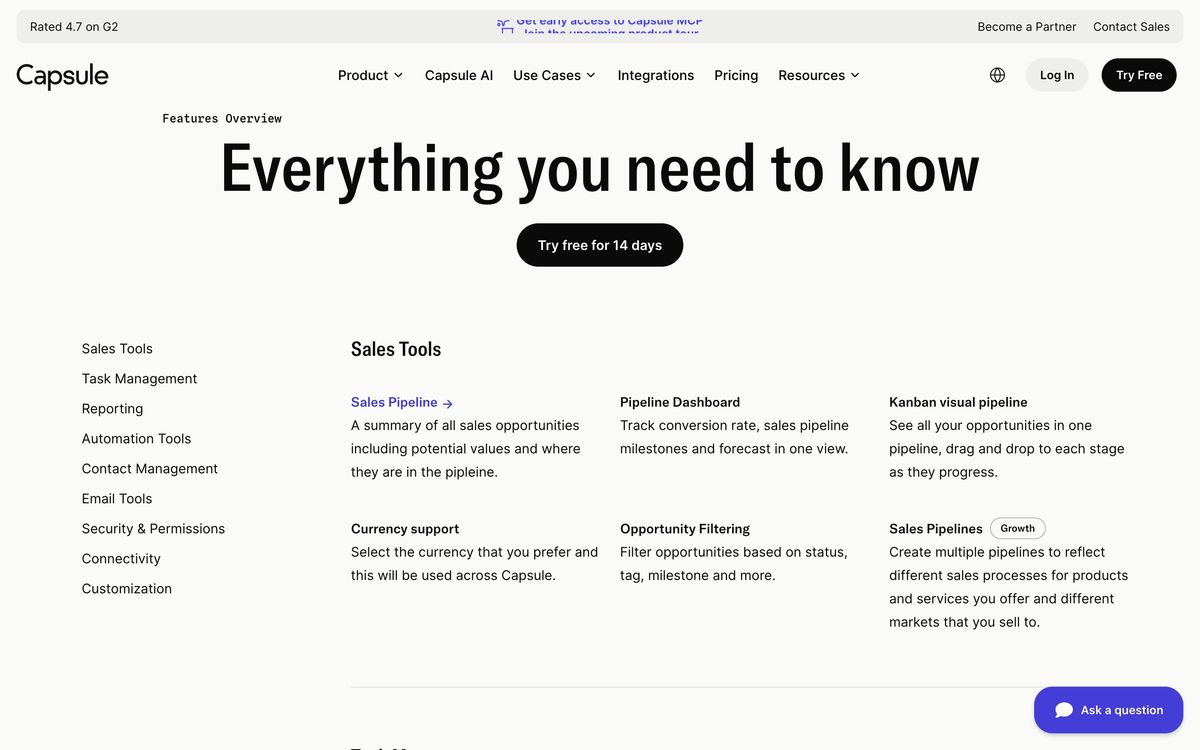
- Contact management with custom fields, tags and complete email history per person
- Sales pipelines with stage tracking, weighted values and simple forecasting
- Project boards that convert a won opportunity into a delivery checklist
- Shared team mailboxes and email templates linked to contact records
- Workflow automations for tasks, stage changes and reminders on paid tiers
- AI assistance for contact enrichment, meeting preparation and thread summaries
Who it's for
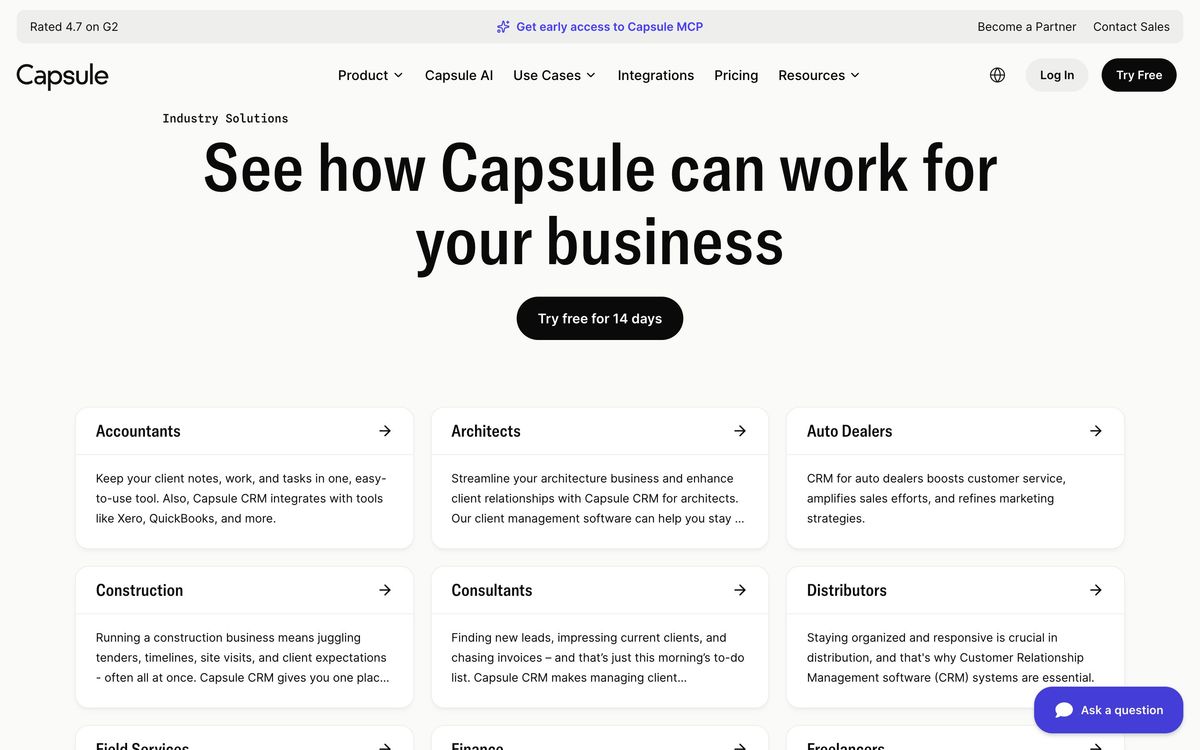
The natural buyer is a firm of roughly two to twenty people that currently tracks customers in a spreadsheet and loses context whenever someone is away: an accountancy practice, a consultancy, a construction or manufacturing business with a long quote cycle, a small agency. Teams that value being able to hand the tool to a new hire without training will get more from Capsule than from a platform with more capability and more setup. The free tier is a fair way to test the model on a real contact list before paying.
It is not the right choice for a sales organisation with quotas, territories and forecast reviews. Reporting stops at pipeline and activity summaries, so revenue leaders who need pipeline velocity, win-loss analysis or attribution will export data elsewhere. Teams expecting marketing automation inside the CRM should also note that Transpond is a separate subscription, and heavy outbound teams will miss a built-in dialler and sequencing.
How it compares
Pipedrive is the closest competitor and is stronger on pipeline discipline, sales reporting and mobile use, at a higher price per seat and with more configuration. HubSpot's starter tiers bundle marketing and CRM in one place with far deeper automation, but the cost escalates sharply as contact tiers and paid seats grow. Zoho CRM offers more features per unit of money than either and integrates across the Zoho suite, though its interface is denser and administration takes real effort. Capsule wins on speed of adoption and on the project boards; it loses to all three on analytics and automation depth.
Verdict
Capsule does a narrow job with unusual clarity: it keeps customer history in one place for a team that would otherwise lose it, and it does not demand a project to get there. The accounting integrations and project boards make it a better fit for professional services than most CRMs at this price, and the free tier lets a business prove the value before committing. The caveat is ceiling rather than quality. Automation and multi-pipeline work require the mid tier, reporting will not satisfy anyone building a forecast, and the marketing side arrives as a second subscription. Small firms that want a reliable record of their customers will be well served; sales teams that need a system to run a process should budget for something heavier.
Ready to try Capsule CRM?
There's a free tier, so you can test it before committing.
More sales tools like Capsule CRM
folk
4.0Lightweight CRM that builds its contact base from Gmail, LinkedIn and WhatsApp instead of manual entry.
Read folk review →SalesRabbit
3.9Field sales platform for door-to-door teams: territory canvassing, lead tracking, contracts and rep performance.
Read SalesRabbit review →Streak
3.9A CRM built as a Gmail extension, so pipelines, deals and email history stay inside the inbox.
Read Streak review →FullEnrich
4.5B2B waterfall enrichment that cascades 20+ data vendors to find verified emails and mobile numbers.
Read FullEnrich review →Amplemarket
4.4All-in-one AI sales platform: B2B contact data, multichannel sequences, and the Duo AI copilot.
Read Amplemarket review →Clay
4.4A credit-based GTM data workbench that chains 100+ enrichment providers and AI into one spreadsheet.
Read Clay review →