
Pecan AI review
Builds and runs predictive models on a company's existing data without a data science team.
A practical way for a marketing or RevOps team to get churn and lifetime value predictions into production, though the closed modelling layer stops anyone who needs a custom algorithm.
Pros
- Connects directly to Snowflake, Databricks, BigQuery and Redshift, so modelling runs on the warehouse rather than on exports
- Automates data preparation, model building and validation, which is where most in-house predictive projects stall
- Predictions are written back into Salesforce and HubSpot, so a score reaches a rep rather than a dashboard
- Model explanations are unusually clear, which matters when a marketing lead has to defend a segment to finance
- Covers churn, lifetime value, demand, lead scoring and fraud from the same setup rather than one model per product
Cons
- The underlying code is not accessible, so custom algorithms or modified model architectures are out of reach
- Pricing is quote-only at every tier, with prediction batch counts and row storage as the metered dimensions
- Reviewers report the best outcomes come from teams that still have a data scientist to frame the question, which undercuts the no-data-science pitch
What Pecan AI actually does
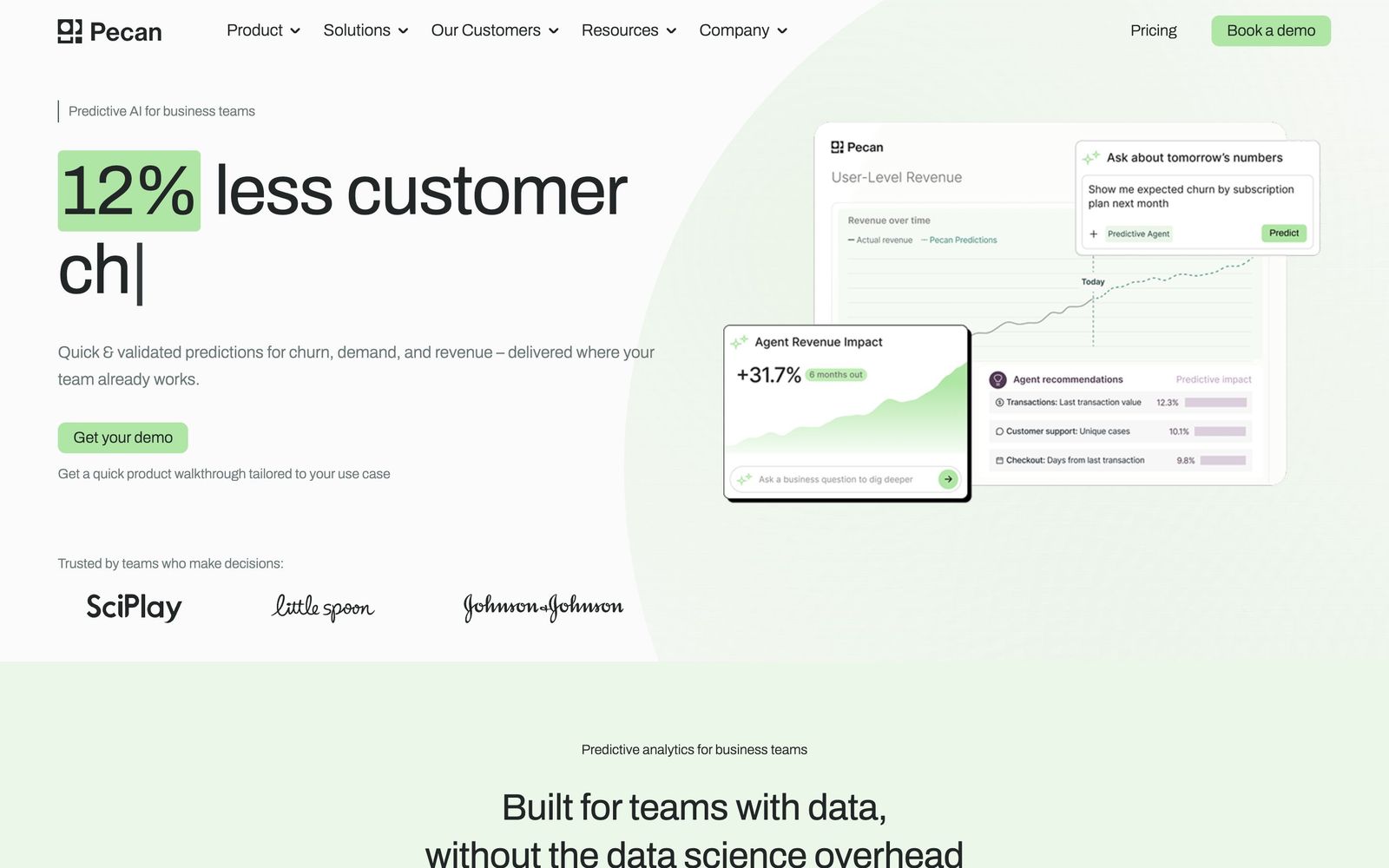
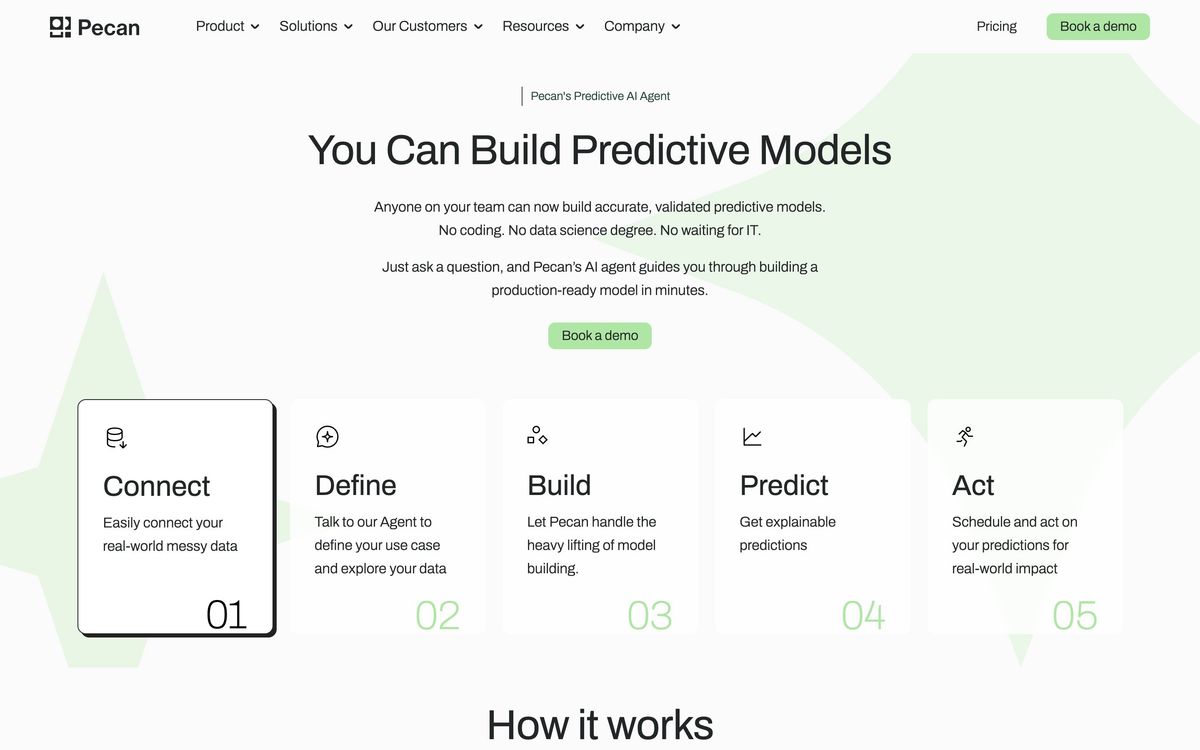
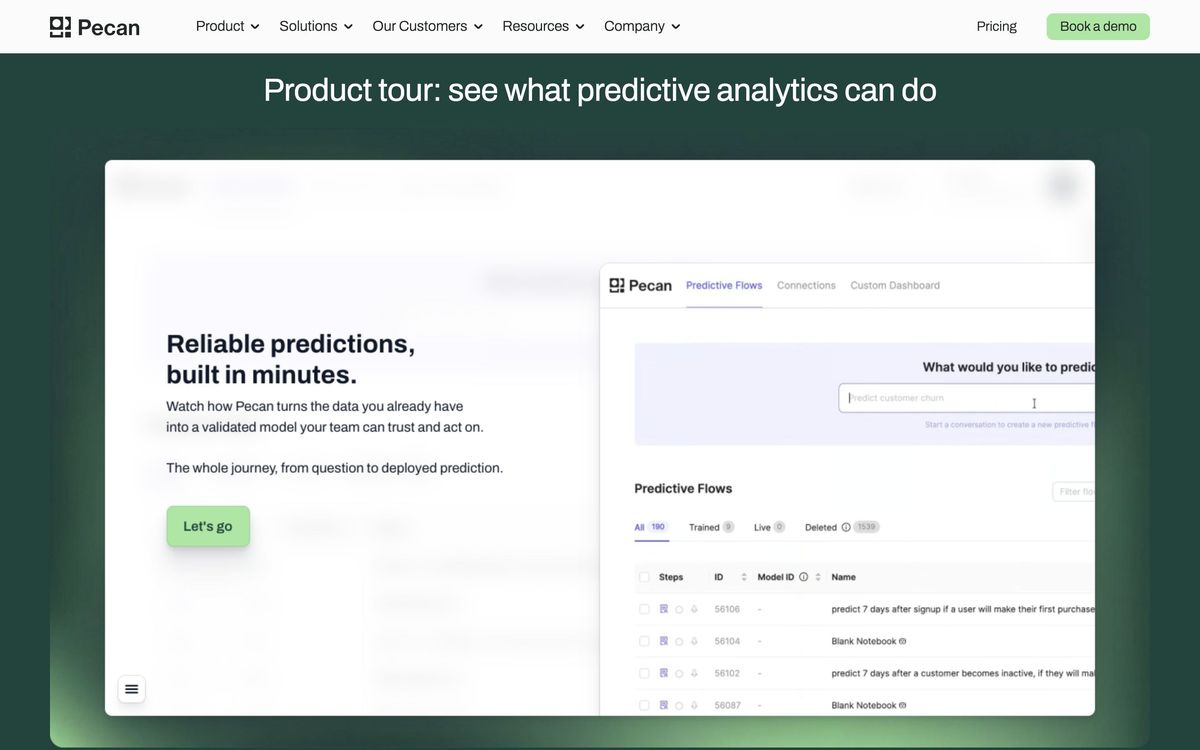
Pecan takes data a company already holds and turns it into predictions about what happens next: which customers churn, which leads convert, what demand looks like next quarter, what a cohort is worth over its lifetime. The distinguishing choice is that the team asks a business question and the platform handles the parts that normally require a data scientist, assembling the training set, engineering features, building and validating the model, and scheduling it to run. A first model can be live in hours rather than the quarter an in-house project usually consumes.
It runs against the warehouse rather than against uploads. Native connectors cover Snowflake, Databricks, BigQuery, Redshift, PostgreSQL, MySQL, SQL Server and Oracle, with app measurement data from AppsFlyer, Adjust, Singular and Firebase, and predictions are written back into Salesforce or HubSpot so a score lands next to the record a rep is working. The company is explicit that a prediction nobody acts on is worthless, and the delivery-into-the-workflow half of the product reflects that.
Key features
The platform is an end-to-end pipeline rather than a modelling notebook.
- Automated model building and validation driven by a business question instead of code
- Direct warehouse connectors across Snowflake, Databricks, BigQuery, Redshift and the major SQL databases
- Scheduled prediction batches pushed into Salesforce, HubSpot or an API endpoint
- Prebuilt use cases for churn, lifetime value, demand forecasting, lead scoring and fraud
- Explainability output showing which inputs move each prediction, in terms a marketer can present
- App-side ingestion from AppsFlyer, Adjust, Singular and Firebase for mobile-heavy businesses
Who it's for
Pecan fits a company with a real warehouse, a genuine volume of customer history, and no machine learning capacity to point at it. Subscription businesses wanting churn scores in the CRM, consumer apps predicting lifetime value early enough to bid on it, and RevOps teams replacing a hand-built lead score with something that retrains, all of those are well served, and all of them would otherwise wait a year for a hire that may never be approved.
It is not for teams with unusual modelling requirements. The code underneath is closed, so a custom algorithm or a modified architecture is simply not available, and reviewers note that specialised use cases hit that wall quickly. It is also poorly matched to a company without a data foundation: thin history or messy source tables produce weak models regardless of how much of the pipeline is automated. And the no-data-science framing should be read carefully, since G2 reviewers report the strongest results from teams that still have someone able to frame the question properly.
How it compares
DataRobot covers far more of the machine learning lifecycle and suits an organisation that already has data scientists to supervise it, at a price and complexity that a marketing team cannot carry alone. Akkio is simpler and cheaper, aimed at smaller datasets and quicker experiments, and correspondingly weaker on warehouse-scale volumes and production scheduling. Building the same thing in-house on a warehouse plus a Python stack gives total control and costs a headcount that is exactly what Pecan's pitch removes. The choice mostly comes down to whether the modelling needs to be inspectable at code level.
Verdict
Pecan solves a real and common problem: a company holds enough history to predict something useful and has nobody to build the model. The warehouse connectors are the right ones, the write-back into Salesforce and HubSpot means predictions reach the people who act, and the explainability output is strong enough to survive a meeting with finance. The caveat is the ceiling. The platform is closed, so any requirement for a custom algorithm ends the conversation, and quote-only pricing across all tiers means the cost of scaling prediction batches only becomes clear well into a sales process.
Ready to try Pecan AI?
More marketers tools like Pecan AI
WhatConverts
4.3Tracks calls, forms, chats and transactions back to the campaign that produced them, in one lead log.
Read WhatConverts review →Databox
4.2Analytics platform pulling 130+ data sources into dashboards, automated reports, goals, AI-queried metrics.
Read Databox review →Survicate
4.1Customer feedback platform for website, in-product, email and link surveys with AI theme analysis.
Read Survicate review →Bïrch
4.0Rule-based automation and bulk campaign management for Meta, Google, TikTok and Snapchat ad accounts.
Read Bïrch review →CallRail
4.0Call, text and form tracking that ties every inbound lead back to the campaign, keyword or page that produced it.
Read CallRail review →Similarweb
4.0Estimated traffic, channel mix and audience data for any website or app, used for competitive and market research.
Read Similarweb review →