
Every review
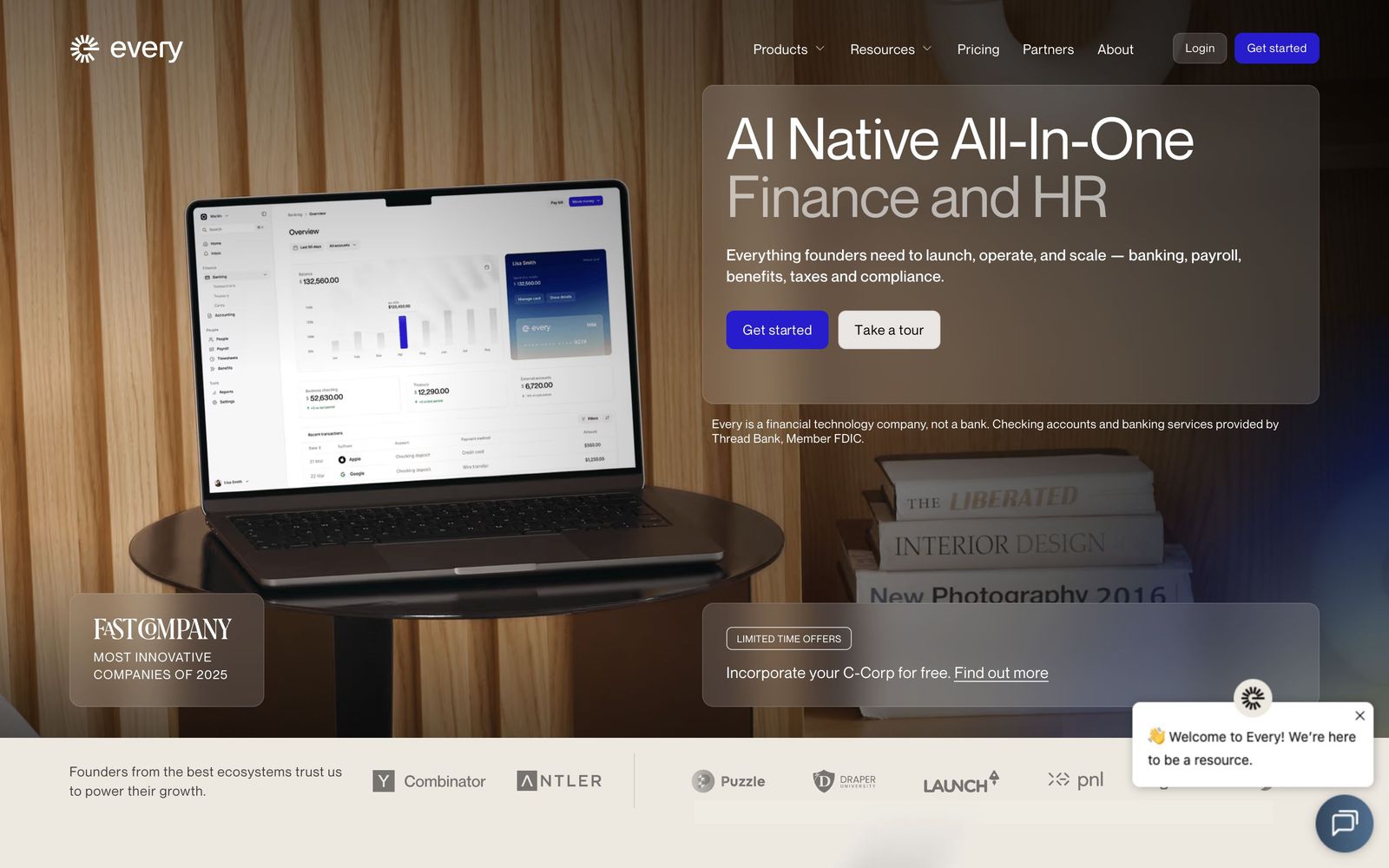
Back office for US startups: incorporation, banking, payroll, bookkeeping and corporate tax in one account.
A reasonable single-vendor back office for a freshly incorporated US C-corp, though every module bills separately and switching later means moving banking and payroll at once.
Pros
- Incorporation, EIN and founder equity documents are filed at no charge for companies that bank on the platform
- Payroll runs in all fifty states and pays US and international contractors from the same employee record
- Bookkeeping includes a named bookkeeper and a controller review, not just categorisation software
- The tax module covers the federal return, Delaware franchise tax, 1099s and the R&D credit study in one engagement
- Idle balances can be swept into short-dated Treasuries with a few days of liquidity
Cons
- Banking is provided by a partner bank, so account limits and dispute handling follow that bank's rules rather than Every's
- Modules are priced separately and the bookkeeping tier is scoped by monthly spend and bank account count, so cost climbs with complexity
- US-only, with no published integration directory, so data living in other finance systems has to be brought over by hand
Every pricing
List prices in USD per month, taken from the vendor at review time.
| Plan | Per month | What it covers |
|---|---|---|
| Incorporation & banking | Free | free, including Delaware C-corp filing, EIN and business checking |
| HR & Payroll | $25 | per employee, plus a $50 monthly base fee |
| Bookkeeping | $330 | starting price for companies under $20k monthly spend |
What Every actually does
Every is a back-office platform for United States startups that bundles the services a founder would otherwise buy from four separate vendors: a business bank account, payroll and benefits, monthly bookkeeping, and corporate tax filing. Incorporation sits at the front of it. The company files a Delaware C-corp, obtains the EIN and produces the founding equity paperwork at no cost, on the expectation that the new entity then keeps its cash and its payroll on the platform. Banking runs through a partner bank rather than Every itself, with a debit card that returns cash back on eligible spend and a treasury feature that sweeps idle balances into short-dated Treasury instruments with a few days of liquidity.
The bookkeeping and tax tiers are software wrapped around people. Subscribers are assigned a bookkeeper and a controller who close the books on an accrual basis each month and deliver a profit and loss statement, a balance sheet and a cash flow statement. The tax engagement covers the federal return, one state, the Delaware franchise filing, 1099s and the research credit study that early-stage companies use to offset payroll tax. Payroll covers all fifty states and pays contractors at home and abroad, with health, dental, vision, 401(k) and flexible spending administration attached to the same employee record. In 2026 the company layered AI agents over payroll, bookkeeping and HR compliance, which draft the routine work and leave the filing to the human staff.
Key features
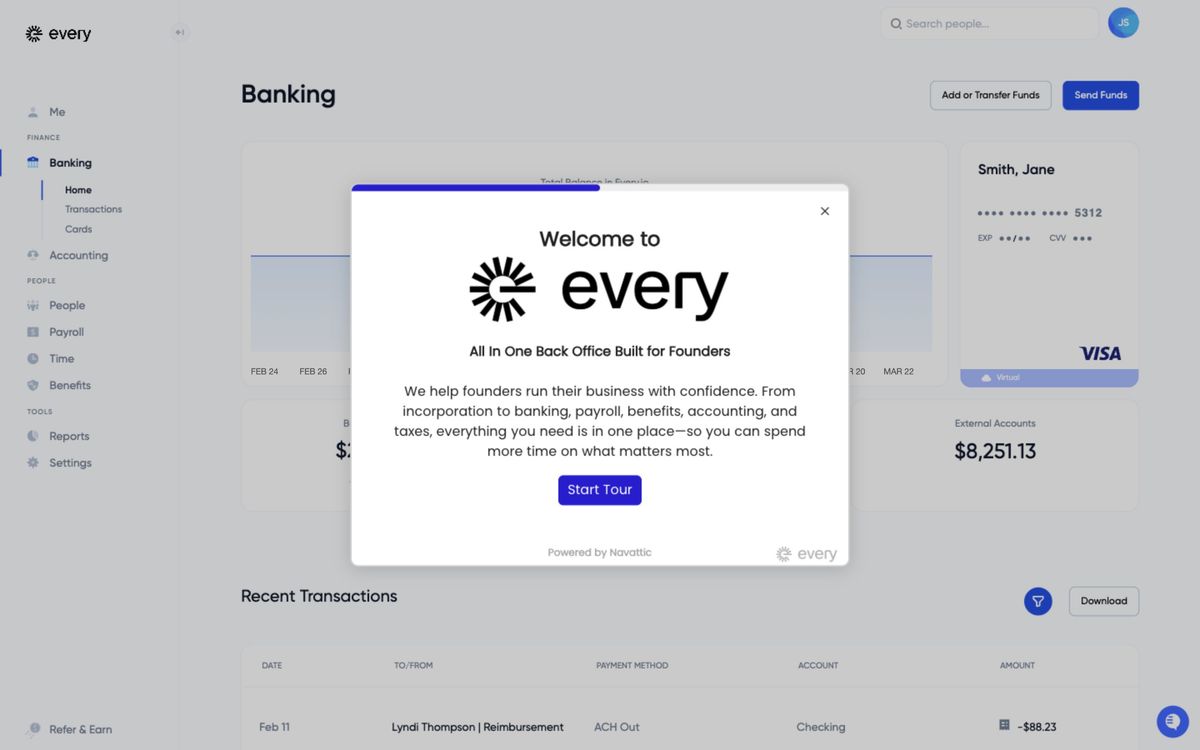
The platform is organised as modules that share one employee record and one transaction ledger:
- Delaware C-corp incorporation with EIN filing and founder equity documents at no charge
- Business checking with bill pay and a cash-back debit card
- Treasury sweeps that move surplus balances into short-dated Treasuries
- Payroll in all fifty states, plus US and international contractor payments
- Benefits administration across health, dental, vision, 401(k) and flexible spending accounts
- Accrual bookkeeping with a named bookkeeper, controller review and monthly financial statements
Who it's for
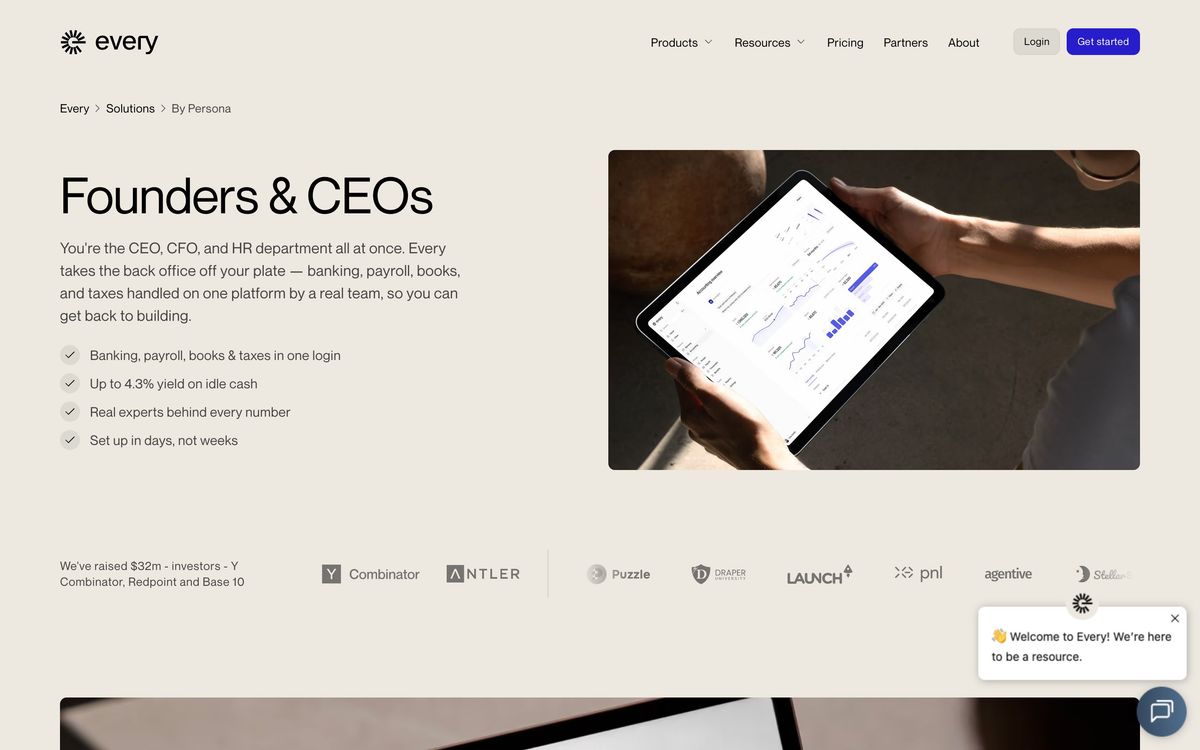
The clean fit is a company that has just incorporated, or is about to, and has no vendor debt to unwind: no bank account, no payroll provider, no bookkeeper on retainer. For that founder the argument is real, because opening banking, running the first payroll and closing the first month happen in one place with one support team, and the tax filing at year end is done by people who already hold the ledger.
It is a poor fit for anyone incorporated outside the United States, for companies with foreign subsidiaries, or for businesses whose accounting is genuinely hard: inventory, deferred revenue at scale, multi-entity consolidation. It is also a hard sell to a team already settled on a bank they like and a payroll system employees know, because migrating both at once to save a login is rarely worth the disruption. Finance teams that expect a deep integration catalogue will find the platform quiet on that front, since its pitch is replacement rather than connection.
How it compares
Mercury is the obvious comparison on banking and wins on product depth, treasury tooling and the ecosystem built around it, but it stops at money movement and leaves payroll, books and tax to other vendors. Gusto and Rippling beat Every on payroll depth, HR workflows and integration catalogues, and Rippling in particular scales into device and app management that Every does not attempt. Pilot and similar outsourced accounting firms deliver comparable bookkeeping and controller work with more accounting judgment behind it, but they sit on top of QuickBooks rather than owning the bank account. Every's case rests on the seam between those tools disappearing, which matters most in the first two years and less thereafter.
Verdict
For a first-time founder incorporating a US C-corp, Every removes a genuinely tedious month of vendor selection and gets banking, payroll and books running against one ledger with human accountants behind it. The rating reflects that convenience and the credible tax work, discounted for two things: the deposits sit at a partner bank rather than with Every, and the per-module pricing means the bundle stops looking cheap once headcount and bookkeeping complexity rise. Companies that expect to stay small and simple get the most from it; those planning a Series A with real accounting complexity should assume a migration eventually.
Ready to try Every?
There's a free tier, so you can test it before committing.
More founders tools like Every
ClickUp
4.5All-in-one work platform: tasks, docs, goals, chat, whiteboards, and AI agents in a single workspace.
Read ClickUp review →Fireflies.ai
4.5AI meeting teammate that records, transcribes, and summarizes calls, with action items and searchable notes.
Read Fireflies.ai review →Miro
4.5Infinite shared canvas for workshops, diagrams and planning, now wrapped around docs, tables and AI.
Read Miro review →Reclaim.ai
4.5AI calendar assistant that auto-schedules focus time, tasks, and habits on Google and Outlook calendars.
Read Reclaim.ai review →Activepieces
4.4Open-source, MIT-licensed AI automation platform with a visual builder, AI agents, and 700+ integrations.
Read Activepieces review →MindStudio
4.4No-code visual builder for AI agents with 200+ models, 1,000+ integrations, and flexible deployment.
Read MindStudio review →