
Zedonk review
Modular PLM and ERP for fashion brands: tech packs, costing, production, stock and a B2B showroom.
The most affordable credible ERP for a small fashion label running wholesale and retail together, though its integration catalogue is short and several connections run on file transfers rather than live APIs.
Pros
- Covers design through invoicing in one system, so costing, production and stock stop living in separate spreadsheets
- Onboarding, training, webinars and helpdesk access are included rather than sold as an implementation package
- Bundles are modular, so a design-only studio can buy the PLM half without paying for the ERP half
- The JOOR connector creates styles, linesheets, images and customers automatically and pulls placed orders back
- Multi-currency and multi-location stock are standard on the operations bundles, which matters for brands selling across markets
Cons
- The integration catalogue is around ten tools, so anything outside Shopify, JOOR, NuORDER and the main accounting packages needs custom work
- The NuORDER connection is a scheduled CSV transfer over SFTP rather than a live API, so stock and orders lag by up to an hour
- There is no free tier or self-serve trial: evaluation runs through a demo and a consultation on implementation cost
Zedonk pricing
List prices in USD per month, taken from the vendor at review time.
| Plan | Per month | What it covers |
|---|---|---|
| Studio Design Suite | $225 | billed annually; PLM, tech packs, grading, style library |
| Core Operations Hub | $425 | billed annually; core ERP, planner, CRM, advanced inventory |
| Studio Operations Suite | $500 | billed annually; adds the digital showroom |
| Commerce Operations Hub | $650 | billed annually; adds barcodes and Shopify integrations |
What Zedonk actually does
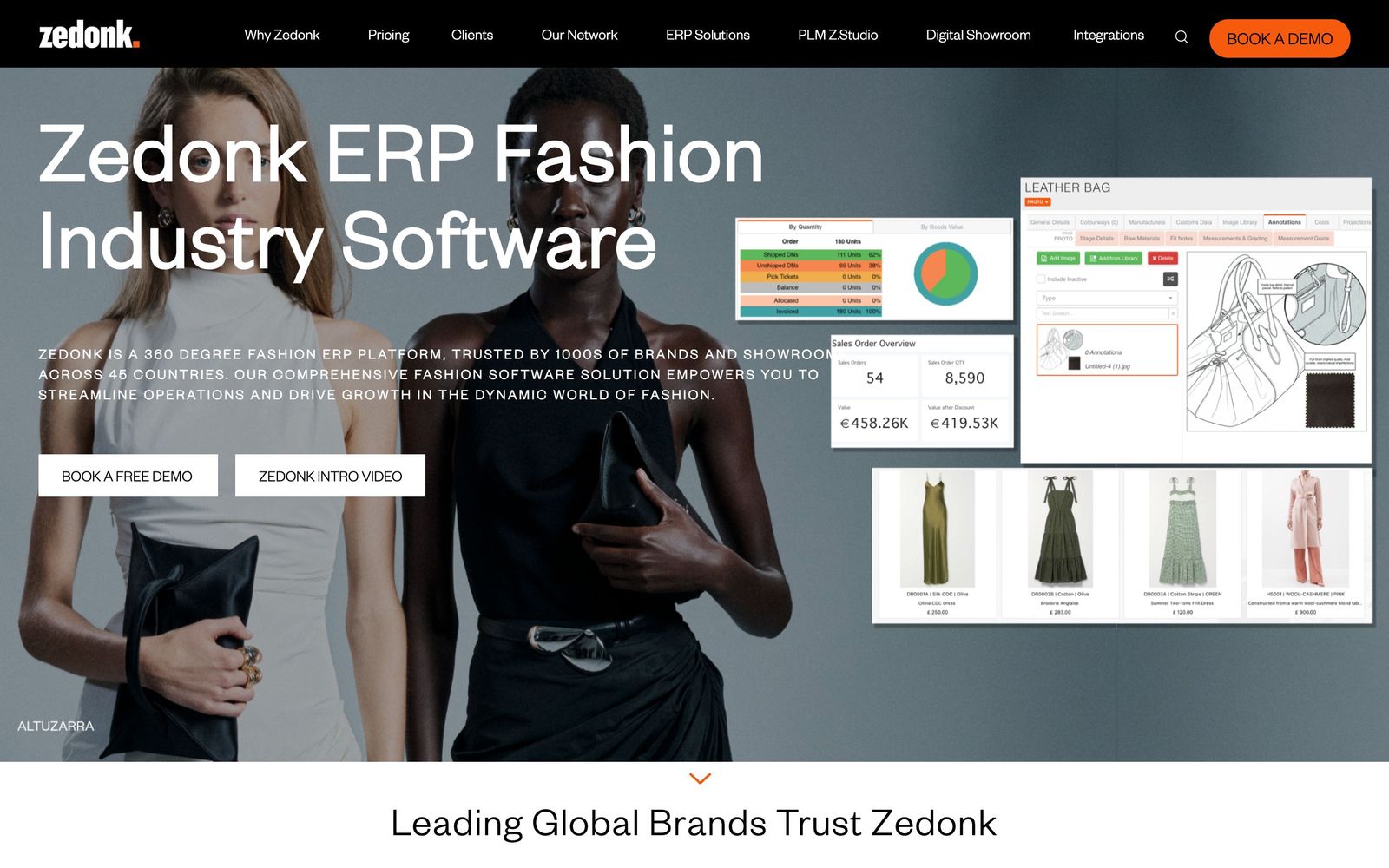
Zedonk is a cloud PLM and ERP built specifically for fashion, used by clothing labels, jewellery makers and the showrooms that sell for them. It follows a garment through its whole commercial life: a tech pack with measurements and grading, a costing sheet that survives contact with real fabric prices, a production order against a factory, stock across warehouses and stores, a wholesale order taken in a showroom, and the invoice at the end. The company reports more than a thousand brands using it across forty-five countries, which for a fashion-only vendor is a substantial installed base.
It is sold in modular bundles rather than seats, which is the more important structural fact. A design studio can buy only the PLM half. A brand that has outgrown spreadsheets but does not sell wholesale can take the operations bundle without the showroom. Onboarding, training, webinars and helpdesk support are included at no extra charge, a meaningful difference in a category where implementation often costs more than the first year of licence.

Key features
The modules split cleanly between product development and commercial operations.
- PLM with tech pack creation, measurement and grading, collection views and a style library
- Costing and production management covering raw materials, purchasing and factory orders
- Advanced inventory across multiple locations, with allocation and fulfilment control
- A B2B digital showroom plus a mobile sales app for writing wholesale orders in person
- Sales orders, invoicing, multi-currency handling, logistics and shipment tracking
- Barcode support and real-time Shopify stock and order syncing on the commerce bundle
Who it's for
The buyer is an independent label somewhere between roughly twenty and several hundred styles a season, running a wholesale book alongside a direct store, and currently holding the whole business together with spreadsheets and email. Zedonk's appeal there is not sophistication but coverage: one place where the costing that decided the wholesale price is the same record as the stock the store is selling. Reviewers on Capterra consistently pick out the costing and fabric ordering workflow as the part that saves the most time.
It is not for brands outside apparel and accessories, since the whole data model assumes styles, colourways and sizes. It is also a poor fit for a company with a complex existing systems landscape, because the published integration catalogue runs to about ten tools and anything beyond it is bespoke work. Large groups needing deep demand planning or a mature warehouse management layer will outgrow it.
How it compares
Against enterprise apparel ERPs such as Centric PLM or aptean-class systems, Zedonk is dramatically cheaper and quicker to stand up, but shallower on planning, analytics and configurability. Against a general small-business ERP with a fashion add-on, it wins on native handling of grading, colourways and seasonal ranges, which generic systems bolt on badly. Against running Shopify plus Xero plus spreadsheets, which is what most of its customers actually leave behind, it replaces the spreadsheets and keeps the other two, since both are supported connections.
Verdict
Zedonk earns its reputation among small labels by being the rare fashion ERP a brand with no operations director can actually adopt, with the training bundled and the modules sized so nobody pays for a showroom they will not use. The gaps are real and worth naming: a short integration list, a NuORDER connection that moves files on a schedule rather than through a live API, and no self-serve trial to test any of it before a sales conversation. For a wholesale-and-retail label drowning in spreadsheets, those are acceptable trade-offs; for a brand with an unusual systems stack, they are the whole question.
Ready to try Zedonk?
More ecommerce tools like Zedonk
Katana Cloud Inventory
4.1Live inventory and production tracking for small manufacturers selling through Shopify, Amazon and wholesale.
Read Katana Cloud Inventory review →Unleashed Software
4.1Cloud inventory, purchasing and light manufacturing for wholesalers and product businesses on Xero.
Read Unleashed Software review →Digit
3.7Cloud ERP for small manufacturers and distributors that keeps QuickBooks or Xero as the ledger.
Read Digit review →Increff
3.9Warehouse, order and merchandise planning software for fashion and D2C brands selling across marketplaces.
Read Increff review →ShipBob
3.9Outsourced ecommerce fulfilment across a global warehouse network, run from one inventory dashboard.
Read ShipBob review →Spocket
3.8Dropshipping catalog weighted toward US and EU suppliers, with one-click import and branded invoicing.
Read Spocket review →