
MRPeasy review
Cloud manufacturing ERP that plans production against materials and capacity for small and mid-sized shops.
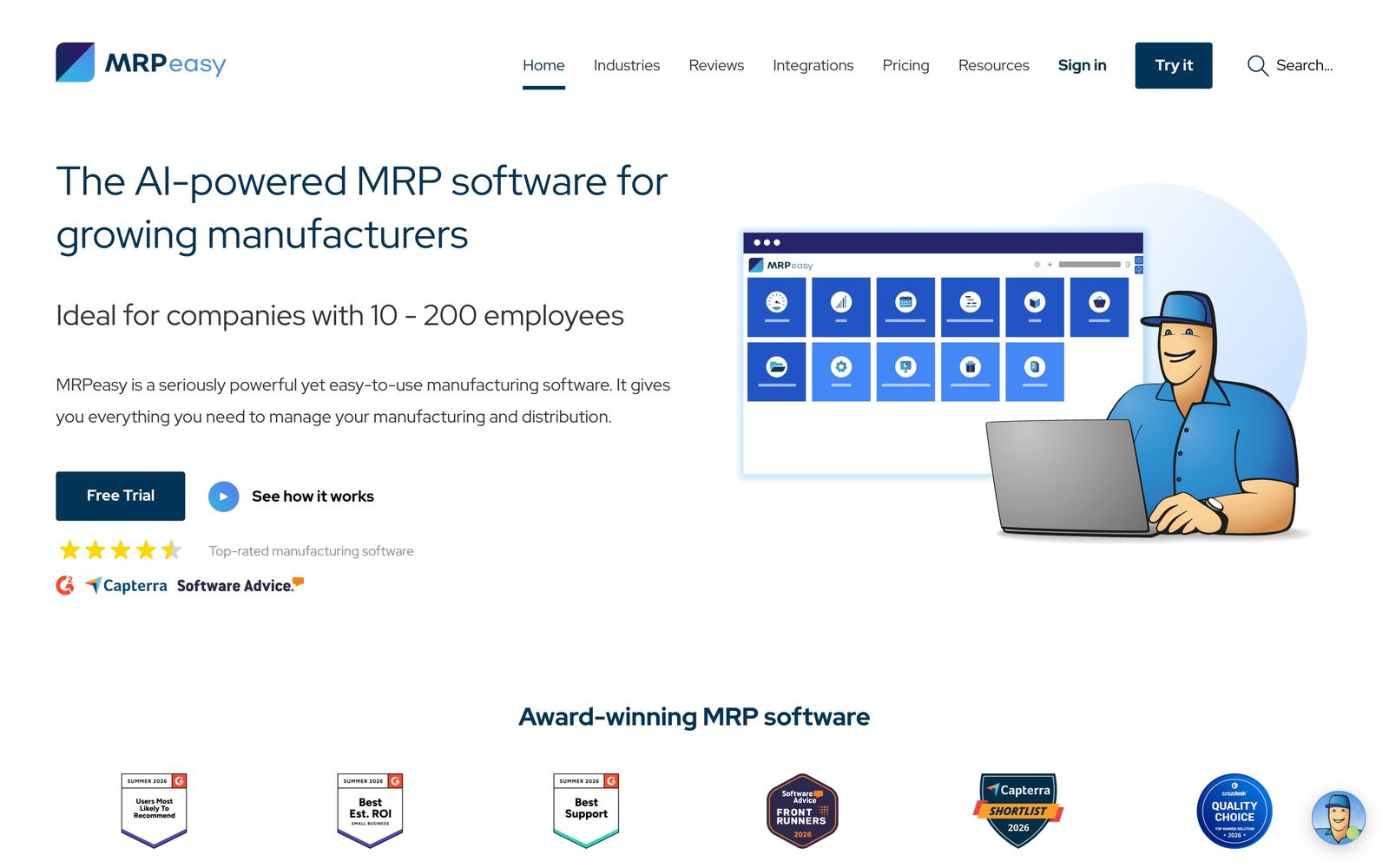
The most realistic ERP for a manufacturer that has outgrown spreadsheets but cannot absorb a six-figure implementation, though limited customisation and per-user pricing start to bite as the shop floor grows.
Pros
- Covers the whole chain in one system: bills of materials, routings, scheduling against capacity, purchasing, stock and product costing
- Most teams reach go-live in weeks without hiring an implementation consultant, which is unusual in this category
- Per-user pricing is published openly and sits far below mid-market ERP, with a bulk rate applying above ten users
- Lot and serial traceability is included rather than an upgrade, which matters for food, cosmetics and regulated production
- Native connections to QuickBooks Online, Xero, Shopify, WooCommerce, Amazon and ShipStation cover most small manufacturers' surrounding stack
Cons
- Customisation is deliberately minimal, every customer runs the same application, and the PDF editor allows very little control over printed documents
- Subcontracting is awkward: materials cannot be substituted inside a subcontractor order without workarounds, which frustrates shops that outsource operations
- Cost scales linearly with headcount, so a growing shop floor where every operator needs a login gets expensive faster than the entry rate suggests
MRPeasy pricing
List prices in USD per month, taken from the vendor at review time.
| Plan | Per month | What it covers |
|---|---|---|
| Starter | $49 | per user; production planning, BOMs, stock, CRM, basic accounting |
| Professional | $69 | per user; adds quality control, serial numbers, subcontracting, B2B portal |
| Enterprise | $99 | per user; adds approvals, barcode scanning, multiple sites, forecasting |
| Unlimited | $149 | per user, two-user minimum; API, webhooks and no system limits |
What MRPeasy actually does
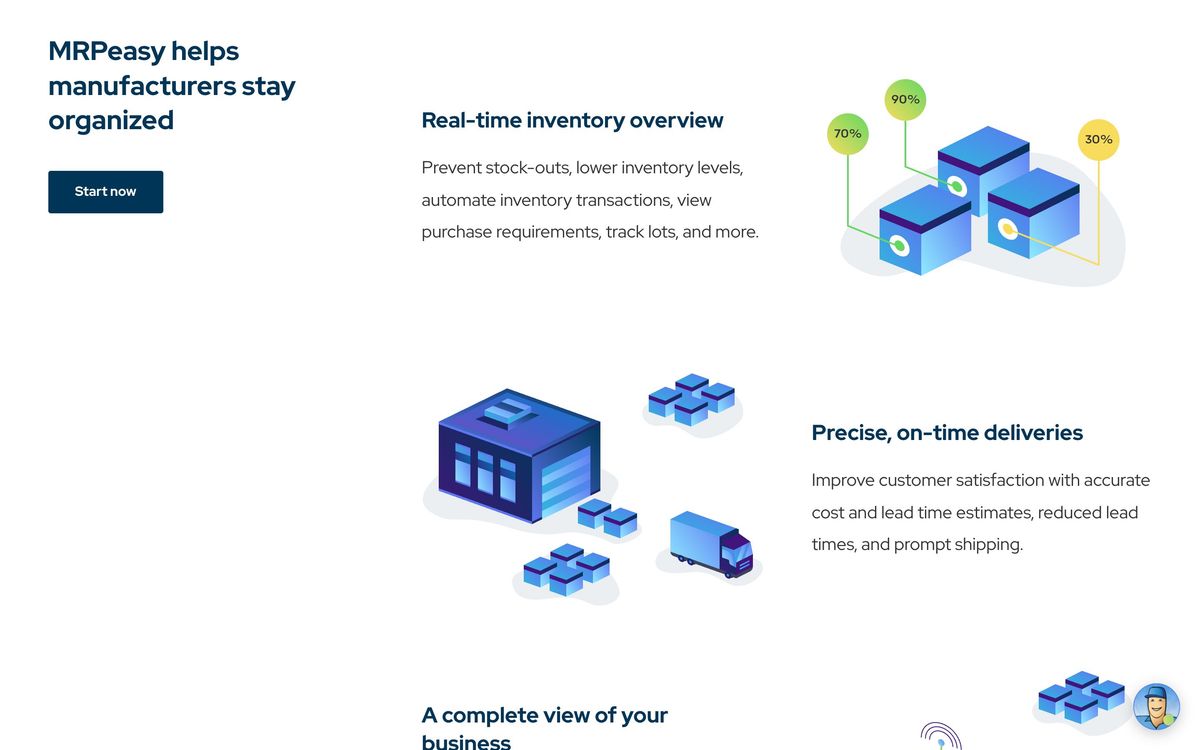
MRPeasy is a cloud ERP for companies that make physical things in modest quantities. The core is material requirements planning done properly: multi-level bills of materials, routings with workstation times, and a scheduler that books manufacturing orders against both the stock on hand and the capacity available, rather than assuming either is infinite. From a customer order it derives the manufacturing orders and the purchase orders needed to fulfil it, then tracks the cost of the finished item as labour and materials are consumed against it. That chain, order to production to procurement to invoice, running as one connected system is the whole proposition.
Around it sit the modules a small manufacturer would otherwise keep in spreadsheets: stock control with lot and serial traceability, procurement with requirement forecasting and supplier records, shop floor reporting for operators, a light CRM, and basic accounting that also syncs outward to QuickBooks Online or Xero. Ecommerce and fulfilment connections cover Shopify, WooCommerce, BigCommerce, Magento, Amazon and ShipStation, which is what makes it relevant to product brands selling their own manufactured goods online. It is sold per user per month with published rates and a bulk rate that kicks in above ten users, and there is a trial rather than a free tier.
Key features
The module list reads like a full ERP, with the depth concentrated in planning and inventory.
- Production scheduling against material availability and workstation capacity
- Multi-level bills of materials with routings and automatic product costing
- Stock control with lot and serial traceability, shortage alerts and stocktakes
- Procurement with requirement forecasting, purchase orders and supplier management
- Shop floor reporting for operators, with barcode scanning on higher tiers
- Sales and CRM records that generate linked manufacturing and purchase orders
Who it's for
The natural buyer is a manufacturer of roughly ten to two hundred people whose planning currently lives in a spreadsheet that only one person understands. Food producers, cosmetics and supplement brands, electronics assemblers, furniture and equipment makers all fit, particularly those with traceability obligations. Product brands that manufacture in-house and sell through Shopify or Amazon get the additional benefit of stock and orders reconciling automatically instead of being maintained twice. Because implementation is measured in weeks and needs no consultant, it is realistic for a company with no IT function.
It is a poor fit for process manufacturers with continuous flows, for shops whose operations depend heavily on subcontracting, and for anyone who needs the system bent to an unusual workflow, the application is identical for every customer by design. Larger manufacturers with multiple plants and complex finance requirements will outgrow both the customisation ceiling and the per-user economics.
How it compares
Katana is the closest competitor and the friendlier product, with a cleaner interface and a stronger ecommerce story, but shallower planning: capacity scheduling and costing go deeper in MRPeasy. Odoo offers far more flexibility and a manufacturing module inside a full business suite, at the price of an implementation partner and real configuration work. Fishbowl leans toward inventory and QuickBooks-centred operations rather than production planning. NetSuite is the eventual destination for companies that outgrow all three, at an order of magnitude more cost and effort. MRPeasy wins on the ratio of planning capability to setup burden.
Verdict
For a small manufacturer, MRPeasy solves the problem that actually hurts: knowing what can be built, when, with what is on the shelf, and what it cost. The pricing is published, the trial is long enough to model a real product line, and traceability is included rather than sold as an upgrade. The limits are equally clear. Printed documents are barely adjustable, subcontracting workflows are stiff, nothing can be customised beyond the settings provided, and the per-user model gets uncomfortable once operators need their own logins. Manufacturers who can adapt to how it works will get an ERP that pays for itself; those who need it to adapt to them should look at Odoo instead.
Ready to try MRPeasy?
More ecommerce tools like MRPeasy
Unleashed Software
4.1Cloud inventory, purchasing and light manufacturing for wholesalers and product businesses on Xero.
Read Unleashed Software review →Zedonk
4.0Modular PLM and ERP for fashion brands: tech packs, costing, production, stock and a B2B showroom.
Read Zedonk review →Increff
3.9Warehouse, order and merchandise planning software for fashion and D2C brands selling across marketplaces.
Read Increff review →ShipBob
3.9Outsourced ecommerce fulfilment across a global warehouse network, run from one inventory dashboard.
Read ShipBob review →Digit
3.7Cloud ERP for small manufacturers and distributors that keeps QuickBooks or Xero as the ledger.
Read Digit review →Quartile
4.4Cross-channel retail media platform managing Amazon, Walmart, Instacart, Google and Meta ads with ML bidding.
Read Quartile review →