
Digit review
Cloud ERP for small manufacturers and distributors that keeps QuickBooks or Xero as the ledger.
A fast, modern route out of spreadsheets for a small manufacturer, though it is a young product with a thin independent track record and no published pricing.

Pros
- Implementation is measured in days or weeks rather than the months a traditional ERP rollout consumes
- Native accounting connectors to QuickBooks, Xero, NetSuite and Sage Intacct mean the ledger does not have to move
- Lot, batch, serial and expiry tracking is built in, which covers food, cosmetics and chemical traceability requirements
- Multi-level bills of materials, routings and production scheduling sit in the same system as inventory and purchasing
- A GraphQL API, webhooks and an MCP endpoint make the data reachable by other systems and by AI assistants
Cons
- No pricing is published anywhere on the vendor site, so cost has to be established through sales before any comparison is possible
- The independent review record runs to roughly a dozen entries, which is too thin to judge how it behaves under strain
- AI features such as automated purchase order drafting and schedule adjustment are new and unproven in third-party testing
What Digit actually does
Digit is a cloud ERP aimed at small and mid-sized manufacturers and distributors: the businesses running production on a whiteboard, inventory in a spreadsheet and accounting in QuickBooks, held together by one person who knows where everything is. It puts purchasing, inventory, production, sales and fulfilment into a single system, then pushes the financial result into the accounting package the company already uses rather than trying to replace it. The vendor names food and beverage, plastics and rubber, apparel, electronics, chemicals, cosmetics and furniture as its recognisable industries.
The positioning is speed. Traditional ERP for this size of company means a partner, a discovery phase and a rollout measured in quarters; Digit sells deployment in days and a modern interface that does not require training weeks. The system covers real manufacturing depth for its class, with multi-level bills of materials, routings, production scheduling and job costing, alongside lot, batch and serial traceability with expiry dates for regulated goods. Sales orders arrive from Shopify, Amazon, eBay and WooCommerce as well as direct entry, and integration runs through native connectors plus a GraphQL API, webhooks and an MCP endpoint for AI assistants. There is an automation layer that drafts purchase orders against stockout risk, adjusts production schedules and generates shipping documents, presented through a dashboard the vendor calls mission control.
Key features
The module coverage is broader than an inventory app and narrower than an enterprise ERP.
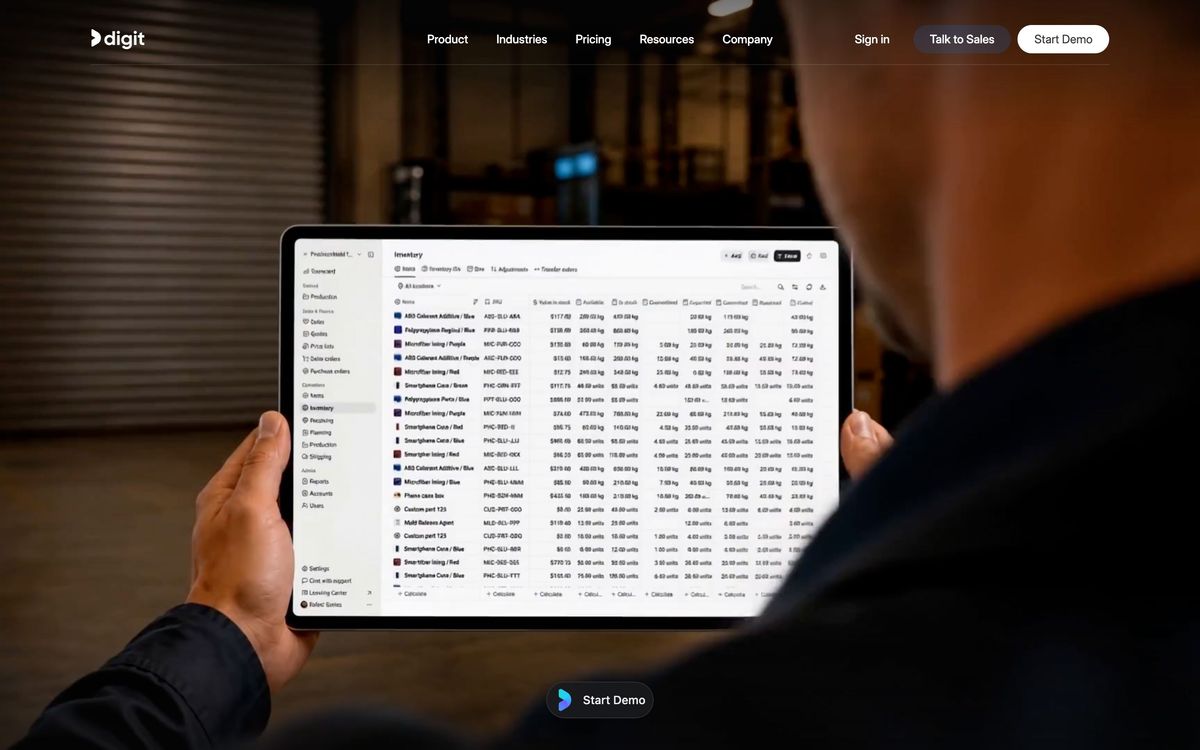
- Multi-site inventory with real-time stock levels, guided picking and packing, fulfilment and demand forecasting
- Production with work orders, multi-level bills of materials, routings, scheduling and job costing
- Purchasing covering material requirements planning, vendor management, receiving and batch capture
- Multi-channel order management with quotes, invoicing and customer records in the same system
- Lot, batch and serial traceability with expiry management for food, cosmetic and chemical compliance
- Native accounting and commerce connectors plus a GraphQL API, webhooks and an MCP endpoint
Who it's for
The fit is a growing manufacturer or distributor that has hit the ceiling of its accounting software's inventory module and cannot absorb a nine-month implementation. Typically that is somewhere between ten and a couple of hundred staff, one to three sites, real production rather than pure resale, and a traceability obligation that makes spreadsheet records genuinely risky. Companies already on QuickBooks or Xero benefit most, since the accounting connectors are the reason to prefer this over a system that expects to own the ledger.
It is not the right choice for a pure ecommerce seller with no production, who needs less than this and should buy an inventory app. It is equally wrong for a business with complex multi-entity finance, heavy regulatory validation requirements or an existing enterprise ERP footprint, where the maturity gap against the incumbents matters more than deployment speed. Any organisation that requires a long vendor track record before signing should also look elsewhere for now.
How it compares
Katana is the closest competitor by intent, with a friendlier visual production floor and published pricing, and less depth in purchasing and multi-site distribution. Cin7 Core and Unleashed both offer deeper inventory and reporting with longer histories and larger customer bases, and both cost real money before implementation. Fishbowl remains the QuickBooks-adjacent legacy option, cheaper but visibly dated. Digit's argument against all of them is time to value and the AI automation layer; its weakness against all of them is that far fewer companies have run it in anger.
Verdict
For a small manufacturer that needs operational control this quarter rather than next year, this is a credible and well-built option, and the accounting integrations remove the usual reason ERP projects stall. The rating reflects promise more than proof. Pricing is not published anywhere on the vendor site, the third-party review base is small enough that a handful of opinions move the average, and the automation claims have not been independently tested. Run a scoped pilot on one product line and confirm the quote in writing before committing the whole operation.
Ready to try Digit?
More ecommerce tools like Digit
Katana Cloud Inventory
4.1Live inventory and production tracking for small manufacturers selling through Shopify, Amazon and wholesale.
Read Katana Cloud Inventory review →Unleashed Software
4.1Cloud inventory, purchasing and light manufacturing for wholesalers and product businesses on Xero.
Read Unleashed Software review →Zedonk
4.0Modular PLM and ERP for fashion brands: tech packs, costing, production, stock and a B2B showroom.
Read Zedonk review →Increff
3.9Warehouse, order and merchandise planning software for fashion and D2C brands selling across marketplaces.
Read Increff review →ShipBob
3.9Outsourced ecommerce fulfilment across a global warehouse network, run from one inventory dashboard.
Read ShipBob review →Spocket
3.8Dropshipping catalog weighted toward US and EU suppliers, with one-click import and branded invoicing.
Read Spocket review →