
Spocket review
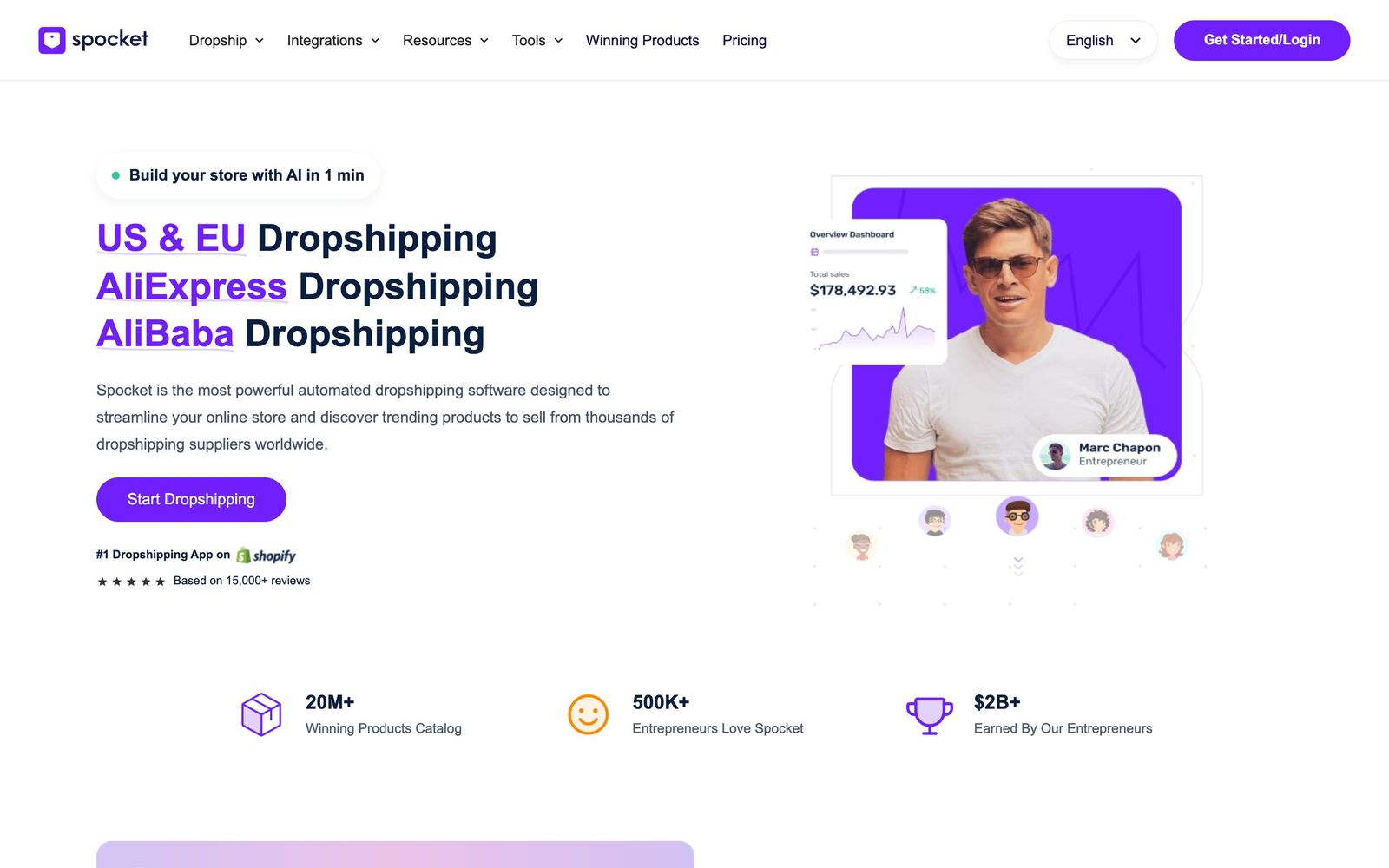
Dropshipping catalog weighted toward US and EU suppliers, with one-click import and branded invoicing.
The right sourcing app for stores that sell on delivery speed rather than lowest price, though the subscription is steep for what it automates and there is no free plan.
Pros
- A large share of suppliers ship from the US and EU, which compresses delivery from weeks to days.
- Products import with images, variants and pricing rules in one click, and stock and order status sync back automatically.
- Branded invoicing keeps the supplier's identity off the paperwork that reaches the customer.
- Orders are unlimited on every tier, so growing revenue does not by itself raise the subscription.
- It connects to more storefronts than Shopify alone, including Wix, Squarespace, Ecwid and BigCommerce.
Cons
- There is no free plan and the trial runs a week, so judging supplier quality means paying before knowing.
- US and EU unit costs sit well above Chinese sourcing, which makes low-ticket items hard to run profitably.
- Reviewers on Capterra and the Shopify App Store repeatedly report being charged after cancelling.
Spocket pricing
List prices in USD per month, taken from the vendor at review time.
| Plan | Per month | What it covers |
|---|---|---|
| Starter | $39.99 | monthly billing; 25 unique products |
| Professional | $24 | billed annually; $59.99 monthly, 250 unique products and 25 premium |
| Empire | $57 | billed annually; $99.99 monthly, 10,000 unique products |
| Unicorn | $79 | billed annually; $299.99 monthly, 25,000 unique products |
What Spocket actually does
Spocket is a sourcing app that sits between an online store and a network of dropshipping suppliers. A merchant browses the catalog, imports a product into their storefront with images and variants intact, and sets a pricing rule. When a customer buys, the order is forwarded to the supplier automatically and the tracking number is pushed back into the store. Inventory levels and price changes sync in the background, which is the part that stops a store selling something the supplier no longer stocks.
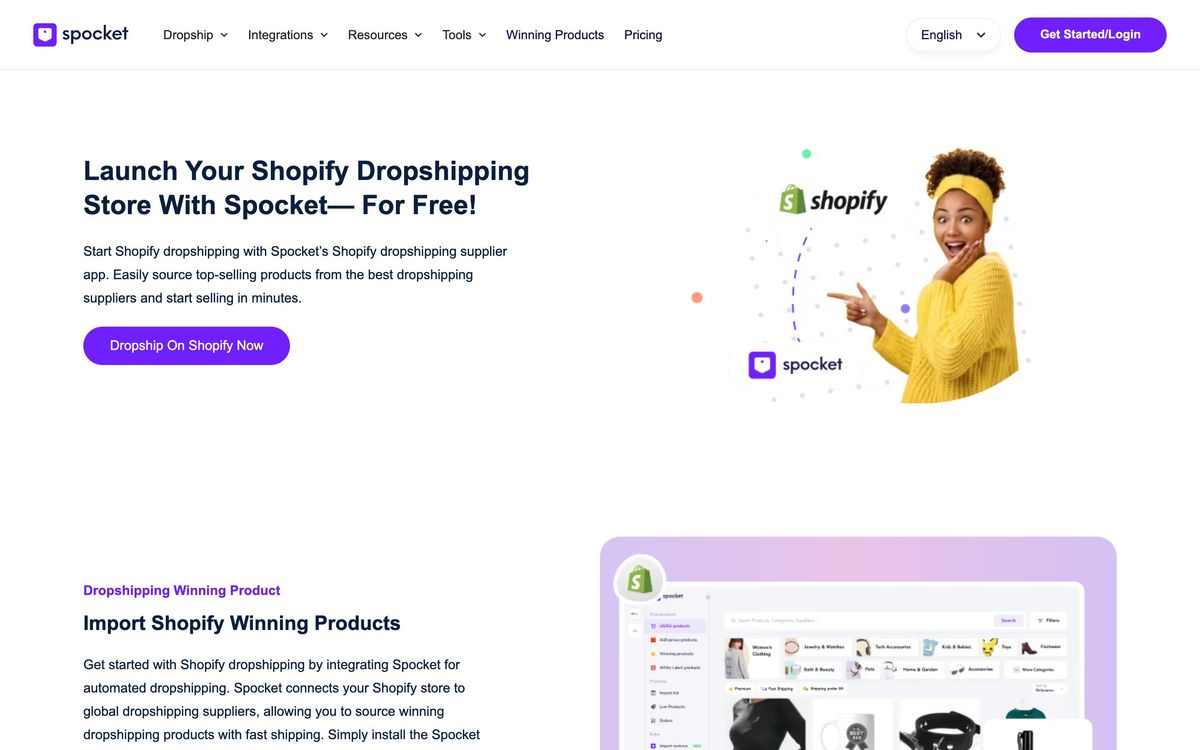
What separates it from the general dropshipping field is where the goods come from. Spocket weights its catalog heavily toward suppliers based in the United States and Europe, and the company states that around 80 percent of its suppliers ship from those regions. That single choice changes the business model of a store built on it: delivery is measured in days rather than weeks, returns are easier to handle, and the product photography tends to be usable as-is. Branded invoicing keeps the supplier invisible on the paperwork. The catalog also carries print-on-demand items, and the platform connects to Shopify, WooCommerce, Wix, Squarespace, BigCommerce, Ecwid, eBay and Amazon rather than Shopify alone.
Key features
The working parts a merchant touches every week.
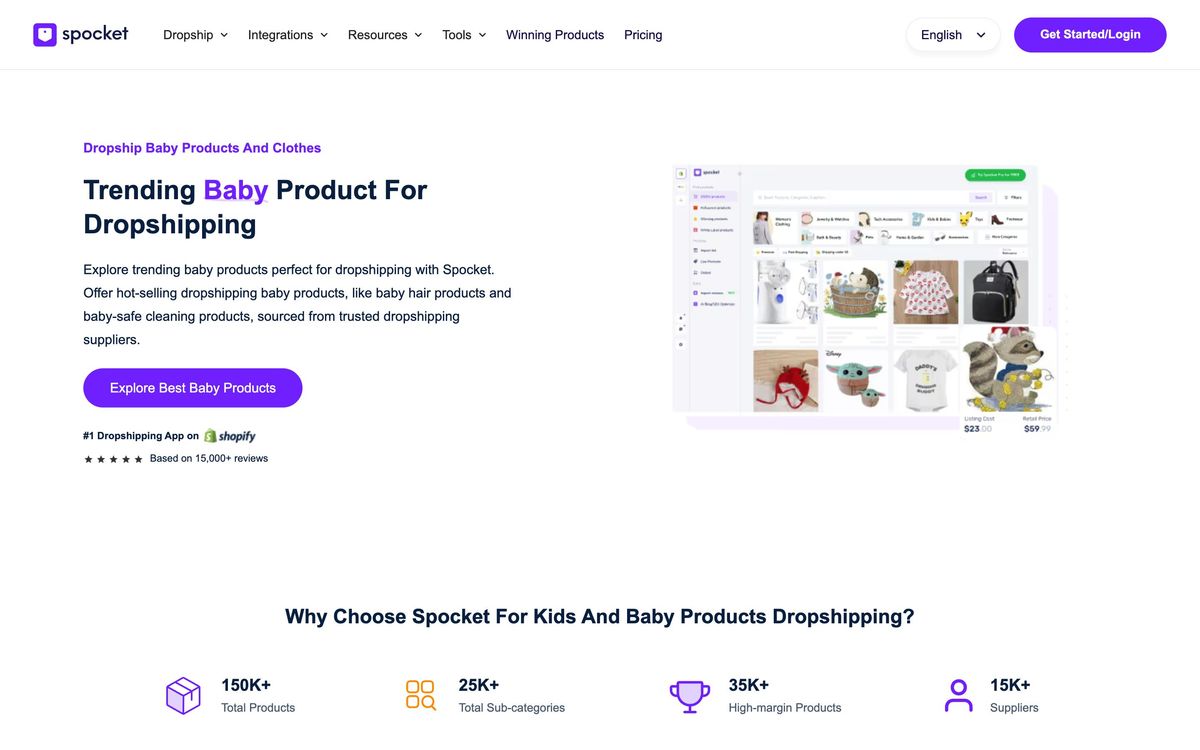
- Supplier catalog filterable by shipping origin, delivery window and product category
- One-click import with editable titles, descriptions, images and automatic pricing rules
- Order forwarding to the supplier with tracking numbers returned to the storefront
- Inventory and price synchronization to prevent selling out-of-stock goods
- Branded invoicing on the documents that reach the end customer
- Multiple connected stores on one account, with print-on-demand stock in the same catalog
Who it's for
Spocket suits a merchant whose competitive claim is delivery speed and product quality rather than the lowest price: home goods, jewelry, beauty, pet accessories, apparel at a mid-price point. It works particularly well for a European or North American store serving its own region, because the shipping advantage is largest there. It also fits someone testing a niche who wants to avoid the reputational cost of three-week delivery times while the concept is being proven.
It is a poor fit for a price-led store. Domestic unit costs are materially higher, and on cheap items the arithmetic simply does not close once advertising is added. It is also a difficult first purchase for a merchant with no budget, since there is no free tier and the trial is short enough that supplier quality has to be judged largely from listings. High-volume operators who need multi-supplier automation across marketplaces will find broader tooling elsewhere for less.
How it compares
AutoDS starts much cheaper and automates across a wider set of source marketplaces and sales channels, but its supplier quality is inconsistent and its strength is arbitrage rather than curation. Zendrop offers deeper catalog volume with custom branding and faster onboarding, and many serious operators run it alongside Spocket rather than instead of it. DSers, tied to AliExpress, is nearly free and unbeatable on unit cost while delivering exactly the long shipping times Spocket exists to avoid. CJdropshipping sits between them with warehousing and sourcing agents. The trade is consistent across all four: Spocket buys shipping speed and product presentation with margin.
Verdict
Spocket solves one real problem well. For a store whose customers will not wait three weeks, having a curated supply base in the same continent removes the single biggest objection to dropshipping as a model, and the import, sync and branded invoicing workflow is tidy enough to run without daily attention. The rating stays below the leaders for reasons that are structural rather than cosmetic: the subscription is expensive relative to the automation it provides, the absence of a free tier forces a blind commitment, and the recurring billing complaints in public reviews are frequent enough to be worth taking seriously. Merchants selling mid-priced goods to a domestic audience will get their money back; anyone chasing the lowest possible landed cost should look elsewhere.
Ready to try Spocket?
More ecommerce tools like Spocket
Katana Cloud Inventory
4.1Live inventory and production tracking for small manufacturers selling through Shopify, Amazon and wholesale.
Read Katana Cloud Inventory review →Unleashed Software
4.1Cloud inventory, purchasing and light manufacturing for wholesalers and product businesses on Xero.
Read Unleashed Software review →Printify
4.0Print-on-demand network that routes each order to one of roughly 140 independent print shops worldwide.
Read Printify review →Zedonk
4.0Modular PLM and ERP for fashion brands: tech packs, costing, production, stock and a B2B showroom.
Read Zedonk review →Catalister
3.9AI product research and listing tool that generates marketplace-ready titles, descriptions and bulk edits.
Read Catalister review →Tapstitch
3.8Print-on-demand and custom apparel manufacturing for sellers who want cut-and-sew garments rather than blank tees.
Read Tapstitch review →