
Tapstitch review
Print-on-demand and custom apparel manufacturing for sellers who want cut-and-sew garments rather than blank tees.
A reasonable supplier for a clothing brand that wants garment-level customisation without minimums, though the catalog and integration list are narrower than Printful's and fulfilment is slower.
Pros
- No minimum order quantity, so a single sample garment can be ordered at the same base price a customer order would pay
- No subscription: the platform is free to use and cost is entirely per order, which suits a brand with irregular volume
- Goes beyond printing on blanks into cut-and-sew and custom garment construction, which matters for brands that want their own fit and trim
- Design tooling and mockups are built in, so a listing can be produced without external design software
- Wholesale and dropshipping run through the same account, letting a brand test on demand and then scale into bulk pricing
Cons
- There is no Amazon or eBay connector, so sellers who list on the big marketplaces still export and import orders by hand
- Fulfilment is concentrated in fewer facilities than the global networks, so delivery times to buyers outside the main lanes are longer and less predictable
- Base costs on cut-and-sew items leave thinner margins than printing on blanks, which pushes retail prices above what casual buyers expect from print-on-demand apparel
Tapstitch pricing
List prices in USD per month, taken from the vendor at review time. Custom means quote-only.
| Plan | Per month | What it covers |
|---|---|---|
| Pay per order | Custom | no subscription; cost is the item base price plus print charges and shipping per order |
What Tapstitch actually does
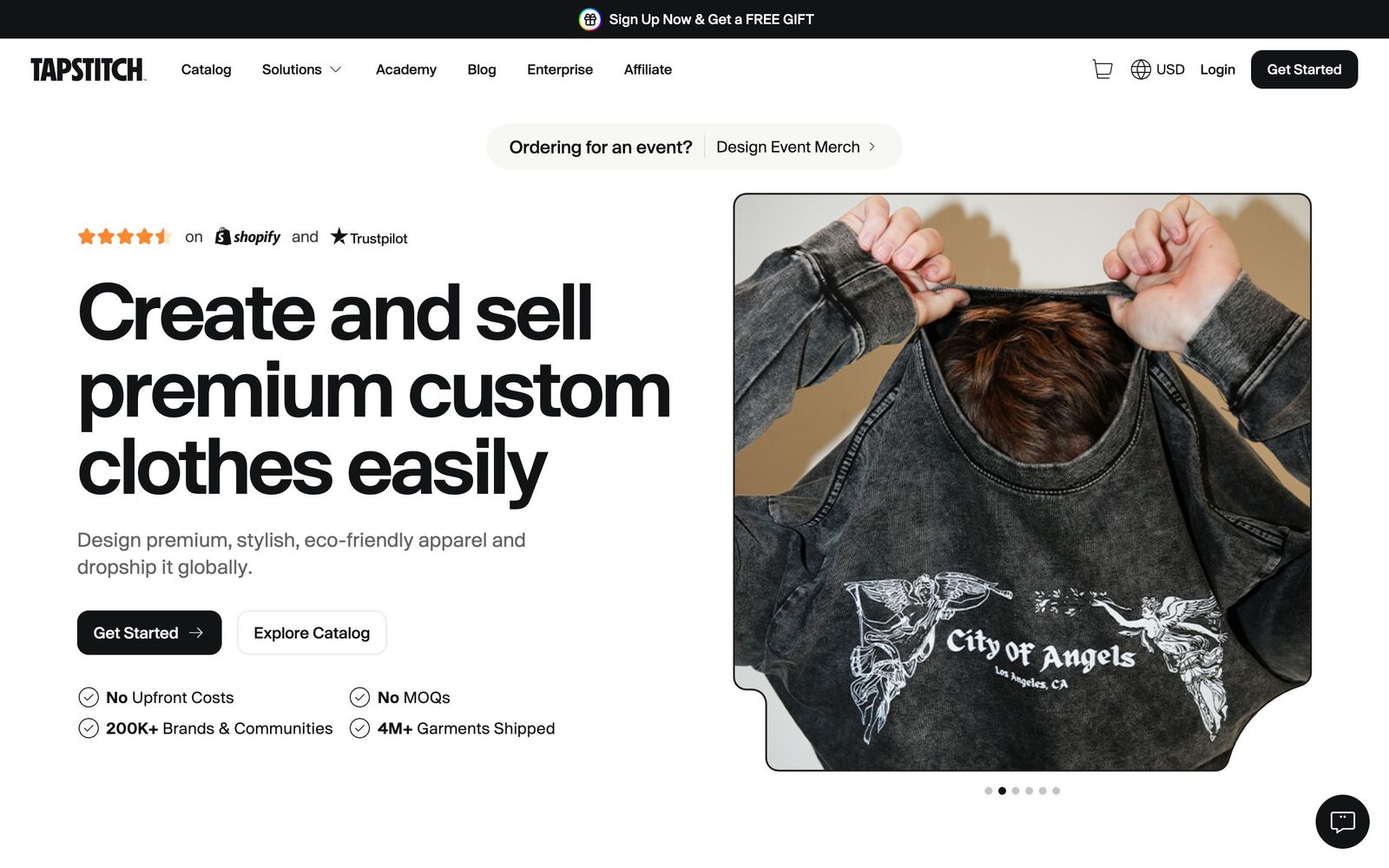
Tapstitch is a print-on-demand supplier aimed at clothing brands rather than at merchandise sellers. The distinction is the manufacturing model: most print-on-demand vendors buy stock blanks in bulk and decorate them, while Tapstitch also produces garments from pattern up, which means a brand can specify fabric, cut and trim rather than accepting whichever blank the supplier stocks. Orders are placed one at a time, with no minimum quantity, and the same account handles both on-demand fulfilment and larger wholesale runs.
Operationally it works the way the category does. A seller designs in the browser editor, generates mockups, and publishes products to a connected Shopify, Etsy, WooCommerce, Wix, BigCommerce, Squarespace or TikTok Shop store. When a customer buys, the order flows to Tapstitch, which produces and ships it under the brand's name, with branded labels and packaging inserts available. The platform itself carries no subscription; the entire cost is the item base price, print charges and shipping, charged per order. Sampling follows the same rule, so a founder can order one of each product at unit price before listing anything, which is the practical use of a zero-minimum policy.
Key features
The product set is narrower than the large networks but deeper on the garment side.
- Cut-and-sew manufacturing alongside printing on standard blanks, including fabric and construction choices
- Browser design editor with 3D and flat mockups for storefront listings
- Sampling at unit price with no minimum order quantity on any item
- Native connectors for Shopify, Etsy, WooCommerce, Wix, BigCommerce, Squarespace and TikTok Shop
- Branded neck labels, hang tags and packaging inserts for private-label presentation
- Wholesale ordering in the same account for brands moving past on-demand volumes
Who it's for
The buyer this fits is a small apparel brand with a point of view about the product itself, someone who cares that the sweatshirt is a specific weight and cut, not just that a design prints cleanly on it. Because there is no minimum and no subscription, the platform works well as a validation step: sample a few pieces, list them, see what sells, then order a wholesale run of the winners. Creators moving from a merch table into an actual clothing line are the clearest case.
It is the wrong supplier for a high-volume merchandise operation. Sellers pushing posters, mugs, phone cases and stickers need a broad catalog, and Tapstitch is a clothing manufacturer; the storefront connectors are there, but Amazon and eBay are not, so marketplace sellers keep moving orders by hand. It is also a poor choice where fast delivery is the promise, since production is concentrated in fewer facilities than the global networks and international transit reflects that. Anyone whose margin depends on a low retail price should model the base costs carefully before committing, because garment-level customisation costs more per unit than decorating a blank.
How it compares
Printful is the obvious comparison and wins on breadth: a much larger catalog, fulfilment centres across several continents, and integrations with nearly every storefront and marketplace, though its garments are decorated blanks and customisation stops at embroidery and labels. Printify undercuts both on price by brokering a network of third-party print providers, which brings the lowest base costs in the category and the least consistent quality, since two orders can be produced by different factories. Gelato competes on delivery speed through local production in many countries but offers no cut-and-sew option at all. Tapstitch sits in the gap none of them fill: real apparel manufacturing at print-on-demand quantities.
Verdict
Tapstitch is a specialist, and judged as one it does its job. The absence of minimums and subscriptions lowers the cost of testing a clothing line to near zero, the sampling policy is genuinely useful, and the manufacturing depth is something the large networks do not offer. The rating reflects the trade that comes with it: a smaller catalog, fewer sales-channel connectors, and shipping times that will not satisfy a buyer trained by two-day delivery. Brands that value the garment more than the logistics will accept that; sellers optimising for volume and reach should stay with the larger networks.
Ready to try Tapstitch?
There's a free tier, so you can test it before committing.
More ecommerce tools like Tapstitch
Catalister
3.9AI product research and listing tool that generates marketplace-ready titles, descriptions and bulk edits.
Read Catalister review →Spocket
3.8Dropshipping catalog weighted toward US and EU suppliers, with one-click import and branded invoicing.
Read Spocket review →Quartile
4.4Cross-channel retail media platform managing Amazon, Walmart, Instacart, Google and Meta ads with ML bidding.
Read Quartile review →soona
4.4Creative-for-commerce platform: studio photo and video, UGC creators, AI editing tools and listing insights.
Read soona review →DataHawk
4.3Enterprise-grade Amazon and Walmart analytics: SKU-level dashboards, anomaly alerts and AI diagnostics.
Read DataHawk review →Gorgias
4.3Ecommerce help desk where order data and refunds live inside the conversation, with an AI agent priced per resolution.
Read Gorgias review →