
DataHawk review
Enterprise-grade Amazon and Walmart analytics: SKU-level dashboards, anomaly alerts and AI diagnostics.
DataHawk is one of the strongest choices for brands and agencies that need owned, BI-ready Amazon and Walmart data with automated diagnostics, but it is built for organizations, not solo sellers hunting their next product.
Pros
- Daily SKU-level analytics unifying sales, advertising, profitability and inventory signals
- Sherlock AI agent detects, diagnoses and suggests fixes for performance issues
- Automated daily anomaly and opportunity alerts
- Pipes data to Snowflake, Power BI, Looker Studio and Google Sheets: no vendor lock-in
- White-label dashboards and multi-account management suited to agencies
Cons
- No free plan or self-serve trial; entry is via demo request
- Overpowered for small sellers who mainly need product research
- Newest AI capabilities (Sherlock) were gated behind a beta waitlist
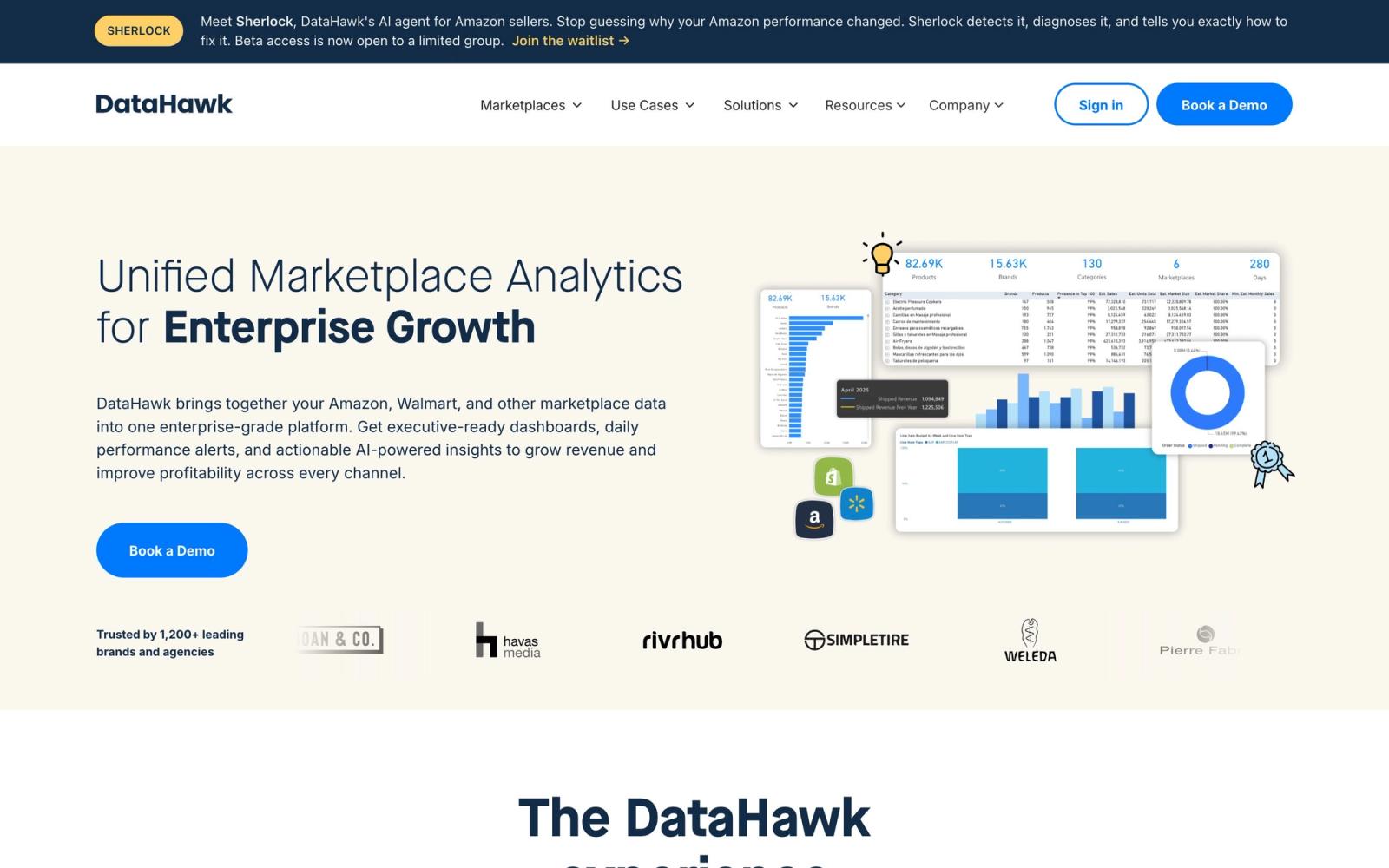
Most Amazon analytics tools were built for individual sellers hunting products. This DataHawk review covers a platform built for the other end of the market: brands, agencies and enterprises that need their Amazon and Walmart data unified, trustworthy and exportable into the BI stack they already run. DataHawk aggregates marketplace data through official partner integrations into daily, SKU-level analytics covering sales, advertising, profitability and inventory, and reports serving more than 1,200 brands and agencies across categories from beauty to publishing.
What DataHawk actually does
DataHawk's foundation is data plumbing done properly. It connects to Amazon and Walmart through official marketplace integrations and produces a daily, SKU-level record of how every product is performing; revenue, advertising metrics, profitability signals, inventory position, and organic versus paid visibility. That data feeds executive-ready dashboards inside the platform, but just as importantly it flows outward: native connections push the same data into Snowflake, Power BI, Looker Studio and Google Sheets. For companies that treat marketplace data as a corporate asset rather than a dashboard subscription, that no-lock-in posture is the headline feature.
On top of the pipeline sit two automation layers. Automated alerts scan daily for performance anomalies and opportunities; a listing that lost the buy box, a keyword that dropped rank, a sudden margin squeeze. And Sherlock, DataHawk's AI agent, goes a step further: the company describes it as detecting an issue, diagnosing why it happened and telling you exactly how to fix it, turning analytics from a reporting exercise into a to-do list. DataHawk cites an average 130 percent revenue lift within six months for customers, a vendor figure worth reading as directional rather than guaranteed.
Key features
- Daily SKU-level analytics across sales, ads, profitability and inventory for Amazon and Walmart
- Sherlock AI agent for automated detection, diagnosis and fix recommendations
- Daily anomaly and opportunity alerting
- Data destinations: Snowflake, Power BI, Looker Studio, Google Sheets
- Executive-ready dashboards with white-label reporting for agencies
- Multi-account portfolio management
- Full data export with no vendor lock-in
Who it's for
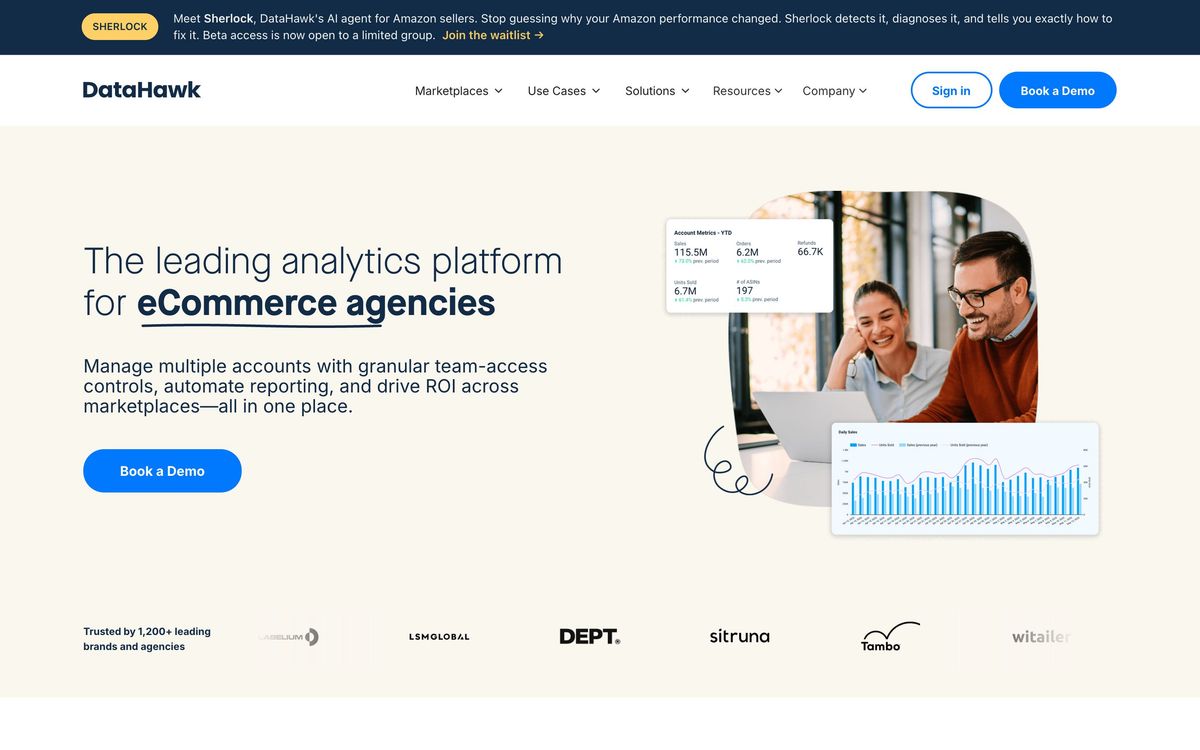
DataHawk is aimed at three groups. Brands selling on Amazon and Walmart that have outgrown seller-tool dashboards and need profitability and forecasting visibility their finance team will accept. Agencies managing portfolios of client accounts, who get white-label reporting and multi-account structure out of the box. And data teams at larger organizations who want marketplace data flowing into Snowflake or Power BI next to everything else. It is not aimed at the solo seller doing product research and keyword hunting; there is no free tier, onboarding runs through a demo, and the feature set assumes you already have products and revenue worth analyzing.
How it compares
Against Helium 10, the contrast is purpose: Helium 10 is a seller's Swiss-army knife (product research, keywords, listing tools) with analytics attached, while DataHawk is analytics-first with enterprise data architecture. A seller starting out needs Helium 10; a brand running forty SKUs across two marketplaces with a BI team needs DataHawk. Against Jungle Scout Cobalt, the closest enterprise competitor, DataHawk's edge is the open data layer (pushing daily SKU-level data into your own warehouse) while Cobalt's strength is market intelligence and share-of-voice data drawn from Jungle Scout's vast catalog dataset. Many enterprise teams shortlist both for different jobs.
Verdict
DataHawk delivers what it promises: enterprise-grade Amazon and Walmart analytics with real data ownership, automated alerting, and an AI layer pointed at diagnosis rather than dashboards for their own sake. In 2026 the Sherlock agent is the most interesting development, though newer capabilities have rolled out gradually via waitlist. The tradeoffs are inherent to the positioning; no free plan, sales-led onboarding, and capability most small sellers will never use. For brands and agencies that have hit the ceiling of seller-suite analytics, DataHawk is one of the two or three platforms genuinely worth a demo.
Ready to try DataHawk?
More ecommerce tools like DataHawk
Aura
4.1Amazon and Walmart repricer that adjusts listing prices every ten seconds against Buy Box competition.
Read Aura review →Getida
4.0FBA auditing that finds Amazon's inventory and fee discrepancies and files the reimbursement claims for you.
Read Getida review →Carbon6
3.8A bundle of Amazon seller tools covering reimbursements, inventory, PPC and external traffic under one owner.
Read Carbon6 review →Feedvisor
3.7Amazon repricing and advertising optimisation driven by one model of demand, inventory and competitive position.
Read Feedvisor review →Gorgias
4.3Ecommerce help desk where order data and refunds live inside the conversation, with an AI agent priced per resolution.
Read Gorgias review →AfterSell by Rokt
4.2Adds one-click upsells to the cart, checkout and thank-you pages of a Shopify store.
Read AfterSell by Rokt review →