
Feedvisor review
Amazon repricing and advertising optimisation driven by one model of demand, inventory and competitive position.
The most sophisticated pricing and advertising engine an Amazon seller can rent, though the contract, the cost and the enterprise onboarding rule it out below serious revenue.

Pros
- Pricing and advertising are optimised against the same demand model, so a bid is not raised on a listing the repricer is about to reposition
- Repricing accounts for inventory position, which stops the classic error of pushing volume on a SKU that is about to run out of stock
- Competitive tracking covers price, promotions, rank, reviews, units sold, ad placement and Buy Box share, and feeds those signals back into decisions
- Advertising management spans sponsored placements, DSP and Amazon Marketing Cloud, which few mid-market tools reach at all
- Reporting is built for margin rather than for revenue vanity, with total advertising cost of sales treated as the working metric
Cons
- The managed platform is an enterprise purchase with annual commitments, and reviewers repeatedly describe friction and long notice periods when trying to cancel
- Historical data retention is short by analytics standards, reviewers cite a window of roughly two to three months, which limits year-on-year work inside the tool
- There is no customer-facing API on the main platform, so data has to leave through exports rather than into a warehouse
What Feedvisor actually does
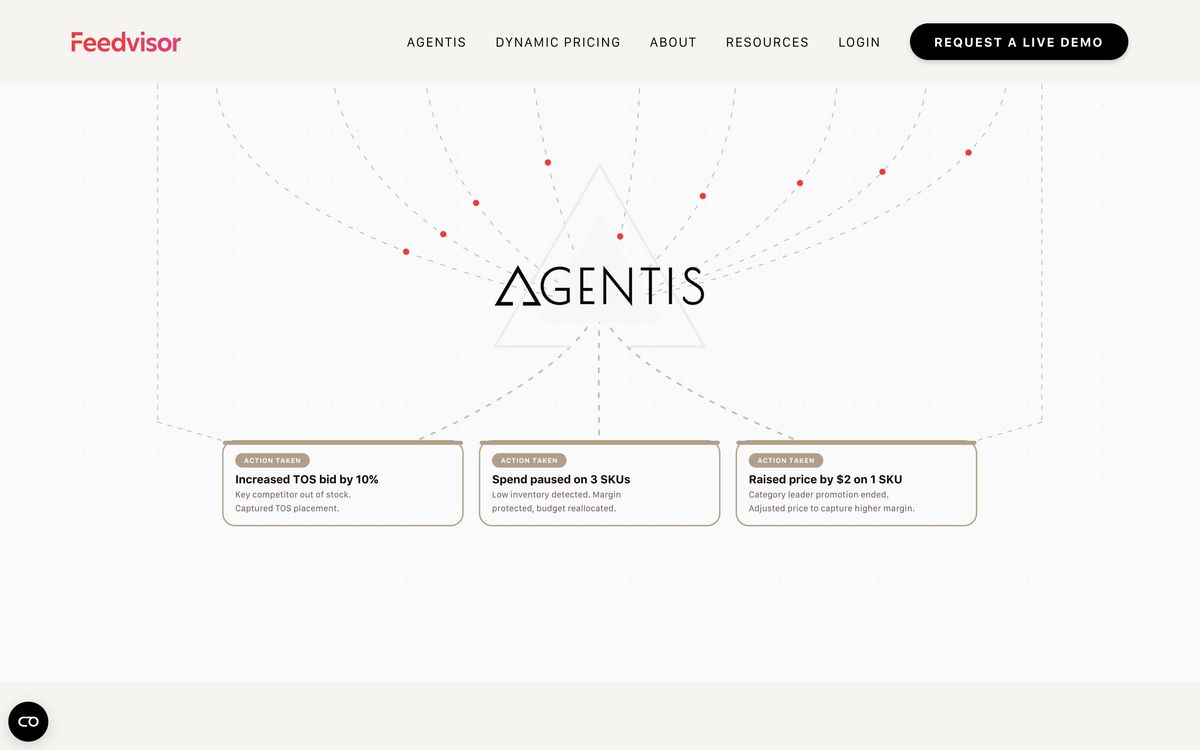
Feedvisor is an optimisation platform for Amazon sellers built on a single premise: price and advertising are one decision, not two. Its repricer moves listing prices against Buy Box competition, demand and, the part most competitors skip, the seller's own inventory position, so a product with six weeks of cover is not priced to sell out in ten days. Its advertising side manages sponsored placements, DSP campaigns and Amazon Marketing Cloud analysis with bids adjusted on live market events rather than on a weekly review cadence.
Both halves feed on the same competitive telemetry. The platform tracks rival prices, promotions, organic rank, review counts, estimated units sold, ad placements and Buy Box share, and uses that picture to decide where a price move will earn more than a bid increase would. The company sells this as two things: a self-serve repricing product aimed at growing sellers, and a managed platform for brands, where a strategist sits alongside the software. The vendor reports several billion dollars of gross merchandise value managed on the platform annually, and it now covers Walmart's marketplace as well as Amazon.
Key features
The capability set is deeper than a repricer and narrower than a full seller suite:
- Repricing that weighs inventory cover and velocity alongside Buy Box competition and margin floors
- Sponsored ads and DSP bid management responding to inventory levels and competitive movement
- Amazon Marketing Cloud analysis for audience overlap and path-to-purchase questions
- Competitive tracking across price, promotions, rank, reviews, units sold and ad position
- Search-term reporting that isolates spend on terms that never convert
- Walmart marketplace pricing and advertising in the same interface
Who it's for
The honest threshold is around a million dollars a year of Amazon revenue, and the platform makes most sense well above that. Below it, the fee consumes the margin the algorithms are meant to protect, and the managed-service element has nothing to work with. The right buyer is a private-label brand with a catalogue large enough that no human can watch every SKU's price and bid, or a reseller competing for the Buy Box on hundreds of listings where a few percentage points of margin across the catalogue is real money.
Smaller sellers should not buy this. A shop running a few dozen SKUs is better served by a cheaper repricer plus a separate advertising tool, accepting the disconnect between them. So should anyone whose analytics live in a warehouse: without a customer-facing API and with a short data-retention window, Feedvisor is not a system of record, and building a longer historical view means exporting on a schedule.
How it compares
Informed.co and Aura are the obvious repricing alternatives, much cheaper, quick to configure, and entirely uninterested in advertising, which is exactly the seam Feedvisor claims. Teikametrics and Perpetua compete on the advertising side with strong bid automation and lighter pricing logic, and they are the sensible pick for a brand whose prices rarely move. Carbon6 assembles a wider bundle of seller tools, from reimbursements to inventory, but nothing in it matches Feedvisor's pricing engine. The trade is consistent: rivals do one half well for a fraction of the outlay, and Feedvisor argues that the two halves are worth joining.
Verdict
When the volume justifies it, Feedvisor does something genuinely difficult, coordinating price and ad spend against inventory in near real time, and the sellers who fit its profile tend to renew. The reservations are commercial rather than technical. Nothing about the cost is published, the agreement is an annual commitment, several reviewers describe an unpleasant exit, historical data does not stretch far, and there is no API to pull results into a warehouse. Read the contract with the same care applied to the algorithm, and treat the platform as an enterprise purchase rather than a tool trial.
Ready to try Feedvisor?
More ecommerce tools like Feedvisor
Carbon6
3.8A bundle of Amazon seller tools covering reimbursements, inventory, PPC and external traffic under one owner.
Read Carbon6 review →BidX
4.2AI ad automation for Amazon and Walmart: Sponsored ads, DSP, AMC analytics and optional managed services.
Read BidX review →Aura
4.1Amazon and Walmart repricer that adjusts listing prices every ten seconds against Buy Box competition.
Read Aura review →Getida
4.0FBA auditing that finds Amazon's inventory and fee discrepancies and files the reimbursement claims for you.
Read Getida review →soona
4.4Creative-for-commerce platform: studio photo and video, UGC creators, AI editing tools and listing insights.
Read soona review →Gorgias
4.3Ecommerce help desk where order data and refunds live inside the conversation, with an AI agent priced per resolution.
Read Gorgias review →