
Catalister review
AI product research and listing tool that generates marketplace-ready titles, descriptions and bulk edits.
Catalister is a genuine time-saver for dropshippers listing dozens of products a week across Shopify and major marketplaces, but its credit-based pricing gets expensive at scale and AI output still needs human review.
Pros
- Generates SEO-optimized titles, bullets, descriptions and alt text tailored per marketplace
- Bulk operations: edit hundreds of products at once for prices, keywords and watermarks
- Competitor catalog import and keyword analysis built in
- Compliance checks flag prohibited keywords and character-limit violations before publishing
- Covers six platforms including Shopify, Amazon and Walmart from one dashboard
Cons
- Credit system charges per action, which adds up fast at high volume
- AI output quality depends heavily on input data and still needs manual review
- No Etsy support
- Image editing capabilities are basic compared to dedicated creative tools
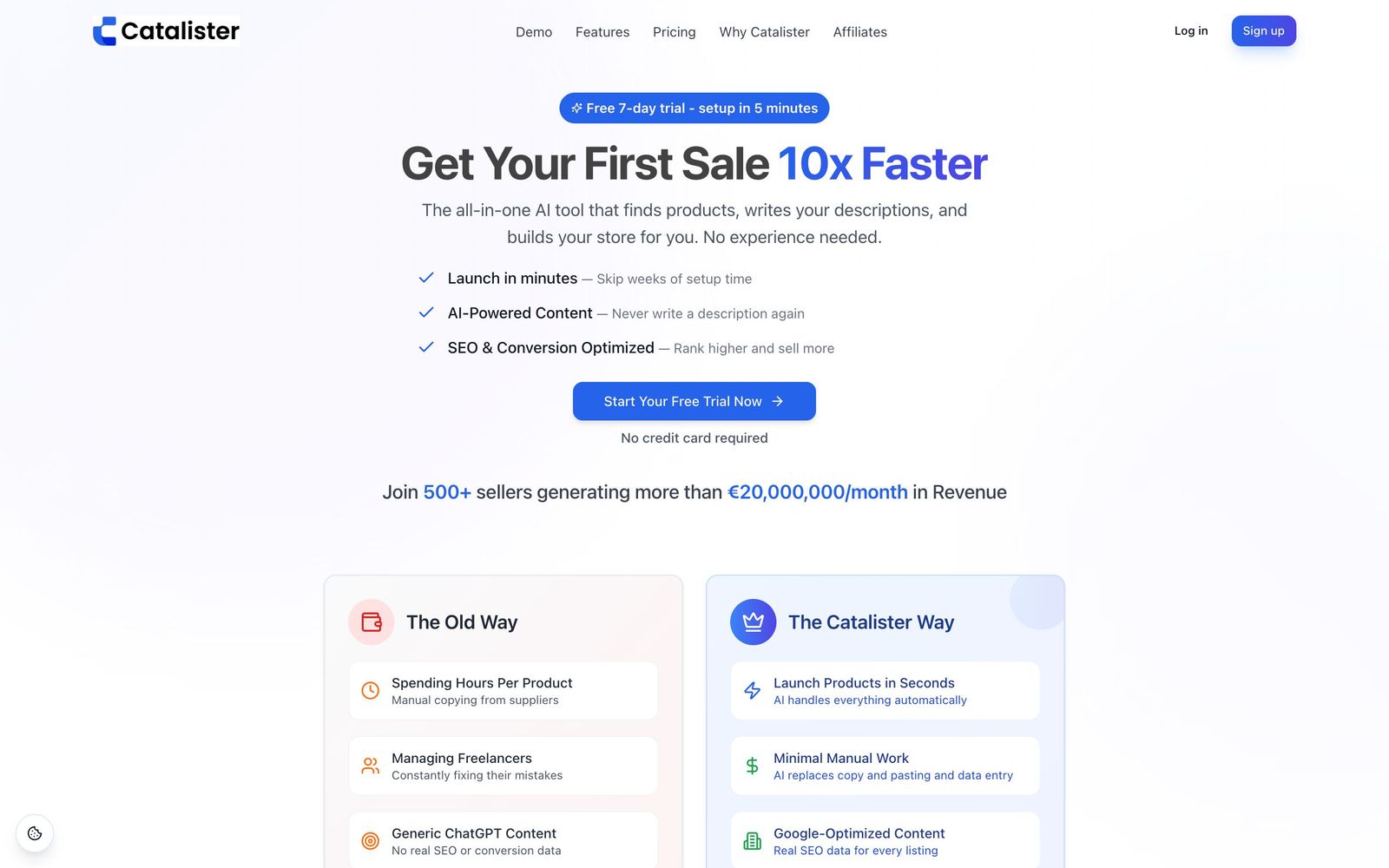
Writing product listings is the least glamorous job in ecommerce, and for dropshippers adding twenty or more products a week it becomes a genuine bottleneck. This Catalister review looks at an AI listing tool that promises to compress that work: paste in a product, get back a marketplace-ready title, bullet points, description and alt text in under a minute. Catalister combines AI listing generation with product research and bulk catalog management, aimed squarely at Shopify dropshippers and multi-marketplace sellers.
What Catalister actually does
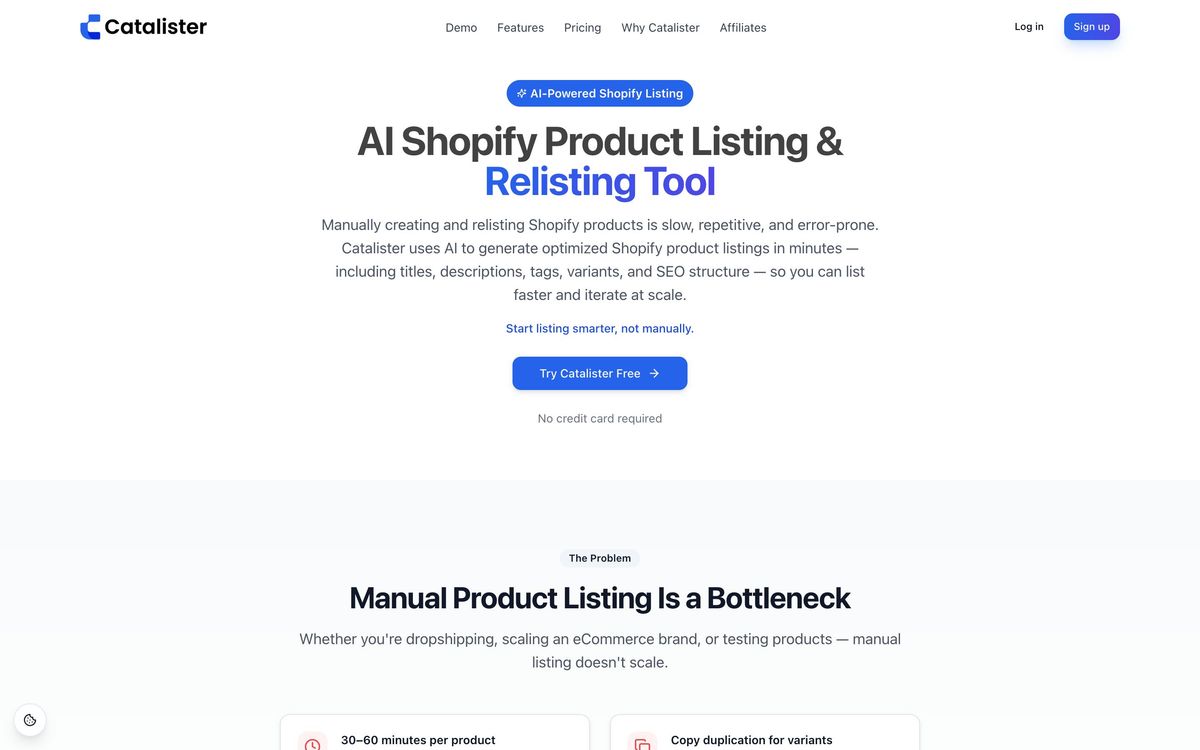
Catalister is built around three jobs. First, listing generation: its AI produces SEO-optimized titles, bullet points, descriptions and image alt text, formatted to the requirements of whichever marketplace you are publishing to. A listing that takes twenty to thirty minutes by hand comes out in seconds, and the formatting differences between Shopify, Amazon and eBay are handled automatically. Second, product research: the tool analyzes market trends, search volume, competitor pricing and sales-velocity signals to help you decide what to list in the first place. Third, catalog operations: you can import competitor catalogs to study their pricing and keywords, and run bulk edits (price updates, keyword additions, watermarks) across hundreds of products at once.
Everything runs on a credit system. Importing a product, generating a listing and publishing to a marketplace each consume credits, with subscription tiers that include a monthly allowance and the option to buy more.
Key features
- AI-generated titles, bullets, descriptions and alt text tuned per marketplace
- Support for Shopify, Amazon Seller Central, eBay, Walmart Marketplace, WooCommerce and BigCommerce
- Product research with trend, search-volume and competitor-pricing signals
- Competitor catalog import and keyword analysis
- Bulk editing of hundreds of products simultaneously
- Compliance checks that flag prohibited keywords, character-limit violations and missing required fields before you publish
The compliance layer deserves a mention: listing rejections on Amazon and Walmart usually come from exactly the kind of small rule violations Catalister catches automatically.
Who it's for
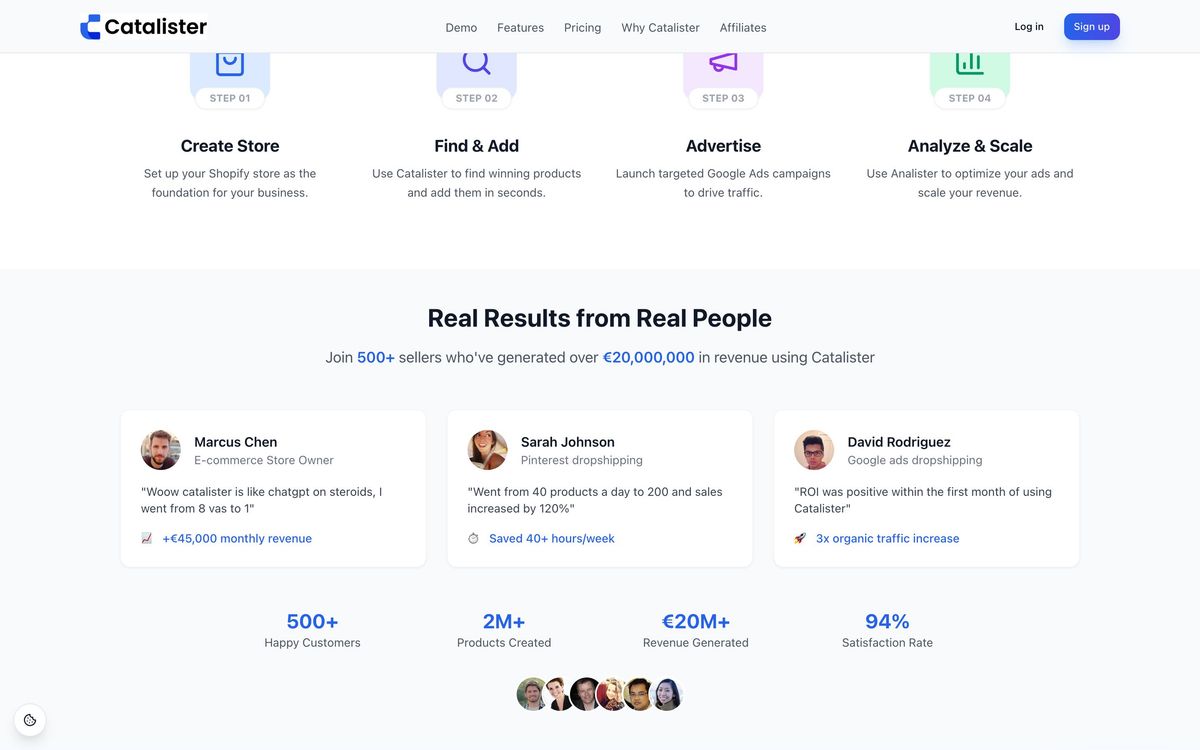
The ideal Catalister user is a dropshipper or small ecommerce team listing products at volume; users report listing eighty products in a weekend, work that would otherwise take a full week. Agencies managing multiple client stores also benefit, since the multi-platform publishing and bulk tooling map well to managing several catalogs. It is a weaker fit for sellers with a small, stable catalog of ten or twenty products: the per-action credit model makes the most sense when listing throughput is your bottleneck, not when you refresh a handful of listings per quarter.
How it compares
Against Smartli, the closest AI-copy alternative, Catalister is broader: Smartli writes excellent product descriptions, ads and blog posts but does not do product research, competitor catalog analysis or multi-marketplace publishing. If you only need copy, Smartli is simpler; if you need the whole list-and-publish pipeline, Catalister covers more ground. Against CopyMonkey, which focuses tightly on Amazon listing optimization, Catalister wins on platform breadth (six channels versus one) while CopyMonkey goes deeper on Amazon keyword strategy specifically.
Verdict
Catalister does what it claims: it turns listing creation from a manual chore into a review-and-publish workflow, and the bulk and compliance tooling are real differentiators for high-volume sellers in 2026. The honest caveats are cost and quality control. Credits are consumed by nearly every action, so heavy users should model their real monthly usage before committing, and the AI output is only as good as the product data you feed it; every listing still deserves a human pass before it goes live. There is a 7-day trial but no permanent free plan. For dropshippers whose growth is limited by how fast they can list, Catalister is worth that trial. For low-volume stores, simpler copy tools will do the job for less.
Ready to try Catalister?
More ecommerce tools like Catalister
Printify
4.0Print-on-demand network that routes each order to one of roughly 140 independent print shops worldwide.
Read Printify review →Spocket
3.8Dropshipping catalog weighted toward US and EU suppliers, with one-click import and branded invoicing.
Read Spocket review →Tapstitch
3.8Print-on-demand and custom apparel manufacturing for sellers who want cut-and-sew garments rather than blank tees.
Read Tapstitch review →Gorgias
4.3Ecommerce help desk where order data and refunds live inside the conversation, with an AI agent priced per resolution.
Read Gorgias review →AfterSell by Rokt
4.2Adds one-click upsells to the cart, checkout and thank-you pages of a Shopify store.
Read AfterSell by Rokt review →BidX
4.2AI ad automation for Amazon and Walmart: Sponsored ads, DSP, AMC analytics and optional managed services.
Read BidX review →