
Kit review
Email list, automation and digital product sales for creators who write more than they design.
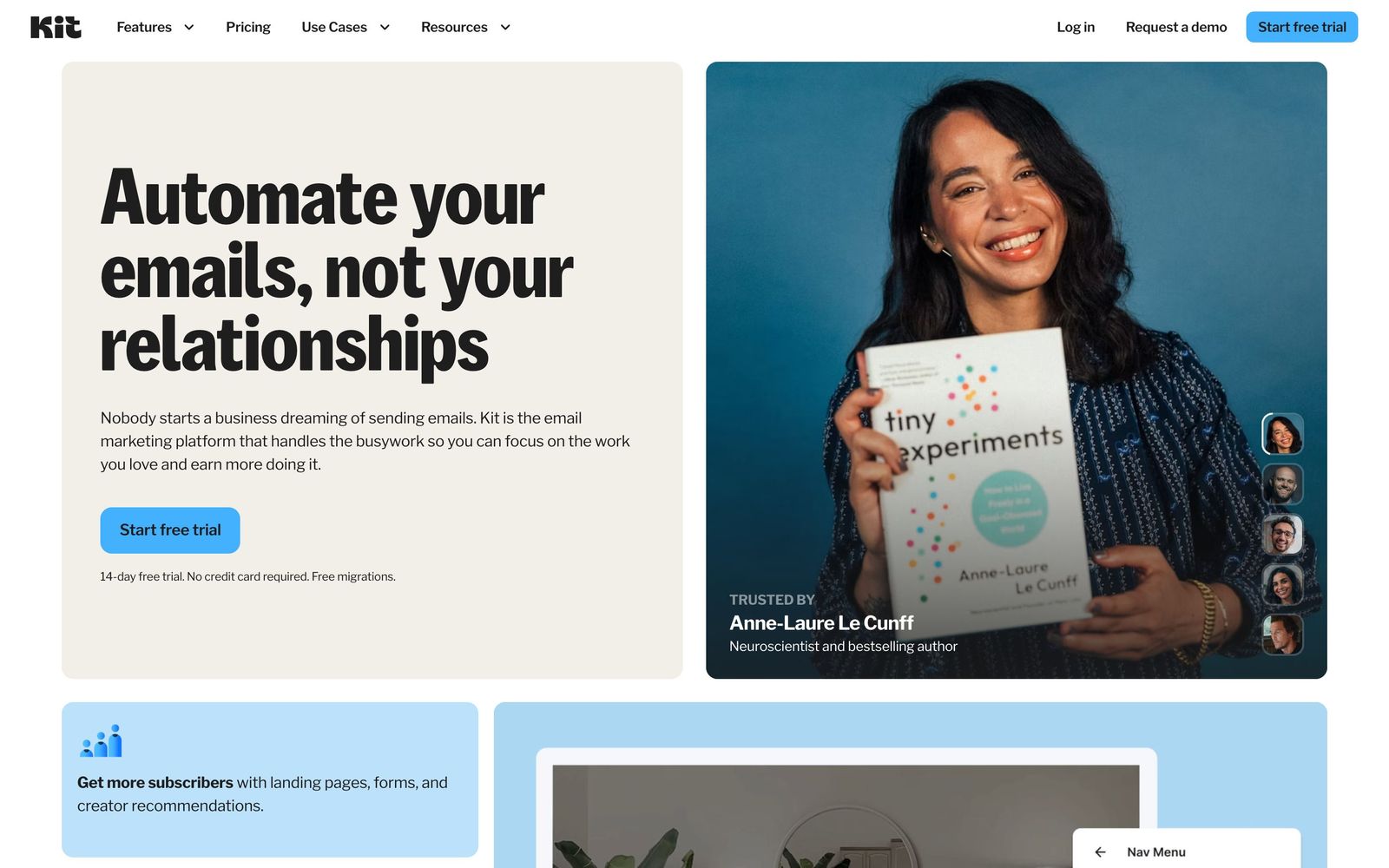
The shortest path from a newsletter to paid products for a solo creator, though the template library is thin and the price climbs steeply with list size.
Pros
- The free tier runs to 10,000 subscribers with unlimited broadcasts, forms and landing pages.
- Digital products, subscriptions and paid newsletters are sold natively, with no separate checkout tool to wire up.
- The tag-and-segment data model keeps one person as one subscriber across several interests instead of duplicating them.
- The visual automation builder links forms, sequences, tags and purchases into a single flow on the paid tiers.
- The Creator Network puts list growth through recommendations inside the product rather than outside it.
Cons
- The template library is small and text-first; an image-heavy branded design means writing custom HTML.
- Pricing scales on subscriber count, so a large but lightly monetized list gets expensive faster than on volume-priced tools.
- Support is email and chat only, with no phone line for the moment a deliverability problem starts costing money.
Kit pricing
List prices in USD per month, taken from the vendor at review time.
| Plan | Per month | What it covers |
|---|---|---|
| Free | Free | up to 10,000 subscribers; broadcasts, forms, landing pages and commerce |
| Creator | $33 | at 1,000 subscribers; unlimited automations, A/B testing, no Kit branding |
| Pro | $66 | at 1,000 subscribers; Subscriber Signals, unlimited team members, priority support |
What Kit actually does
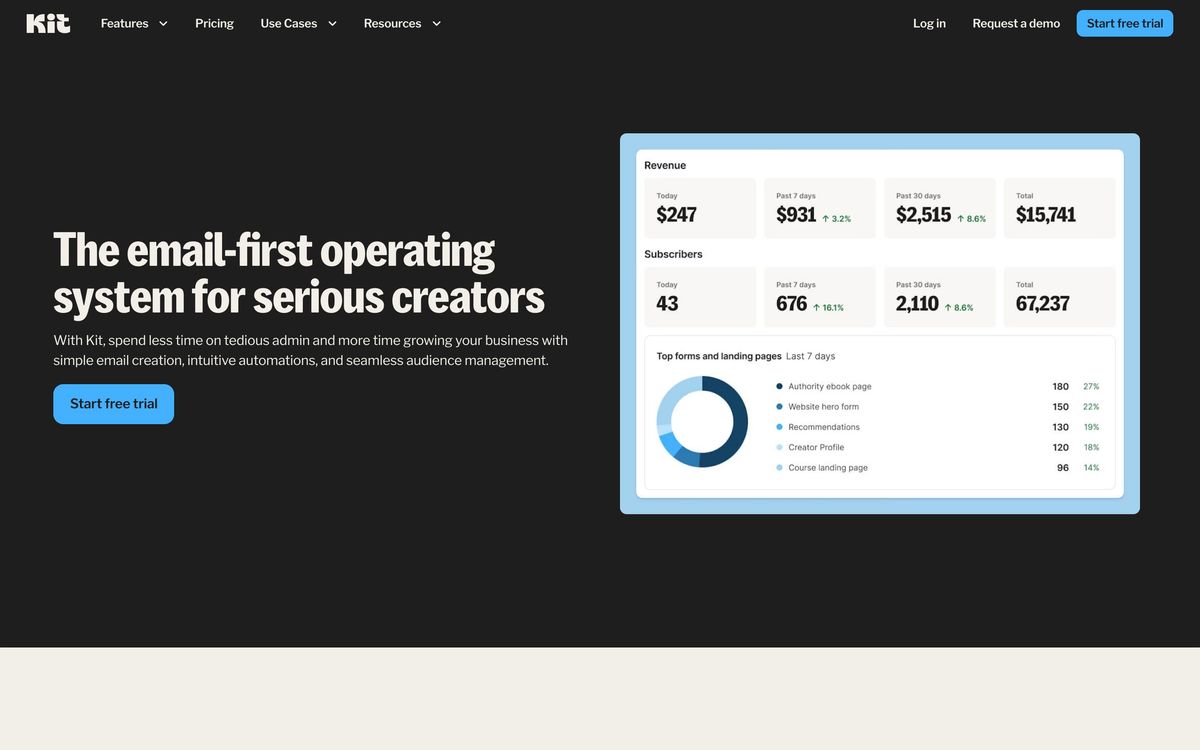
Kit, called ConvertKit until 2024, is email marketing built on the assumption that the sender is a person rather than a brand. The design consequences run through the whole product: emails default to plain, text-forward layouts that read like correspondence, subscribers carry tags instead of living on separate lists, and the interface treats writing as the main activity rather than campaign assembly. A newsletter, a signup form, a landing page and an automated welcome sequence can be live within an hour without a website existing.
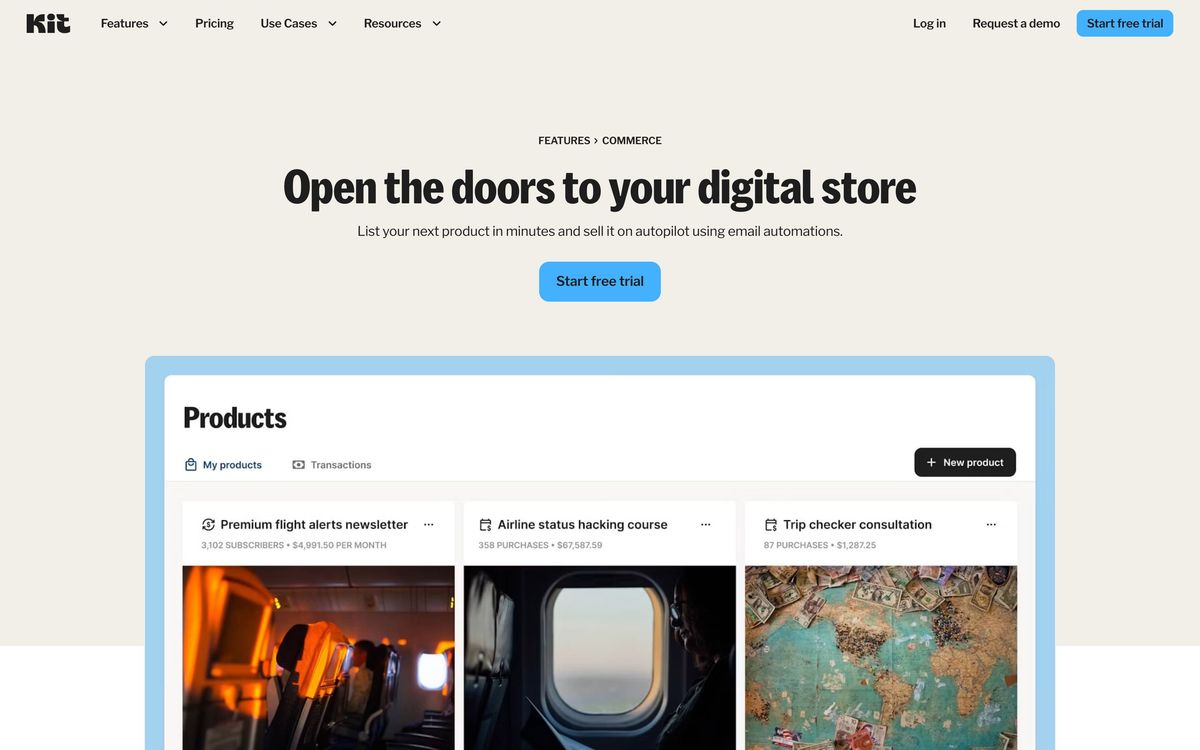
The second half of the product is money. Kit sells digital products, subscriptions and paid newsletter tiers directly, so a creator can charge for a template pack, a course or a members-only edition without wiring up a separate checkout. Automations connect those purchases back to tags, which means a buyer stops receiving the sales sequence automatically. Growth tooling is built in too: the Creator Network lets newsletters recommend one another at the point of subscription, which for many creators has become a larger acquisition channel than social media. Roughly forty integrations cover storefronts, course platforms, community tools and scheduling.
Key features
The pieces that carry the product for a working creator.
- Broadcasts and unlimited email sequences with tag-based segmentation
- A visual automation builder connecting forms, sequences, tags and purchase events
- Landing pages and embeddable forms that need no website to publish
- Native commerce for digital products, subscriptions and paid newsletter tiers
- Creator Network recommendations for cross-promotion at signup
- Subscriber Signals and engagement analytics on the highest tier
Who it's for
Kit fits a writer, teacher, podcaster or independent operator whose business is an audience and whose products are digital. The free tier is unusually generous, and for a creator selling their first course it can carry the entire operation: list, forms, landing pages, checkout. It also suits small media teams who care about deliverability and segmentation more than visual design, since the plain formatting genuinely helps inbox placement.
It is a poor fit for an ecommerce brand, where purchase-behavior segmentation and product blocks matter and Kit has little to offer. It is also wrong for a design-led company that needs email to look like the website, because the template set is thin and matching a brand guideline means hand-written HTML. Anyone with a very large list and thin revenue per subscriber should check the subscriber-count pricing carefully before committing.
How it compares
Beehiiv is the direct rival for pure newsletters and beats Kit on analytics, ad-network monetization and price at large list sizes, while offering less mature automation. Substack is simpler and free until money changes hands, then takes a share of every paid subscription and keeps the audience relationship on its own terms. MailerLite costs considerably less at the same subscriber count and has a better visual editor, but its creator commerce is weaker. ActiveCampaign wins outright on automation logic and CRM depth for anyone whose business is sales rather than publishing. Kit's argument against all four is that it is the only one that treats writing, growth and selling as one workflow.
Verdict
Kit remains the default recommendation for creators who intend to sell something to their list, and the free tier makes that recommendation almost costless to test. Tag-based segmentation, native commerce and the Creator Network fit together in a way stitched-together stacks do not, and the plain-text bias is a deliberate deliverability choice rather than laziness. The weaknesses are equally consistent: design flexibility is limited enough that visually ambitious senders will fight the editor, support has no phone channel when something urgent breaks, and subscriber-based pricing rises faster than revenue for creators with big lists and small offers. Judged as a business tool for independent publishers, it earns its place; judged as a general marketing platform, it is narrower than the price suggests.
Ready to try Kit?
There's a free tier, so you can test it before committing.
More creators tools like Kit
Gamma
4.5AI design partner that generates presentations, documents, websites, and social content from a prompt.
Read Gamma review →Riverside
4.5Browser recording studio that captures every remote guest locally in 4K, then edits and publishes the episode.
Read Riverside review →Consensus
4.4AI search engine over 200M+ academic papers, with a Consensus Meter showing where the science agrees.
Read Consensus review →QuillBot
4.4AI writing suite used by 35M+ writers: paraphrasing, grammar checking, summarizing, and citations.
Read QuillBot review →Murf AI
4.3Generative speech platform with 200+ voices in 35+ languages: studio voiceovers, dubbing, and a real-time API.
Read Murf AI review →Pangram Labs
4.3Research-backed AI detection with independently verified accuracy, covering 20+ languages and major LLMs.
Read Pangram Labs review →