
Synthflow AI review
No-code voice AI agents for inbound and outbound calls: booking, lead qualification and support, 24/7.
The most accessible way to ship a production voice agent without code, backed by 200+ integrations, but usage-based costs and complex call flows still demand attention.
Pros
- Visual flow designer plus natural-language prompt view make agents genuinely buildable without code
- Over 200 integrations across CRMs, calendars and telephony, including HubSpot, Salesforce, Zendesk and Cal.com
- Handles both inbound answering and outbound campaigns with voicemail detection and live-agent handoff
- Supports 30+ languages and high-quality voices via its ElevenLabs integration
- SMS follow-ups and real-time analytics close the loop after calls
Cons
- Usage-based pricing means costs scale with call minutes and need monitoring
- Complex branching flows have a real learning curve despite the no-code label
- Latency and call quality depend on your telephony and configuration choices
- Free trial only: no permanent free plan
Synthflow AI is a no-code platform for building voice AI agents that make and answer phone calls; appointment scheduling, lead qualification, customer support and outbound follow-up, running 24/7 with human-like voices. Where many voice AI products are developer toolkits, Synthflow's bet is that an operations manager should be able to design, test and launch a phone agent from a visual interface, and the platform has grown fast on that promise, raising a $20M Series A to chase the conversational AI market.
What Synthflow AI actually does
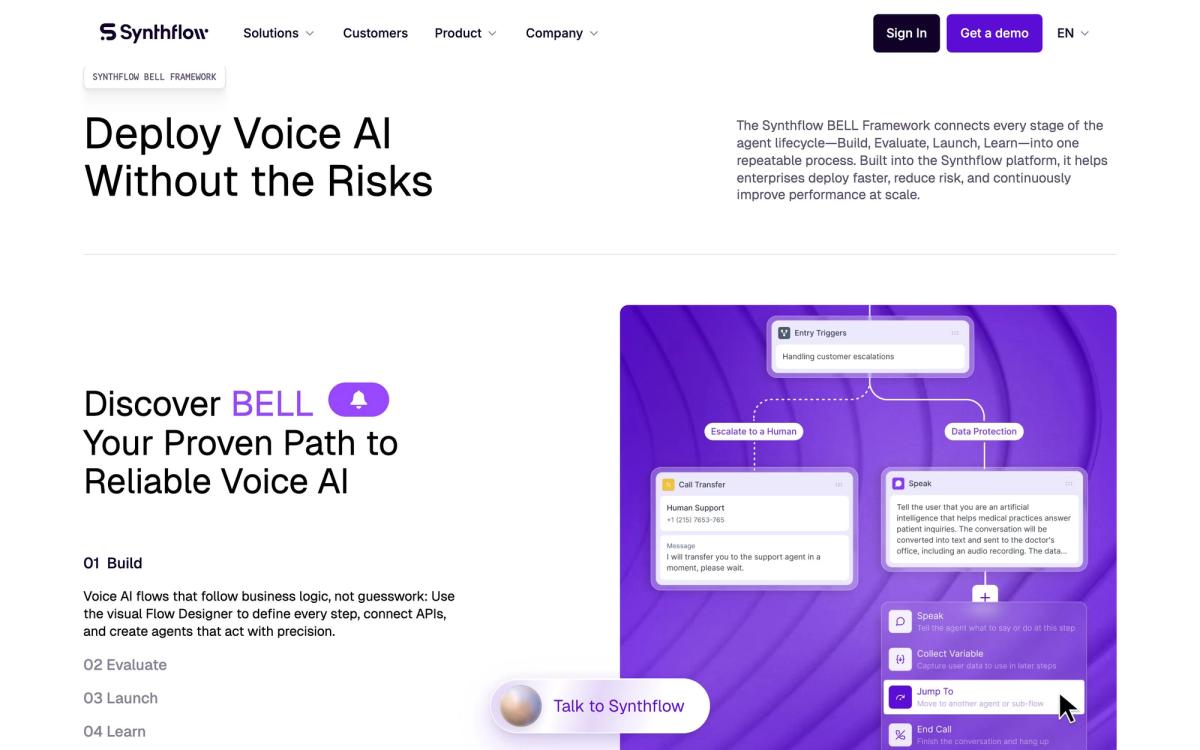
You build an agent two ways: a Prompt View where you describe behavior in plain language, and a Visual Flow Designer where you lay out branching conversation logic (greeting, qualification questions, objection paths, booking, escalation) as a diagram. A knowledge base layer lets the agent draw on your business's documents and FAQs so it answers specifics instead of generalities. On the call itself, Synthflow handles the unglamorous mechanics that decide whether voice AI feels usable: voicemail detection, call routing, warm handoff to a live agent, and SMS follow-ups after the call. Voices come through an ElevenLabs integration, with support for more than 30 languages and dialects. The actions layer connects conversations to outcomes; booking into Cal.com or a calendar, updating HubSpot or Salesforce, creating Zendesk tickets, or firing Zapier and Make automations; across a catalog of over 200 integrations, with native SIP options for Twilio, Telnyx, RingCentral and Vonage.
Key features
- No-code agent building via prompt view and visual flow designer
- Inbound answering and outbound calling campaigns from one platform
- Knowledge base grounding for business-specific answers
- Voicemail detection, call routing and live-agent handoff
- SMS follow-ups and real-time call analytics
- 30+ languages with ElevenLabs-powered voices
- 200+ integrations: HubSpot, Salesforce, Zendesk, Freshdesk, Cal.com, Zapier, Make and native telephony via Twilio, Telnyx, RingCentral, Vonage
Who it's for
Synthflow fits service businesses and agencies that lose revenue on the phone: missed inbound calls, slow follow-up on leads, appointment no-shows that a reminder call would have prevented. It is a particularly good match for teams with a CRM-centric workflow, since agents can read and write CRM data mid-call. Agencies reselling voice agents to clients are an explicit audience. It is less suited to enterprises wanting full programmatic control of the voice stack (developer platforms serve that buyer) and to businesses whose calls are too nuanced or high-stakes to delegate, where AI should triage rather than resolve.
How it compares
Retell AI and Vapi are the usual alternatives. Both are more developer-oriented: stronger APIs and deeper control over models and latency, at the cost of needing engineering time to ship anything. Synthflow trades some of that control for speed (a working agent in an afternoon rather than a sprint) and its integration catalog means less custom glue for mainstream stacks. Against business-in-a-box agents like Goodcall, Synthflow offers far more configurability and outbound capability, with correspondingly more setup decisions to make.
Verdict
Synthflow AI is the strongest pick in the no-code tier of voice AI: real flow control, real integrations, and the operational details (voicemail detection, handoff, follow-up texts) that separate demos from production. The honest caveats are that per-minute economics reward monitoring, sophisticated flows still take iteration to get right, and perceived quality depends on telephony choices. Start with one high-volume, low-complexity call type, measure containment and booking rates, and expand from there.
Ready to try Synthflow AI?
More service-businesses tools like Synthflow AI
Quo
4.2Shared business phone system for calls and texts, with an AI agent that answers when nobody can.
Read Quo review →LucroVox
3.4AI phone receptionist for home services and clinics that answers, qualifies and books around the clock.
Read LucroVox review →Jane
4.4Practice management and EMR for allied health clinics: booking, charting, billing and payments in one record.
Read Jane review →Bókun
4.3Booking system and OTA channel manager for tour, activity and rental operators, owned by Tripadvisor.
Read Bókun review →Boulevard
4.3Booking, point of sale and client records for salons, spas and medspas that run on appointments.
Read Boulevard review →Buddy Punch
4.3Online time clock for hourly staff, with GPS, geofencing and photo verification on every punch.
Read Buddy Punch review →