
Bókun review
Booking system and OTA channel manager for tour, activity and rental operators, owned by Tripadvisor.
The strongest distribution story in tour booking software because of the Viator relationship, though setup is genuinely hard and the widget is the least polished part.
Pros
- Direct Viator connection with no Bókun booking fee, which removes a layer of cost for operators whose volume already comes from Tripadvisor
- Marketplace of resellers and OTAs lets an operator open new channels through contracts inside the platform rather than one-off integrations
- Availability, pricing rules and allocations sync across every connected channel, which is what prevents double-booked seats
- Real free tier that runs a small operation on manual and Viator bookings at no cost
- Resource management assigns guides, vehicles and equipment to departures, not just seats
Cons
- Initial configuration of products, pricing rules, availability and channel connections is slow and defeats non-technical operators without help
- Operators report OTA sync faults where open time slots show as unavailable, which quietly costs bookings
- The website booking widget looks dated and offers little styling control, so direct-booking conversion often needs custom work
Bókun pricing
List prices in USD per month, taken from the vendor at review time.
| Plan | Per month | What it covers |
|---|---|---|
| Free | Free | 1 user; manual and Viator bookings with no Bókun booking fee |
| Start | $49 | up to 5 users; 1.5% on applicable bookings, 0% on Viator and offline |
| Plus | $149 | up to 10 users; 1.25% on applicable bookings; adds Zapier and allocation manager |
| Premium | $499 | unlimited users; 1% on applicable bookings; multi-company management and priority support |
What Bókun actually does
Bókun is a reservation system and channel manager for businesses that sell experiences: guided tours, attractions, boat and bike rentals, transfers, activity centres. It holds the operator's products, availability and pricing in one place, takes bookings through a website widget or a counter point-of-sale, and pushes the same live inventory out to online travel agencies so that a seat sold on one channel disappears everywhere else within seconds. Tripadvisor owns the company, which shapes the product more than any feature list does.
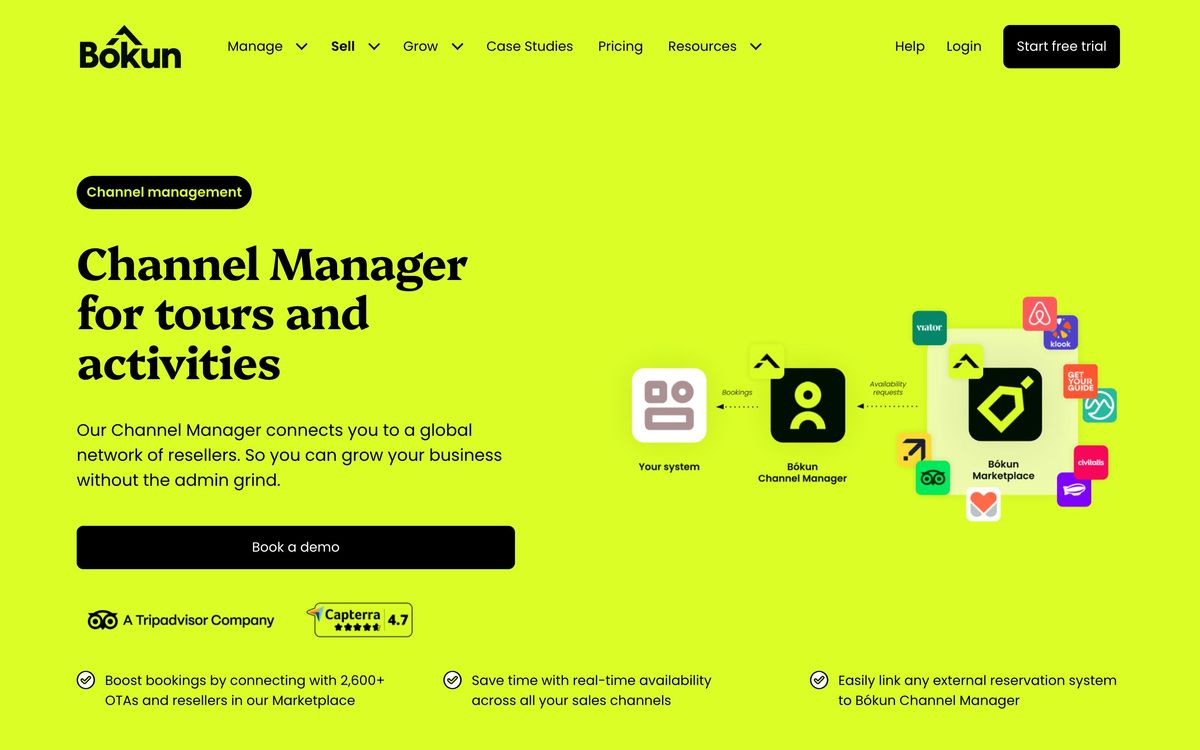
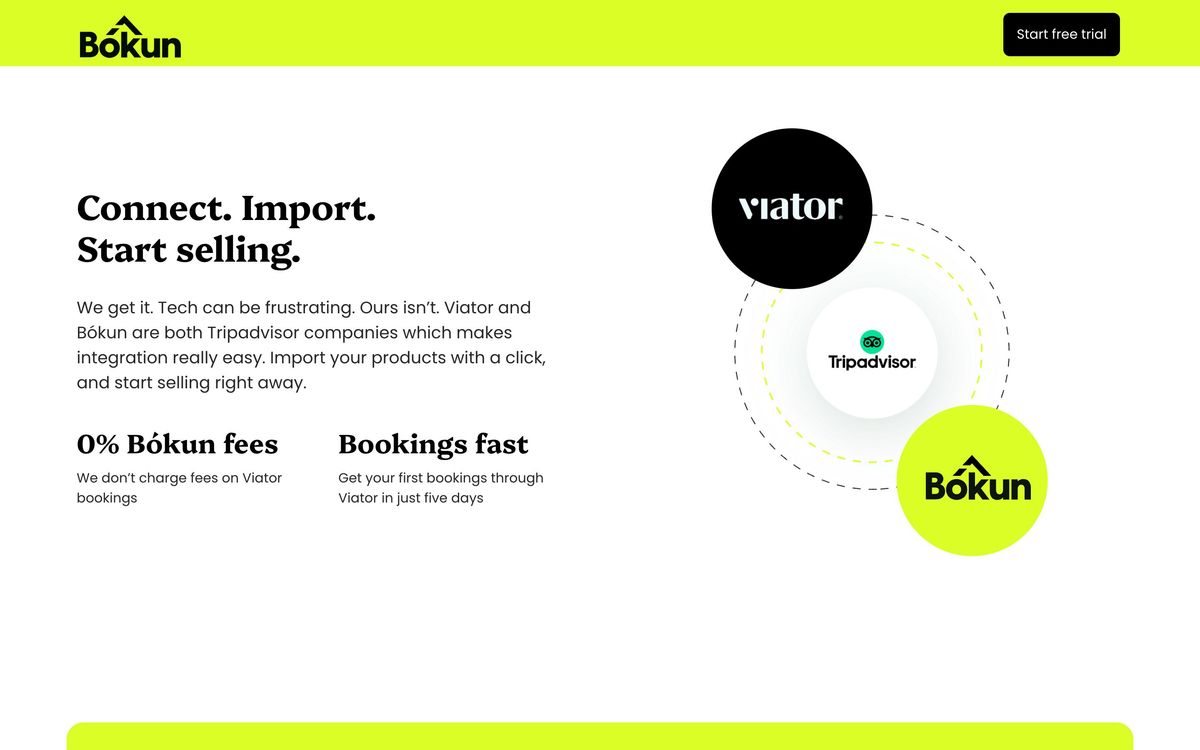
That ownership shows up in distribution. Bookings coming through Viator, Tripadvisor's experience marketplace, carry no Bókun booking fee on any plan, while other connected channels carry a percentage that falls as the plan rises. Beyond Viator, a marketplace inside the platform lets operators find and contract with resellers and other OTAs - Expedia, Klook, Google Things to Do and a long tail of regional agents - without negotiating a technical integration each time. The operational side covers the rest of the job: seasonal pricing rules, allocation limits per channel, guide and vehicle assignment, automated confirmations and reminders, gift cards, and combination products that bundle several experiences into one sale.
Key features
The machinery an operator relies on in season:
- Product builder with availability calendars, seasonal and group pricing rules, and per-channel allocations
- Channel manager keeping inventory synchronised across OTAs and resellers in real time
- Marketplace for contracting with resellers, including commission terms and connection setup
- Booking widget, hosted site builder and point-of-sale mode for walk-up and phone sales
- Resource management assigning guides, vehicles and equipment to individual departures
- Automated customer messaging, gift cards and multi-product combination experiences
Who it's for
The operator who gains most already sells through OTAs and is losing time to manual reconciliation - copying a departure list from one extranet to another, or discovering an overbooked minibus on the morning of a tour. For them the channel manager is the product, and the Viator fee structure makes the arithmetic favourable if Tripadvisor is already a meaningful source of bookings. Multi-product operators with complicated availability, shared resources or seasonal pricing get more out of the product builder than a simple calendar tool would ever offer.
It suits a single-product operator far less well. A walking-tour guide running one departure a day, selling mostly direct, will spend an evening configuring something a lightweight booking page would have handled in an hour, and will not use the marketplace at all. Operators whose brand depends on a polished direct-booking flow should look closely at the widget before committing, since styling control is limited and many operators end up paying a developer to work around it.
How it compares
FareHarbor is the main rival in North America, with a strong direct-booking experience, no software fee and hands-on account management, but it ties the operator to its own payment terms and is less neutral about distribution. Rezdy competes squarely on channel management and has a more polished reseller marketplace for B2B agent relationships, though its base subscription costs more and it lacks the Viator fee advantage. Checkfront is the more general reservation system, easier to configure and better suited to rentals and accommodation-style inventory, but it is weaker on OTA distribution. Bókun wins on distribution reach and on cost when Viator volume is high; it loses on ease of setup and on direct-booking polish.
Verdict
For an experience operator whose growth depends on being visible in more places than their own website, this is the most economically sensible platform on the market, and the free tier makes it genuinely testable before any commitment. The rating stops below the top of the range for reasons that show up in the first fortnight rather than the first year: configuration is a project, not an afternoon, the booking widget is the weakest customer-facing element, and sync faults with OTA availability - rare but real - have a direct revenue cost. Operators without an OTA strategy should ask whether they need a channel manager at all before paying for one.
Ready to try Bókun?
There's a free tier, so you can test it before committing.
More service-businesses tools like Bókun
Healthie
4.0HIPAA-compliant EHR and practice management for wellness providers: scheduling, telehealth, charting and billing.
Read Healthie review →Carepatron
3.9Practice management and clinical records for small health and wellness practices, with booking, telehealth and AI notes.
Read Carepatron review →Consentz
3.8Clinic software for aesthetics practices: consent forms, treatment records, booking and payments in one chart.
Read Consentz review →Shore
3.8Online booking, customer records, an iPad till and campaigns in one system for salons and studios.
Read Shore review →Momence
3.7Class booking, memberships, payments and marketing in one back office for studios, gyms and spas.
Read Momence review →ABC Trainerize
3.7Coaching platform for trainers and studios: programme delivery, client check-ins, scheduling and payments in one app.
Read ABC Trainerize review →