
Confido Health review
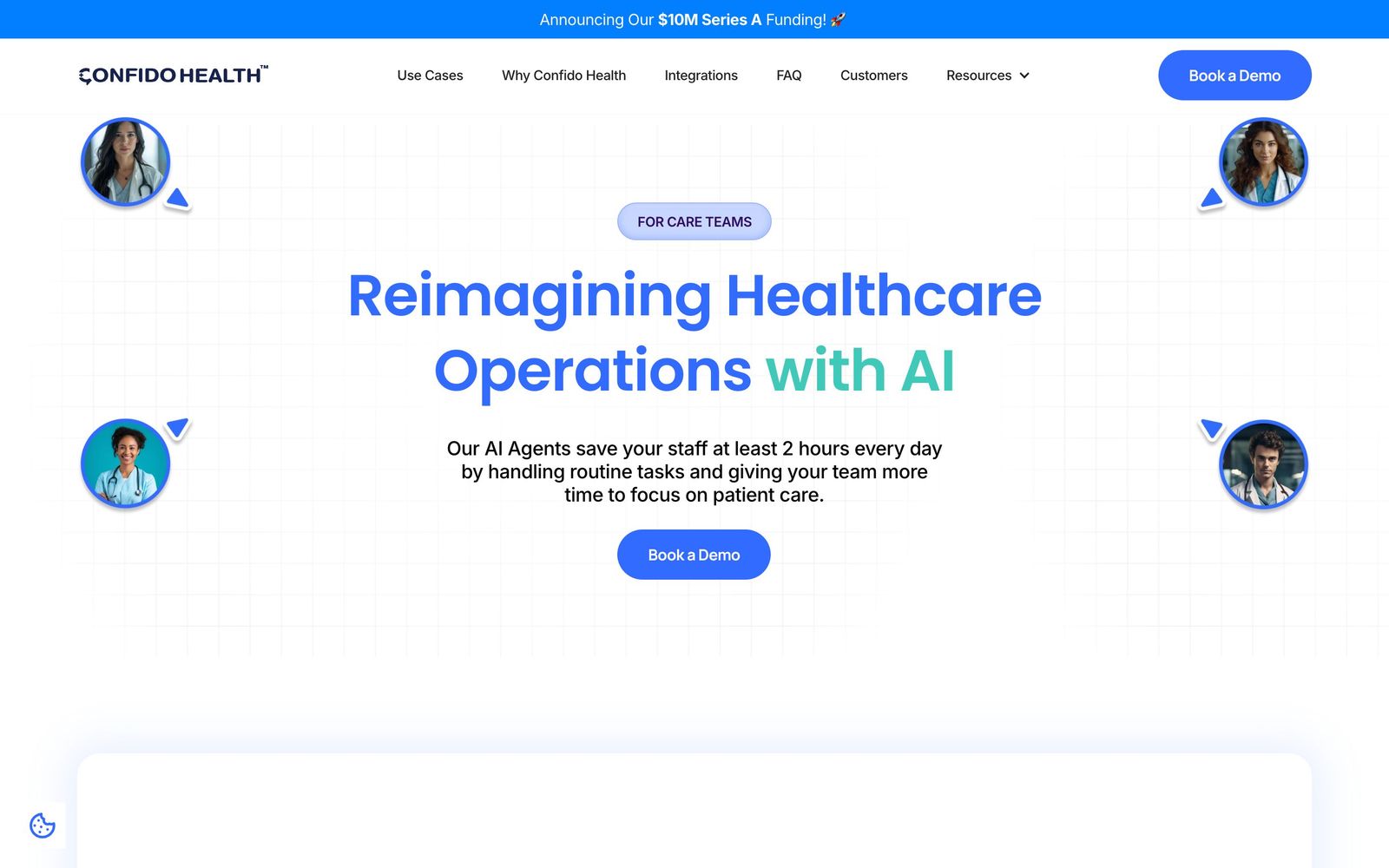
24/7 voice AI agents for healthcare that answer patient calls and write outcomes back to the EHR or PMS.
One of the strongest healthcare-specific voice AI options because agents act inside the EHR rather than just answering calls, but it is a young, demo-led product without self-serve.
Pros
- Voice agents resolve calls end to end (scheduling, refills, payments, referrals) and write results back to the EHR/PMS
- Named agents cover distinct workflows: appointment management, pre/post-op engagement, care gap closure and collections
- Claims to handle roughly 75% of incoming calls, freeing about two staff hours per person per day
- Deploys in about 30 days using prebuilt, specialty-specific templates
- Backed by a $10M Series A and adopted across pediatrics, orthopedics, nephrology, dermatology and dental
Cons
- Young company (founded 2022) with a shorter track record than incumbent patient-communication vendors
- No self-serve or free tier; everything starts with a demo and an integration scoping call
- Automation rates vary by specialty and call mix, so the headline numbers will not match every practice
Confido Health builds voice AI agents for healthcare practices: software that answers patient phone calls around the clock, holds a natural conversation, and actually completes the task the patient called about. Where a basic AI phone agent takes a message, Confido's agents schedule and reschedule appointments, handle refill requests, take payments, manage referrals and run insurance-related workflows, then write everything back into the practice's EHR or PMS so staff never re-key a thing. Founded in 2022, the company raised a $10M Series A in late 2025 to push beyond scheduling into the rest of the patient-access front door.
What Confido Health actually does
The product replaces the phone tree. An inbound call gets answered on the first ring by a voice agent that authenticates the patient and resolves the request: booking into open slots, processing a payment, kicking off a refill, answering routine questions. Confido says automation rates run above 80% on supported workflows and that agents handle roughly three quarters of incoming call volume, which translates to about two hours per staff member per day not spent on the phone. The agents also work outbound; recall campaigns, pre- and post-operative check-ins, care gap closure and transitions-of-care follow-ups. Confido packages these as named agents: Sara for appointment management and collections, Ryan for surgical engagement, Lilly for care gaps and care transitions. Integration is the differentiator: connections to systems like athenahealth, eClinicalWorks, DrChrono, ModMed, Practice Fusion and Dentrix mean outcomes land in the chart, not in a separate inbox someone has to process.
Key features
- 24/7 inbound voice AI that authenticates patients and resolves scheduling, refills, payments and referrals
- Outbound calling for recalls, pre/post-op engagement, chronic care programs and care gap closure
- Direct write-back to major EHR and PMS platforms
- Phone system connections including RingCentral and 3CX
- Specialty templates that get practices live in around 30 days
- Text messaging alongside voice for confirmations and follow-ups
Who it's for
Confido fits practices where the phone is the bottleneck: multi-provider specialty clinics, dental groups, nephrology and renal networks, FQHCs and hospital outpatient departments with chronic hold times and front-desk turnover. The named-agent workflows map best onto specialties with repetitive, high-volume call patterns. A small practice with one receptionist and modest call volume will find the value proposition thinner, and there is no self-serve tier to experiment with; adoption means a demo, scoping and an implementation project.
How it compares
The nearest competitor is Assort Health, which also builds specialty-specific voice AI for medical call handling and competes directly on EHR integration depth; the two are close enough that bake-offs come down to your specific EHR and specialty templates. Weave sits in an adjacent category; it modernizes the human-staffed front desk with phones, texting and reminders, but a person still answers the call. Practices often discover they want both layers: a communication platform for staff and a voice agent absorbing the volume staff cannot. Against generic voice AI builders, Confido's healthcare-only focus and write-back integrations are the moat; you are buying workflows, not a toolkit.
Verdict
Confido Health is one of the most credible answers to the unanswered-phone problem in healthcare, because it closes the loop inside the EHR instead of generating callbacks for staff. The honest caveats are youth (the company is a few years old and moving fast) plus a sales-led process and automation rates that depend on your call mix and systems. For clinics where patients routinely give up on hold, it deserves a demo; measure it on resolved-call rate in your own environment rather than the marketing numbers.
Ready to try Confido Health?
More service-businesses tools like Confido Health
Quo
4.2Shared business phone system for calls and texts, with an AI agent that answers when nobody can.
Read Quo review →LucroVox
3.4AI phone receptionist for home services and clinics that answers, qualifies and books around the clock.
Read LucroVox review →Jane
4.4Practice management and EMR for allied health clinics: booking, charting, billing and payments in one record.
Read Jane review →Bókun
4.3Booking system and OTA channel manager for tour, activity and rental operators, owned by Tripadvisor.
Read Bókun review →Boulevard
4.3Booking, point of sale and client records for salons, spas and medspas that run on appointments.
Read Boulevard review →Buddy Punch
4.3Online time clock for hourly staff, with GPS, geofencing and photo verification on every punch.
Read Buddy Punch review →