
LucroVox review
AI phone receptionist for home services and clinics that answers, qualifies and books around the clock.
A workable after-hours answering layer for trades and clinics, though the vendor publishes no prices and has almost no independent track record to check.
Pros
- Answers immediately and outside business hours, which is the whole job for a trade whose callers ring the next number after one voicemail
- Books directly into the calendar or field service system in use rather than leaving a message for someone to action later
- Integrations cover the field software trades actually run: ServiceTitan, Housecall Pro and Jobber, plus a custom API path
- Plans are tiered by monthly call volume rather than by seat, which fits a business with one phone line and uneven demand
Cons
- No prices are published anywhere on the site: the plan table lists call volumes and features with the amounts blank, so comparison requires a sales call
- No presence on G2, Capterra or Trustpilot, meaning there is no independent evidence about voice quality, booking accuracy or support
- Lead qualification and CRM integration are withheld from the entry plan, so the cheapest tier answers and books but does not screen
What LucroVox actually does
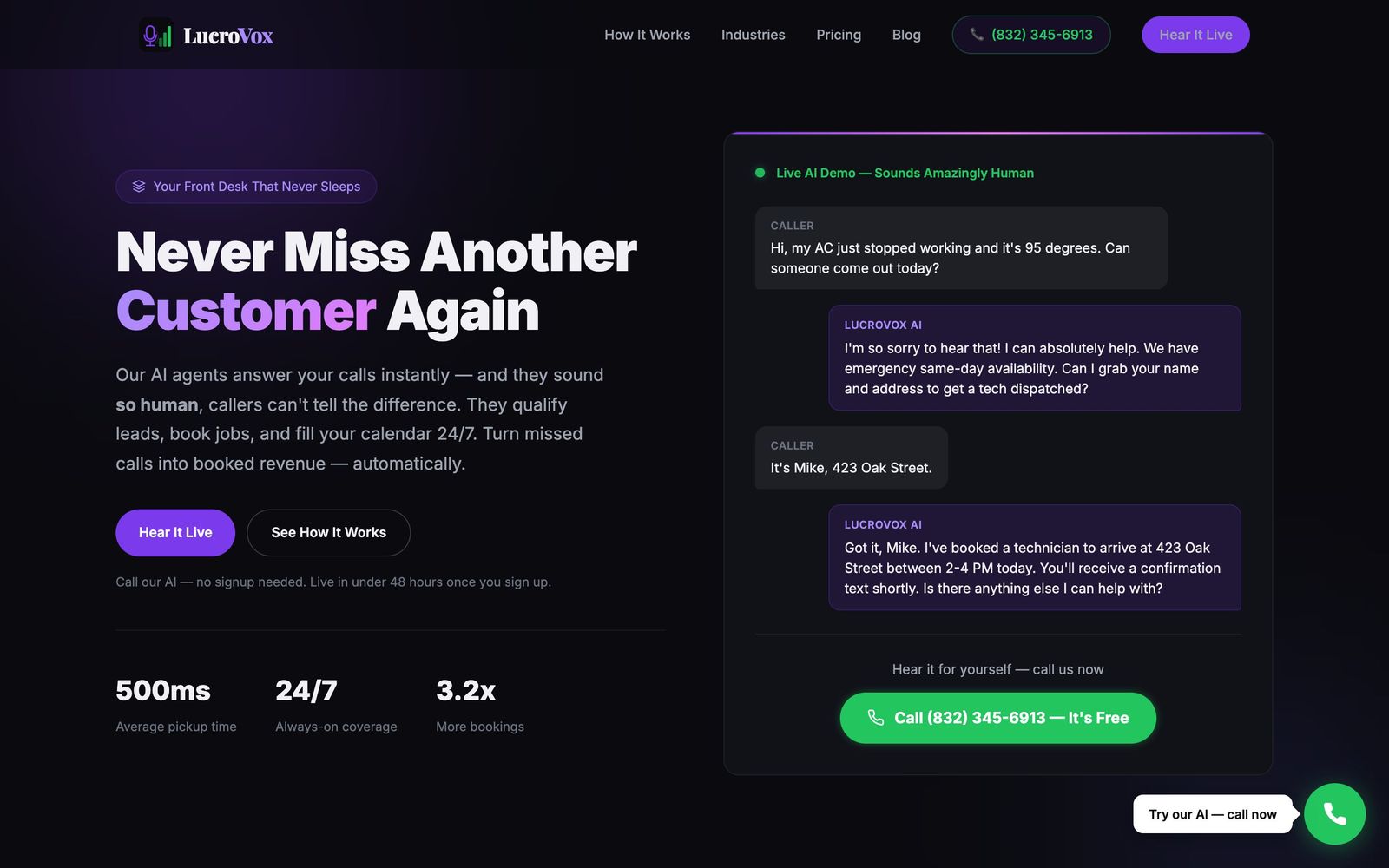
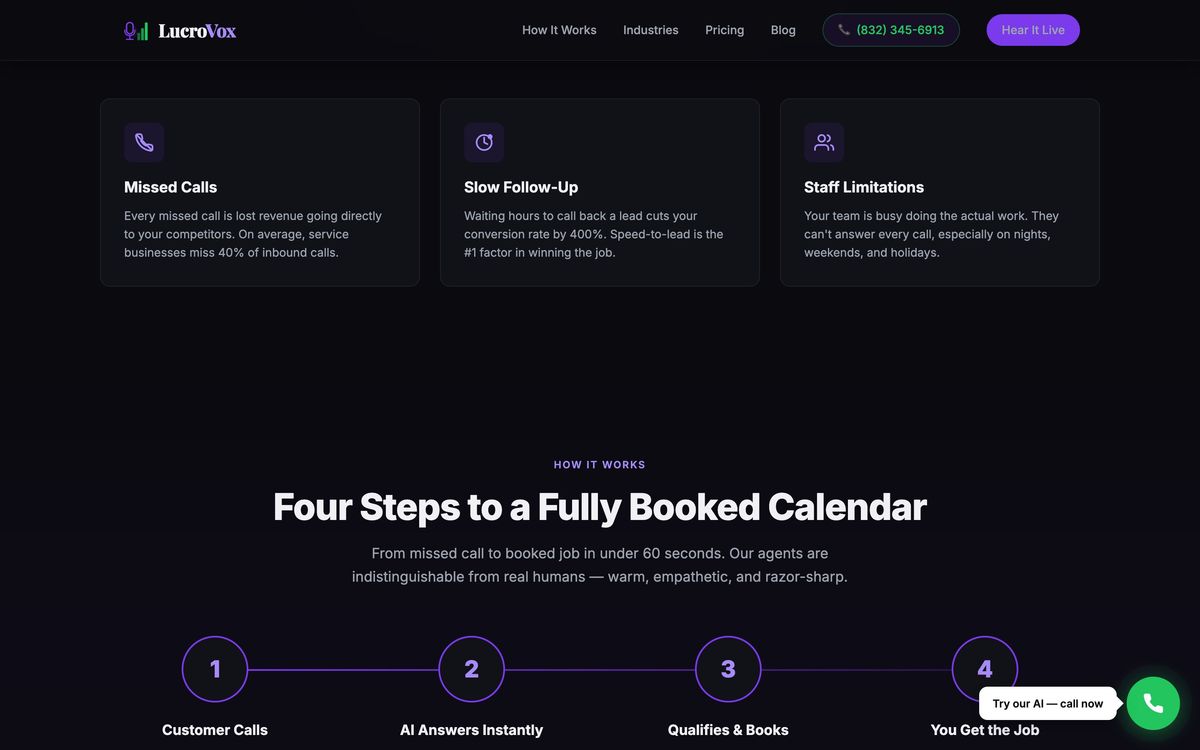
LucroVox is an AI receptionist for businesses that lose money to unanswered phones. The target list is specific, covering HVAC, plumbing, roofing, other home services, med spas and clinics, and so is the failure it addresses: a customer with a burst pipe calls three numbers and books with whoever picks up. The service answers inbound calls with a synthetic voice, follows a greeting and script configured for the business, asks qualifying questions and books an appointment into the calendar, at any hour.
Around the call itself sit the mechanics that make it usable day to day: SMS follow-up to the caller, email notification to the business, and calendar or CRM write-back through integrations with Google Calendar, Calendly, ServiceTitan, Housecall Pro and Jobber, with a custom API for anything else. Plans are tiered by how many calls the agent handles each month rather than by feature depth alone, with higher tiers adding advanced qualification, CRM integration, priority support and, at the top, white-label branding and multi-location routing. Trials run two weeks on the lower plans and a month at the top. Prices are not published: the plan comparison lists volumes and features with the amounts left blank, and buyers are directed to a phone number or straight to checkout.
Key features
The capability set is deliberately narrow, aimed at intake rather than conversation.
- Inbound call answering with a configured greeting and script, available outside business hours
- Lead qualification questions asked before booking, from the middle tier upwards
- Appointment booking written into Google Calendar, Calendly or the field service system already in use
- SMS follow-up to the caller and email notification to the business after each call
- CRM integration with ServiceTitan, Housecall Pro and Jobber, plus a custom API for other systems
- White-label branding and multi-location call handling on the top tier
Who it's for
A single-location trade or clinic where the owner or a shared handset answers calls between jobs, and where after-hours calls currently reach voicemail. The economics are simple at that size: one recovered job a month usually covers a plan, and the alternative of a human answering service costs more per call and books less reliably into a field service calendar.
It is not for businesses whose calls are genuine conversations rather than intake, and not for anyone with a contact centre or a receptionist who does more than triage. Larger operators should weigh vendor risk carefully. LucroVox is small and recent, with no meaningful independent review record, no G2 or Capterra presence to check against, and no published pricing, which makes comparison shopping impossible without a sales conversation. Anyone routing every inbound lead through it should keep a fallback path to a human.
How it compares
Smith.ai and Ruby answer with real people and handle nuance far better, at a materially higher cost per call and without native booking into a trade calendar. Goodcall and Slang.ai occupy the same AI-answering territory with published pricing and longer track records, and Slang is the stronger option for restaurants and clinics specifically. Synthflow and similar voice-agent builders give more control to teams willing to configure their own agent instead of buying one preconfigured for a trade. LucroVox's pitch is the vertical fit, with scripts and integrations already shaped for home services.
Verdict
The problem LucroVox picks is real and the shape of its answer is right: a voice agent that answers immediately, qualifies briefly and writes an appointment into the system a trade already runs. The integration list covers the field service software that matters, which is more than many generic voice agents manage. What keeps the rating low is everything around the product rather than the product itself: no published prices, no independent reviews, and a small vendor holding the front door of a business that lives on inbound calls. Trial it on overflow and after-hours traffic before pointing the main line at it.
Ready to try LucroVox?
More service-businesses tools like LucroVox
Boulevard
4.3Booking, point of sale and client records for salons, spas and medspas that run on appointments.
Read Boulevard review →Confido Health
4.224/7 voice AI agents for healthcare that answer patient calls and write outcomes back to the EHR or PMS.
Read Confido Health review →Quo
4.2Shared business phone system for calls and texts, with an AI agent that answers when nobody can.
Read Quo review →SimplePractice
4.2HIPAA-compliant practice management for therapists: scheduling, notes, telehealth, client portal and billing.
Read SimplePractice review →Vida
4.1AI phone agents that also text, email and web-chat, answering for businesses 24/7 in 10 languages.
Read Vida review →Distance
4.0AI agents for service businesses that answer leads on every channel, qualify them and book jobs 24/7.
Read Distance review →